Your Puppy's First Walk After Vaccinations: When and How Far
Waiting until a puppy is fully vaccinated is the wrong frame, because waiting has its own cost. Here is how the two real risks compare, what the published vaccine guidance actually says, how to choose lower-risk ground before the series is finished, and how far a puppy can reasonably walk at each age.

Contains affiliate links · our policy
In this guide
Most puppies can start going out before the vaccine series is finished, and the closing socialisation window is a reason not to wait. What changes between nine and sixteen weeks is not whether you go out, but whether the puppy's feet touch the ground and whose ground it is. That part is your vet's call, not the internet's.
We may earn a commission from links on this page, at no extra cost to you.
Two true things point in opposite directions on a puppy's first walk after vaccinations, and most articles tell you only one of them. Parvovirus is real, it persists in soil, and an incompletely vaccinated puppy is exactly the dog it kills. The socialisation window is also real, it closes early, and the behaviour problems that can follow from missing it are, on the AVSAB's reckoning, a bigger killer of young dogs than infection is. The indoor half of the job is covered in how to leash train a puppy.
The Two Risks You Are Balancing
Start with the risk everybody fears. The Cornell Riney Canine Health Center describes canine parvovirus as highly contagious and dangerous, affecting primarily young, unvaccinated dogs, and says it commonly affects puppies between the age of 6 weeks to 6 months. Dogs are exposed by ingesting virus shed in the faeces of infected dogs, and Cornell adds the detail that should change where you walk: parvovirus is hardy in the environment and resistant to many household disinfectants, and without disinfection or direct sun exposure it may survive in the environment for months to years. A verge where every dog on the street toilets is a different proposition from your own garden.
Now the risk nobody puts on a poster. The AVSAB's puppy socialisation position statement says the primary and most important time for puppy socialisation is the first three months of life, and that incomplete or improper socialisation during this time can increase the risk of behavioural problems later in life including fear, avoidance and aggression. It goes further: behavioural issues, not infectious diseases, are the number one cause of death for dogs under three years of age.
The AVSAB then makes the comparison directly: while puppies' immune systems are still developing, it says, the combination of maternal immunity, primary vaccination and appropriate care makes the risk of infection relatively small compared to the chance of death from a behaviour problem. Hence the conclusion that should reframe this search — the AVSAB believes it should be the standard of care for puppies to receive such socialisation before they are fully vaccinated.
So "wait until sixteen weeks" is not the cautious option. It is a different gamble with a longer fuse.
What the Vaccine Schedule Actually Says
We will not give you a schedule — that is a prescription, and not ours to write. Here is what the published guidance commonly describes, so you know what your vet is working from.
Writing in Today's Veterinary Practice, Richard B. Ford, DVM, MS, summarising the AAHA canine vaccination guidelines, describes three doses of a combination core vaccine between 6 and 16 weeks of age, typically at 2, 3 and 4 months, with emphasis on a final dose between 14 and 16 weeks. His reason for that last date is the key to everything: maternally derived antibody may be high enough to interfere with vaccines given at 12 weeks, particularly for parvovirus, so the later dose catches puppies whose borrowed immunity blocked the earlier ones. Cornell describes the same shape from the parvovirus side, with vaccination typically starting at 8 weeks and a booster every 2 to 4 weeks until 16 to 20 weeks of age.
Two things follow. Nobody can tell you from a web page that your puppy is protected on a given date, because maternal antibody levels vary between littermates. And the published spread for the end of the series is itself a reason to ask rather than assume. On the gap between the last dose and protection, PetMD, in an article by Brittany Grenus, DVM, reviewed by Molly Price, DVM, puts public outings at about two weeks after the final core round, typically around 18 to 22 weeks — a veterinary convention, not a biological fact.
The conversation to have at your next appointment
The variable that decides your answer is not your puppy's age. It is how much parvovirus is circulating where you live, and your vet knows that and we do not. Ask three things: whether there is parvovirus activity locally right now, which outdoor surfaces near you your vet would and would not put this puppy down on, and when your vet expects this puppy to be adequately protected. If your puppy is lethargic, vomiting or has diarrhoea, nothing here applies — that is a same-day phone call.
Before the First Pavement Walk
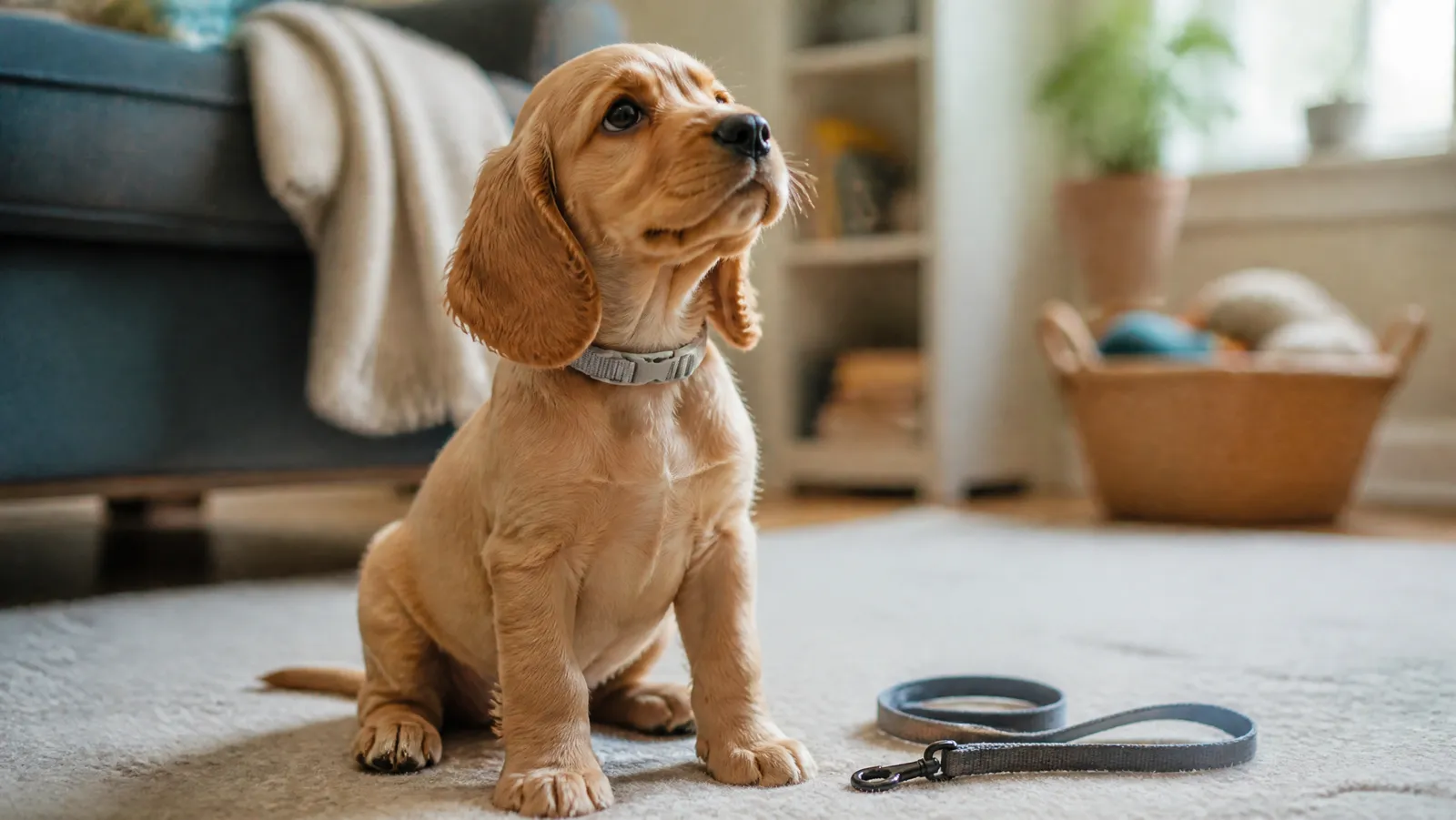
Almost everything that makes a first walk go well happens indoors, weeks earlier, and costs nothing. The answer to when to start leash training a puppy is day one or two at home with the front door shut, because the first stage has no walking in it.
- The gear becomes unremarkable. Harness on while something good is happening, off after a few minutes, until the puppy stops noticing.
- The leash gets clipped on indoors. Let it hang during supervised play, so the line is not something that only ever appears at the front door.
- Fit gets checked before you leave. This is when the collar or harness question gets settled, and our puppy harness roundup covers measuring rather than guessing. Then the first outdoor trip is one new variable instead of five.
Going Out Before the Series Is Finished
The practical version of the AVSAB's position: the puppy goes out, the puppy's feet mostly do not. Carrying is the whole trick, and it buys a great deal of socialisation at close to zero infectious risk. The AKC's guidance to new owners is plain — until your pet has had their last set of vaccinations, avoid areas commonly used by other dogs, and carry your puppy if you cannot. PetMD's vet-reviewed version says young puppies can be exposed to new sights and sounds in public while being carried in a sling or stroller. Traffic noise, umbrellas, bicycles and children at volume all happen just as well from chest height.
A sling matters more than it sounds: arms fail at about ten minutes, and a bored puppy on your hip gets put down. The ARZQUT reversible puppy sling is about $12 as of November 2026, and ARZQUT lists it for pets up to 12 pounds — weeks of use for a labrador, months for a toy breed.
Lower-risk ground, when you do set them down, means ground other dogs have not been using as a toilet — a clean paved surface in a quiet spot, a private garden where you know every dog that has used it, a friend's kitchen floor. We say lower risk rather than safe on purpose, because the virus Cornell describes can outlast a season in soil and nobody can certify a pavement.
Higher-risk ground is specific and worth memorising. The AVSAB statement asks that visits to dog parks, or other areas that are not sanitised and/or are highly trafficked by dogs of unknown vaccination or disease status, be avoided. Cornell's prevention list names dog parks and pet stores directly; add the verges and tree pits where every dog stops. The AKC quotes Chyrle Bonk, DVM, saying dog parks and off-leash activities are out, and advises keeping a puppy from meeting dogs you do not know until they have had all of their vaccinations. Known, vaccinated, puppy-tolerant dogs at someone's house are different.
The First Real Walk: What It Looks Like
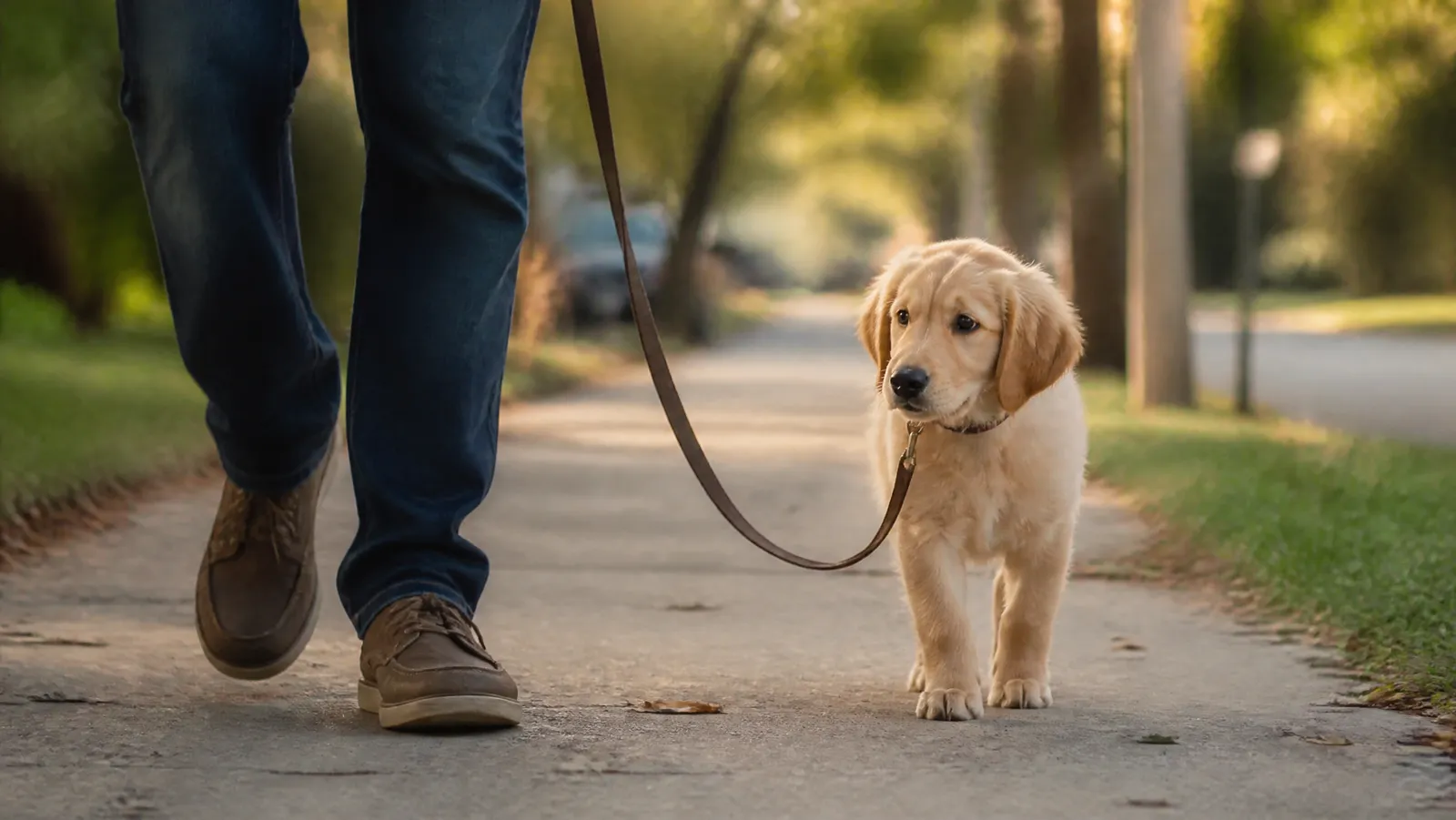
Lower your expectations to the floor. A first walk is a sniffing and looking exercise, not a walking-skills exercise, and the actual skill of loose leash walking is a hallway project that should already be underway. Outdoors your only job is that nothing frightening happens. Three minutes is a complete outing: to the end of the drive, one sniff of a gatepost, back inside while the puppy still wants more.
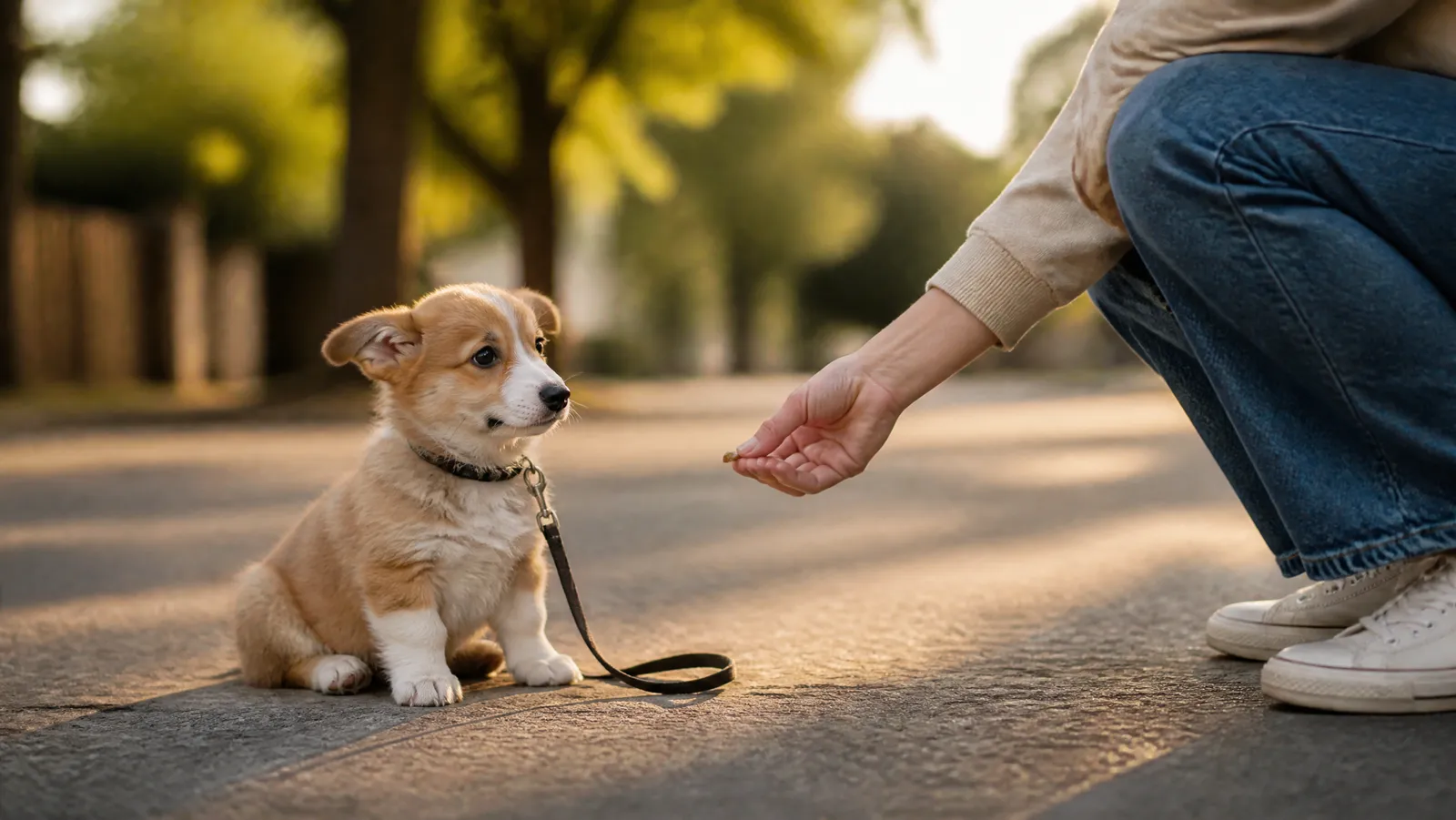
Expect one of two things, both normal. The first is the statue. Writing for the AKC, Stephanie Gibeault, MSc, CPDT, explains that a leash is a form of restraint and that a leashed puppy cannot go where they want or escape from anything that frightens them. She notes that at first a puppy will most likely drag their heels and pull backward rather than pull you forwards, and suggests carrying the puppy 20 or 30 feet from home and letting them walk back on their own. A puppy who will not walk is not a failed puppy. What we never do is drag: the AVSAB's humane dog training position statement says methods relying on force, pain or emotional or physical discomfort should not be used in canine training. Food, patience and going home early are the whole toolkit.
The second is the opposite — a puppy who comes out of the door at full volume, spins and grabs the lead in their teeth. That is over-arousal, not naughtiness, and a puppy biting the leash at the start or end of a walk is usually telling you the session has run past them. Shorten it, do not escalate it.
How Far Can a Puppy Walk, and for How Long?
The rule you have been given is five minutes of exercise per month of age. The PDSA names it and takes it apart: there is no scientific evidence behind this rule, and although it might work for some, it is not appropriate for most puppies. In the Veterinary Ireland Journal, Siobhan Menzies, BVM&S CCRP MRCVS, lists the same formula among the misconceptions owners arrive with, advises letting puppies set their own pace, and warns against brisk walking on a short lead with young pups, which she calls potentially concussive. Use the formula as a sanity check on the upper end, and the puppy for everything else.
- 1
Watch the puppy, not the clock
The PDSA's instruction is to watch them on walks and get them to rest when they show signs of being tired, with the catch that most puppies are too excitable to show those signs, so you have to make them rest. Lagging, sitting down and a sudden loss of interest all mean the outing finished a few minutes ago.
- 2
Count sniffing as the exercise
Free sniffing is a different activity from road walking at your pace, and distance covered tells you little about either. Menzies' guidance is that off-lead or loose long-line activity must be at the pup's pace. Ten minutes of nose-down mooching in a private garden costs a puppy less and gives them more than ten minutes of street work.
- 3
Stop while they are still keen
End with the puppy wanting another lap. It is the easiest thing to get wrong on a nice afternoon.
- 4
Ration intensity rather than minutes
Menzies advises starting endurance training only after growth plates close, giving around seven months for small breeds and 10 to 14 months for large ones. The PDSA makes the same point in reverse: growth plates need to fuse before a dog is ready for high-impact activity, and too much exercise while a puppy is growing could cause lasting joint damage. Running, jumping and repetitive fetch are what to postpone; a short, sniffy walk is not what either source is warning about. The evidence is observational, so we will not hand you a number of minutes — Menzies cites a Norwegian cohort of large-breed puppies, Krontveit and colleagues in the American Journal of Veterinary Research in 2012, in which off-lead exercise on varied soft terrain from birth to three months was associated with a lower risk of hip dysplasia. That same cohort also associated walking on stairs in the first three months with a higher risk, although Menzies lists "avoid stairs entirely" among the misconceptions owners arrive with, so read it as a reason to carry a young puppy down a steep flight rather than a ban. The PDSA is equally clear that the opposite error is real: limiting a puppy's exercise too much can lead to behavioural problems.
What to Take
Our method, stated plainly: we did not run a testing panel. We took what the outings above require and read what each maker claims. Prices are approximate, as of November 2026.
The sling, which is the one that matters here
The ARZQUT reversible sling is about $12: soft breathable cotton, reversible and machine washable, with an adjustable safety hook that clips to the collar or harness and a safety buckle at the opening ARZQUT says stops a puppy jumping out. The shoulder-strap pocket leaves both hands free for treats. Two limitations, both from the listing: ARZQUT lists it for pets up to 12 pounds, so a large breed outgrows it in weeks, and cotton on a 15 inch strap is for errands, not hiking.
The first-walk set
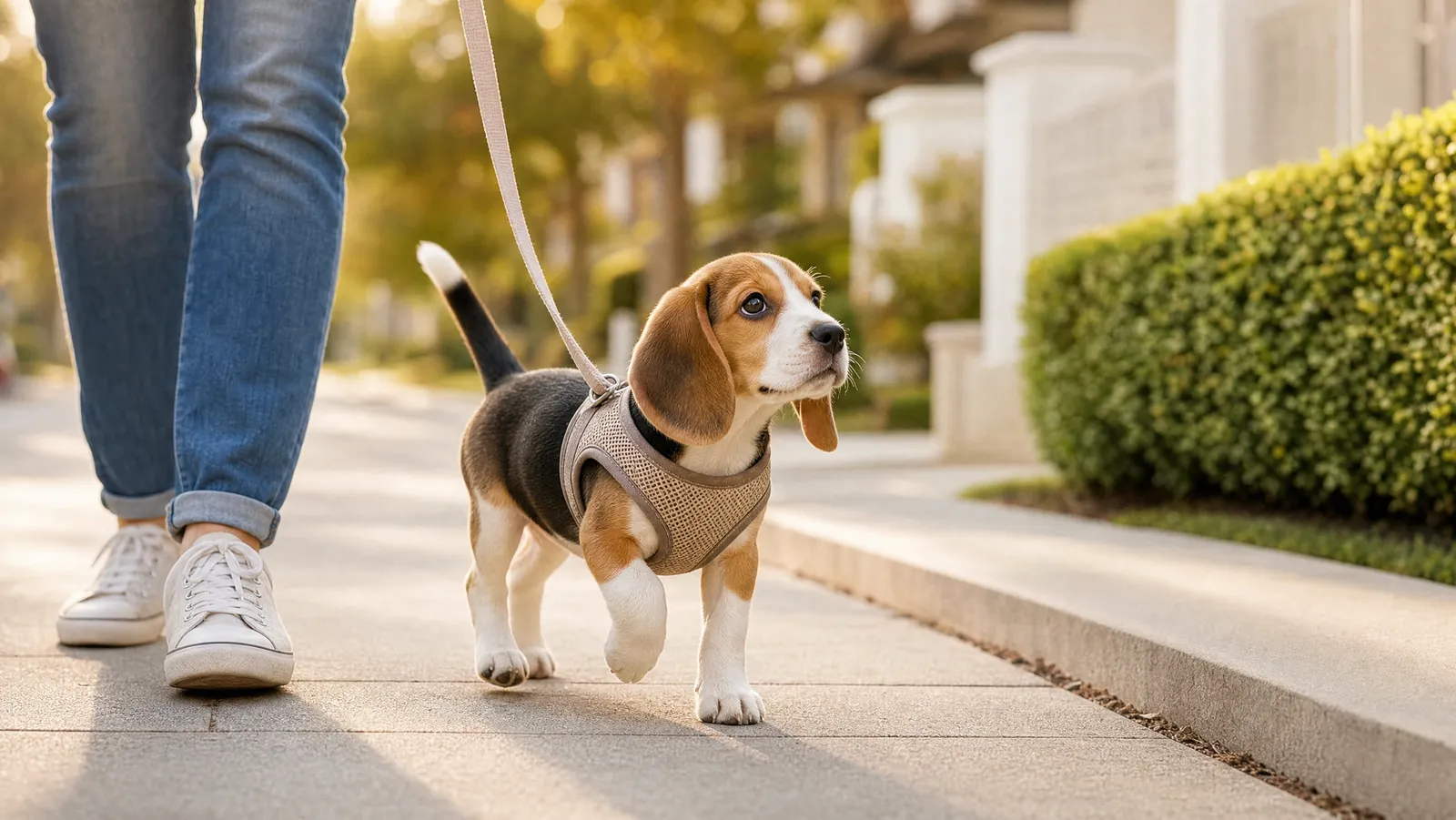
The BINGPET step-in harness set is about $17 and covers three jobs: a step-in mesh vest, a 5 ft swivel leash with a padded handle, and a 24 to 32 inch car tether. Step-in is the feature we would choose deliberately now, because nothing has to pass over a head-shy puppy's head in the week you are making equipment boring. BINGPET sizes by measurement rather than breed: S for a 14.5 to 16 inch chest, M for 16 to 18 inches. Its limits: BINGPET says it is not recommended for large dogs, and stock was limited when we checked.
Water
The Kalimdor 19 oz bottle is about $10 and solves a one-handed problem. The trough is 2.8 inches wide, enough for a puppy to drink without wetting their chest, and a button re-collects unused water into the bottle rather than pouring it away. Kalimdor says a silicone seal ring and lock key prevent leaks in a backpack. Two caveats: food-grade plastic rather than stainless steel scratches and stains, and Kalimdor notes the silicone ring must be seated correctly or it will leak.
A lead a nine-week-old does not notice
The Mendota Petite Snap Leash is about $8, hand made in the USA from waterproof premium nylon, and Mendota calls it minimalist and small enough to fold into a pocket. It comes in three widths and lengths from 18 to 72 inches, guaranteed for the life of your pet. On a three-minute driveway outing, a cord this light is one less thing to object to. The limits are what make it good: the Fine 1/8 inch width will not grow with a large breed, and there is no padded handle.
Heat, hard surfaces and the puppy who will not tell you
Summer pavement can go wrong in minutes. The ASPCA advises not letting dogs linger on hot asphalt when the temperature is very high, noting that being so close to the ground a dog's body can heat up quickly and sensitive paw pads can burn, and says to keep walks at those times to a minimum. It also advises plenty of fresh clean water in hot or humid weather, and care not to over-exercise them. Its overheating signs are worth knowing in advance: excessive panting or difficulty breathing, drooling, mild weakness, stupor or collapse. Treat suspected overheating as an emergency call.
The Bottom Line
The question is not when your puppy is allowed outside. It is where their feet go, and that has a local answer. The AVSAB holds that socialisation before full vaccination should be the standard of care. Cornell's point is that parvovirus can outlast a season in unsanitised ground. Both are true, and carrying a puppy past a bus stop satisfies both.
Three things this week. Book one carried outing a day, somewhere with noise and strangers and nothing underfoot. Ask your vet the three questions in the callout above, because local parvovirus activity decides your plan. And keep the first ground-level walks shorter than feels reasonable: three minutes, one gatepost, back inside while the puppy is still keen. For the indoor work that makes all of this easy, go back to the leash training groundwork.
Our top picks


BINGPET Step-In Puppy Harness with 5 ft Leash and Car Seatbelt (Small)

The item that turns carried socialisation from an arm workout into an errand you can actually run. ARZQUT lists the sling at 21 by 12 inches with a 15 inch shoulder strap, suitable for pets up to 12 pounds, in soft breathable cotton with a reversible design, and it is machine washable, which matters while a puppy is still having accidents. An adjustable safety hook clips to the collar or harness, and ARZQUT says a safety buckle at the opening stops a puppy jumping out.
What we love
- Adjustable safety hook clips to the puppy's collar or harness, plus a safety buckle at the opening ARZQUT says stops a puppy jumping out
- Soft breathable cotton with a reversible design
- Shoulder-strap pocket for phone, keys and cards, so both hands stay free for treats
- Machine washable, which a puppy carrier needs to be
- ARZQUT lists it at 21 by 12 inches with a 15 inch shoulder strap
Keep in mind
- ARZQUT lists it for pets up to 12 pounds, so a fast-growing medium or large breed outgrows it in weeks
- Cotton fabric on a 15 inch strap is built for errands and street time, not hiking
A three-piece set that covers the whole first outing: a step-in mesh vest, a 5 ft swivel leash with a padded handle, and a 24 to 32 inch car tether for the drive. The step-in design is the part we would pay for, because nothing has to go over a head-shy puppy's head, and the neck and chest straps both adjust. BINGPET sizes by measurement rather than breed, listing size S for a 14.5 to 16 inch chest and size M for 16 to 18 inches.
What we love
- Step-in design so nothing goes over the puppy's head, with adjustable neck and chest straps
- BINGPET sizes by chest measurement rather than breed or weight: S for 14.5 to 16 inches, M for 16 to 18 inches
- Breathable quick-dry mesh and machine washable
- Reinforced D-rings and reflective stitching for dark mornings
- Three pieces in the box: vest harness, 5 ft swivel leash with padded handle, and a 24 to 32 inch car tether
Keep in mind
- BINGPET says it is not recommended for large dogs, so measure the chest rather than guessing by breed
- Stock was limited when we checked, so the size you need may not always be available
One-handed water, which is the only kind that works while the other hand holds a puppy. The 19 oz bottle has a 2.8 inch trough wide enough for a puppy to drink from without wetting their chest, a one-key open and lock mechanism, and a button that re-collects unused water back into the bottle instead of pouring it on the pavement. Kalimdor says a silicone seal ring and lock key keep it from leaking in a backpack.
What we love
- A 2.8 inch trough wide enough for a puppy to drink from without wetting their chest
- A button re-collects unused water back into the bottle instead of pouring it away
- One-key open and lock with genuine one-handed operation
- Kalimdor says a silicone seal ring and lock key prevent leaks in a backpack
- Food-grade plastic that dismantles for cleaning
Keep in mind
- Food-grade plastic rather than stainless steel, so it scratches and stains over time
- Kalimdor notes the silicone ring must be seated correctly or it will leak

A lead light enough that a nine-week-old barely registers it, which is the whole requirement for a first outing. Mendota describes it as minimalist, a favourite among owners and trainers, and small enough to fold into a pocket, and it is hand made in the USA from waterproof premium nylon. It comes in three widths and in lengths from 18 to 72 inches, and Mendota guarantees its gear for the life of your pet.
What we love
- Minimalist cord that folds into a pocket, which Mendota says is a favourite among owners and trainers
- Three width options and lengths from 18 to 72 inches, so the same cord covers a short street lead and a longer drifting line
- Hand made in the USA from premium durable nylon
- Waterproof nylon, which earns its keep on wet grass
- Mendota guarantees its gear for the life of your pet
Keep in mind
- The Fine 1/8 inch width suits a very small puppy and will not grow with a large breed
- No padded handle, so it is not the lead you want once a bigger puppy starts to lunge
Frequently asked questions
When can my puppy go on their first walk after vaccinations?
There are two defensible answers, and the gap between them is the whole problem. The AVSAB's puppy socialisation position statement says it should be the standard of care for puppies to receive socialisation before they are fully vaccinated, and that puppies can start socialisation classes as early as 7 to 8 weeks with one set of vaccines at least 7 days beforehand. PetMD, in an article by Brittany Grenus, DVM, reviewed by Molly Price, DVM, puts public outings at about two weeks after the final round of core vaccines, typically around 18 to 22 weeks. Carried outings can start much earlier than ground-level walks, and which ground is acceptable for your puppy is a question for your own vet.
How far can a 12-week-old puppy walk?
Less than the internet's favourite formula implies, and the formula itself is shaky. The PDSA names the five minute rule directly, five minutes of exercise per month of age, and says there is no scientific evidence behind this rule, and although it might work for some, it is not appropriate for most puppies. In the Veterinary Ireland Journal, Siobhan Menzies, BVM&S CCRP MRCVS, advises letting puppies set their own pace and warns against brisk walking on a short lead with young pups. In practice the useful measure is the puppy in front of you: stop while they are still keen, and count sniffing time as the point of the outing rather than an interruption.
Is it safe to put my puppy down on the pavement before their final shot?
No surface is safe, only lower or higher risk, and the difference is who else has used it. The Cornell Riney Canine Health Center notes that parvovirus is hardy in the environment and resistant to many household disinfectants, and that without disinfection or direct sun exposure the virus may survive in the environment for months to years. Its prevention list includes avoiding high risk areas such as dog parks and pet stores while a dog is unvaccinated or still a puppy. The AKC's guidance for new owners is to avoid areas commonly used by other dogs until the last set of vaccinations, and to carry your puppy if you cannot.
When is a puppy actually fully vaccinated?
Later than most owners assume, and the exact date is a veterinary judgement rather than arithmetic. Writing in Today's Veterinary Practice, Richard B. Ford, DVM, MS, summarising the AAHA canine vaccination guidelines, describes three doses of a combination core vaccine between 6 and 16 weeks of age, with emphasis on a final dose between 14 and 16 weeks because maternally derived antibody may be high enough to interfere with vaccines given at 12 weeks, particularly for parvovirus. The Cornell Riney Canine Health Center describes parvovirus vaccination typically starting at 8 weeks with a booster every 2 to 4 weeks until 16 to 20 weeks of age. Your vet sets the dates.
My puppy freezes on the pavement. Have I started too early?
Probably not, and freezing is common rather than a failure. Writing for the AKC, Stephanie Gibeault, MSc, CPDT, explains that a leash is a form of restraint and that a leashed puppy cannot go where they want or escape from anything that frightens them, which some puppies find intimidating. She notes that at first a puppy will most likely drag their heels and pull backward rather than pull you forwards, and suggests carrying the puppy 20 or 30 feet away from home and letting them walk back on their own. Her reminder is the one to keep: a leash is for safety, not for control.
About the author
James Martin
I'm an animal lover through and through. I grew up with dogs, my family always had at least one pet, and today I share my home with a rescue who is the love of my life. I started Healthy Puppy Review to help owners cut through the marketing noise and make confident, well-researched choices about their dog's health and happiness.