When to Start Leash Training a Puppy (and What to Do First)
You can start the day your puppy comes home at eight weeks, because the first stage of leash training happens indoors and involves no walking at all. Here is the four-week indoor sequence we would run, what the AVSAB actually says about the socialization window, and why the sidewalk is your vet's call rather than ours.

Contains affiliate links · our policy

In this guide
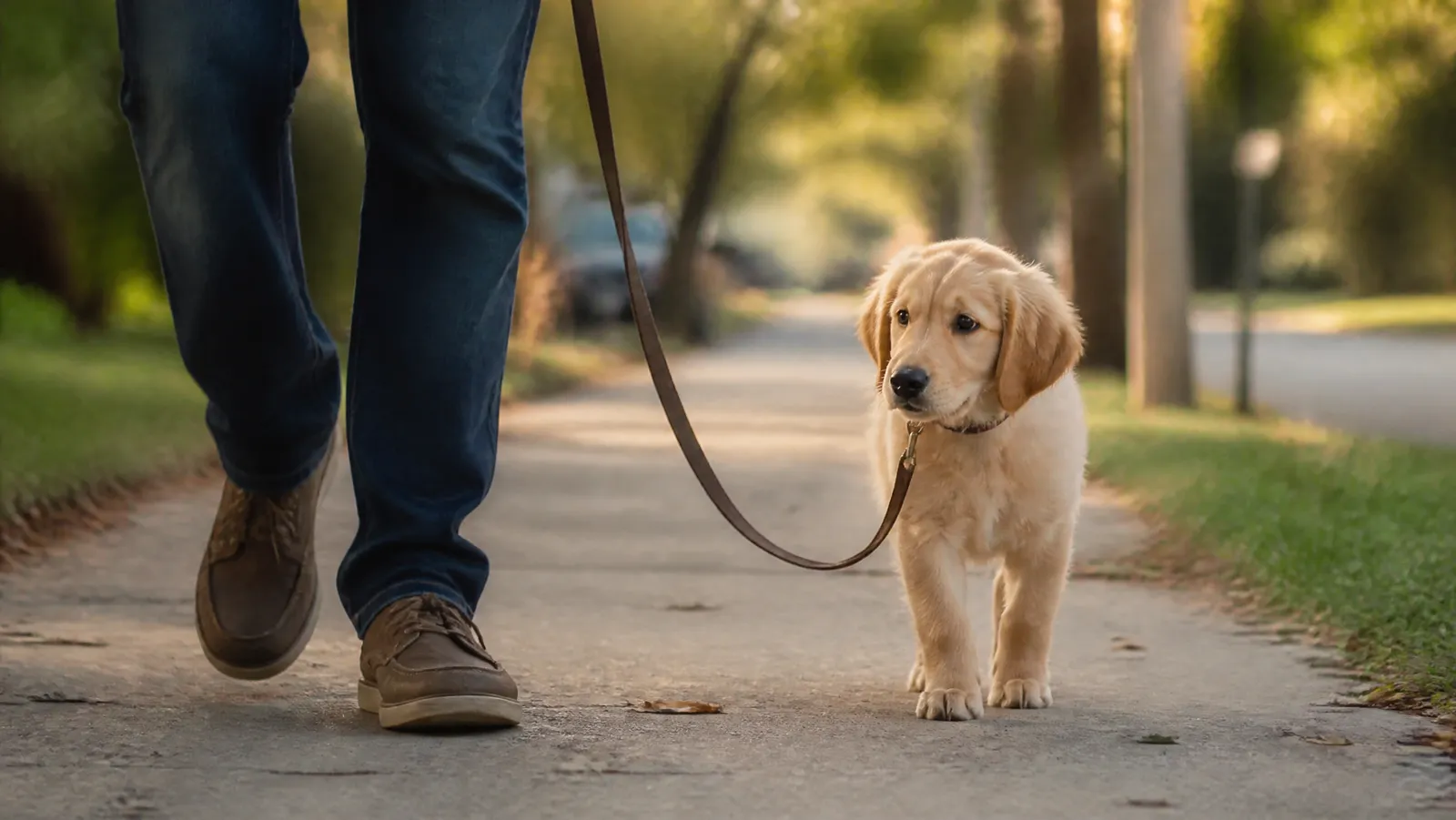
You can start leash training a puppy the day you bring them home, usually at eight weeks old. The first two or three weeks happen entirely indoors and involve no walking at all — a collar worn in short bursts, a leash the puppy is paid to ignore, and a few steps across a kitchen floor.
We may earn a commission from links on this page, at no extra cost to you.
That surprises people, because we picture leash training as the finished product: a dog walking politely down a quiet street. That part comes later, and how to leash train a puppy covers it. This article is about everything before the front door opens — the groundwork that decides whether walk one is pleasant or a twenty-minute standoff on the driveway.
The Short Answer: Day One, Indoors
There is no minimum age for the first stage, because the first stage is not a walk. It is three small jobs, and every one of them happens on carpet.
- The gear stops being news. A collar a puppy has worn through plenty of short sessions is usually unremarkable by walk one, and a leash becomes furniture: something that clips on, hangs there and predicts food.
- Following you pays. Your left knee becomes the most profitable place in the room.
- Leash pressure means something. Not a fight, but a signal that a treat is about to appear by your leg.
The AKC's leash-walking guidance runs in the same order: if the breeder has not already introduced a collar and leash, it says, it is your job to help your puppy feel confident wearing them, starting in the house with short periods of time and using treats to lure your puppy towards you while they are clipped to the leash. Its progression is explicit — when your puppy will walk with you in the house, try the backyard before moving to the sidewalk.
What makes eight weeks the right moment is not capability but that almost nothing is frightening yet. A nylon strap around a neck is a non-event now and a negotiation at six months.
Why 8 to 16 Weeks Matters for Puppy Leash Training Age
We push people to start early because of the window, not because young puppies learn faster.
The AVSAB's puppy socialization position statement is blunt about it: the primary and most important time for puppy socialization is the first three months of life, when puppies should be exposed to as many new people, animals, stimuli and environments as can be achieved safely and without causing overstimulation. It is the stretch when sociability outweighs fear.
The stakes are bigger than a tidy walk. The AVSAB notes that behavioral issues, not infectious diseases, are the number one cause of death for dogs under three years of age. Hence its headline position: the society believes it should be the standard of care for puppies to receive such socialization before they are fully vaccinated, because maternal immunity, primary vaccination and appropriate care together make the risk of infection relatively small compared to the chance of death from a behavior problem.
Read that carefully, because it gets flattened into "vets say take your unvaccinated puppy outside." It does not. The same statement asks for exposure to be managed — classes held where possible on surfaces that are easily cleaned and disinfected, such as indoor environments, and dog parks or other areas that are not sanitized or are heavily trafficked by dogs of unknown vaccination or disease status avoided — and describes classes starting as early as 7 to 8 weeks of age, with a minimum of one set of vaccines at least seven days beforehand and a first deworming.
Indoor collar and leash work sits comfortably inside those limits. You can do all of it on your own floor.
This part is your veterinarian's call
Disease risk is local and every puppy's vaccination schedule is individual. The AVSAB position above describes managed, low-risk socialization — not sidewalks, dog parks or communal grass. Before your puppy's feet touch ground other dogs use, ask the vet giving the shots what they advise, and follow that over anything you read here.
Week One: Wearing the Gear
The goal is that your puppy stops noticing they are wearing something. Nothing clips on yet.
- 1
Buckle the collar on, then take it straight back off
Count a few seconds, feed a treat, unbuckle, and repeat a handful of times across the day. The AKC's advice is to start in the house with short periods of time, pairing the collar with praise, play and treats.
- 2
Build up to minutes, then to mealtimes
Once a few seconds are uneventful, leave the collar on while something good is already happening: dinner, a stuffed chew, a game.
- 3
Check the fit every week
The AKC's gear-measuring guide says you should easily be able to slide two fingers between the collar and your dog's neck, and an eight-week-old's neck changes fast — puppies move up a collar size rather than out a notch.
- 4
Practise the collar grab
Reach for the collar, touch it, feed a treat, let go — the AKC suggests a "Gotcha" game for exactly this. A puppy who thinks a hand on the collar predicts chicken is one you can catch at the kerb in six months.
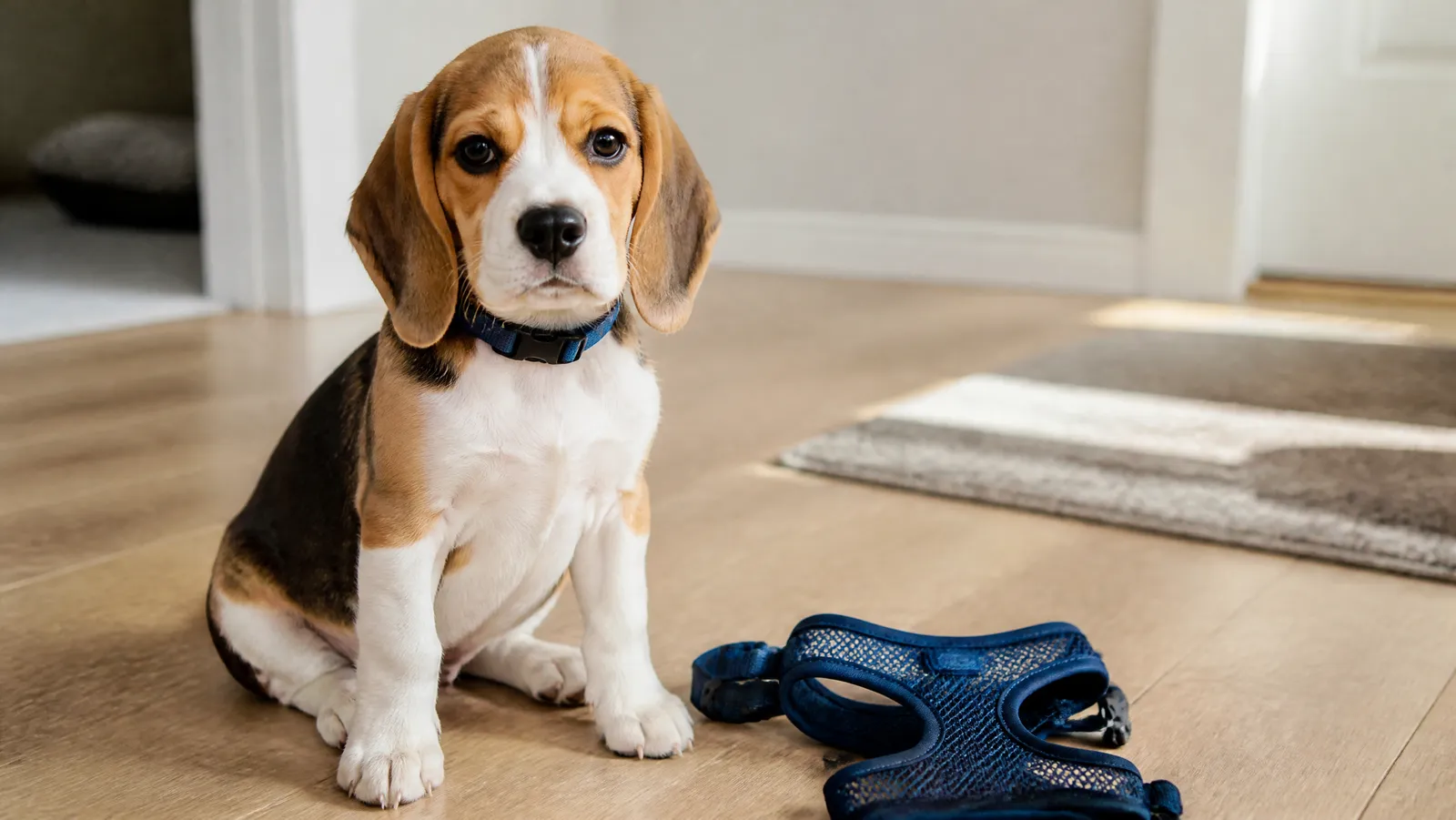
If your puppy ducks away from anything going over their head, that decides your gear: a step-in harness removes the over-the-head moment, while a flat collar is simpler to live with indoors. We work through the trade-offs in our guide to picking a collar or harness for a puppy.
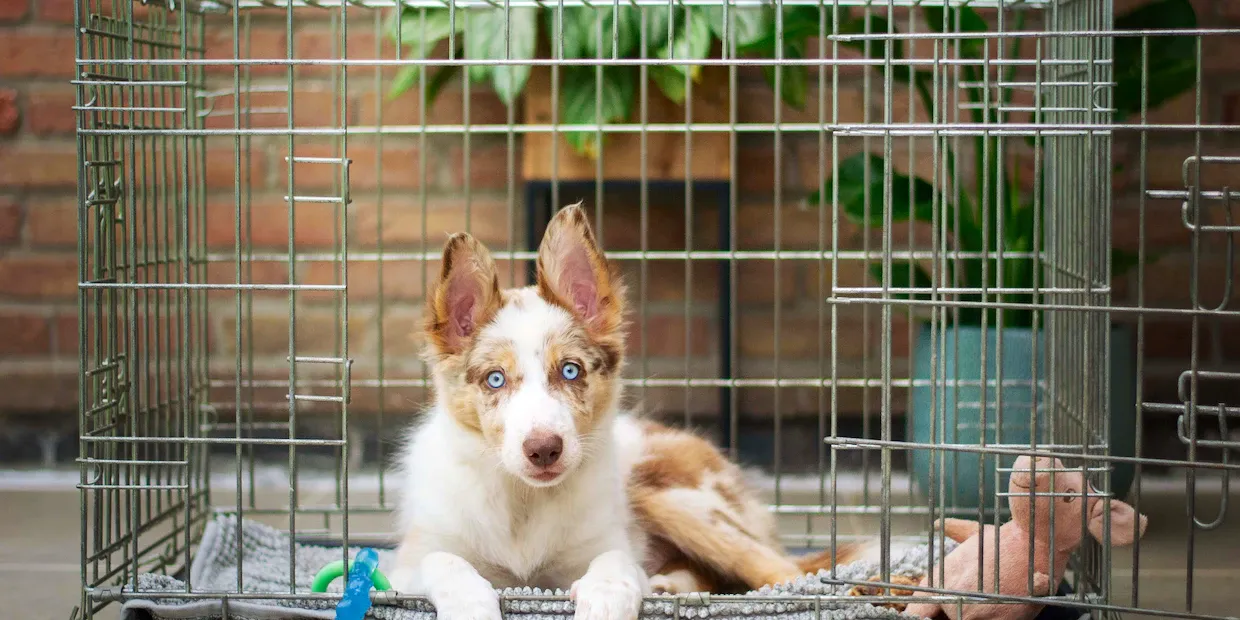
Keep a rest plan running alongside it: the AVSAB asks owners to schedule naps in safe places such as crates or puppy pens, and an overtired puppy practises nothing well. Crate training your puppy comes first if that is not set up.
Week Two: The Leash Exists
Now the leash clips on — and does nothing.
Attach it, drop the handle, and let your puppy trail it around a room while you supervise every second. Five minutes is plenty. The point is that a thing hanging off the collar is normal and that stepping on it is not a crisis. Keep it watched: Joytale states plainly that its rope leash is not chew-proof and that a dog should not be left unattended with it — the right warning for every soft leash sold.
Expect the leash to go in the mouth, because at this age everything does. Trade it for a chew rather than pulling it back — tugging a leash out of a puppy's teeth can teach them it is a tug toy, the exact game you do not want on a pavement. The redirect logic behind how to stop puppy biting applies here too.
The second half of the week is the follow game, off leash: walk a few steps away, make a happy noise, pay your puppy for arriving at your leg. This becomes loose leash walking later, and it is far easier to teach before a leash is involved.
Week Three: Moving Together Indoors
This is the week it starts to look like leash training, and the week most people rush.
Pick up the handle. Take two steps. Pay. That is the whole exercise. Then build: three steps, a turn, a stop, a sit — with the treat delivered down by your leg, because reward placement tends to pull a dog towards it and treats fed out in front can encourage forging.
Keep it short to the point of feeling silly. The Fear Free Happy Homes handout distributed by the AVSAB gives three minutes as a general guideline for most dogs and says puppies might only be able to train for one minute at a time, because their attention spans are very short. Count out 10 to 20 treats, stop when they run out, and end with your dog wanting more.
A treat pouch on your waistband makes this work, because the reward has to land while the puppy is still in position. The AUDWUD silicone treat pouch is about $7 as of October 2026 and opens one-handed with a magnet. Those treats are food, so count them inside the day's calories — see our puppy feeding schedule.
When your puppy hits the end of the leash, stop and wait. Do not pop, jerk or correct. The AVSAB's humane dog training position statement is unambiguous: evidence supports reward-based methods for all canine training, and aversive methods — which by definition rely on force, pain, or emotional or physical discomfort — should not be used, with no evidence they work better in any context. That covers prong collars, choke chains, shock collars and leash jerks, none of which belongs on an eleven-week-old.
Week Four: The Back Yard, Then the World
A private, enclosed yard is the correct next step, and the AKC says so in as many words: when your puppy will walk with you in the house, try the backyard before moving to the sidewalk. Outdoors multiplies the distractions, so drop back to week-three difficulty. Two steps, pay, repeat.
What happens after the yard is a medical question rather than a training one. VCA Hospitals says core puppy vaccinations usually begin between 6 and 8 weeks old, are given at least three times about 3 to 4 weeks apart, and finish at or after 16 weeks of age, with rabies often given at 12 to 16 weeks. It adds that protection is not instant — usually 10 to 14 days before a reasonable level is established — and advises waiting until a puppy has finished the full course before close contact with dogs of unknown vaccination history. Dr. Emily Wilson, DVM, quoted by the AKC, says she usually recommends waiting two weeks after the last booster to let the immune system fully respond.
The first walk after vaccinations is also shorter than new owners expect: the AKC's own example is a 10-week-old going out for a 10-minute walk two or three times a day.
What You Actually Need to Buy
Four items, roughly $40 at October 2026 prices.
A light, adjustable collar. The Joytale Feather-Light Puppy Collar is about $6 as of October 2026 in the 3/8 inch width Joytale sizes for an 8 to 12 inch neck, and its one-second quick-release buckle suits a week when the collar comes off as often as it goes on. The limitation is printed on the listing: Joytale says it is not recommended for heavy pullers or tie-outs, and advises a harness instead.
A harness, if your puppy ducks the collar. The BINGPET step-in puppy harness set is about $17 as of October 2026: a mesh vest, a 5ft anti-tangle leash and a car tether, with nothing passing over the puppy's head. Fit it by tape measure, not breed — BINGPET lists size S for a 14.5 to 16 inch chest and M for 16 to 18 inches, and says the set is not recommended for large dogs.
A plain six-foot leash. The Joytale Rope Dog Leash is about $8 as of October 2026, with an EVA padded handle intended to prevent rope burn and a metal clasp on a tangle-free swivel. Joytale rates the climbing-grade rope for dogs up to 120 lbs, so it outlasts the puppy stage — but says it is not chew-proof and should not be left on an unattended dog.
Somewhere to keep the treats. The AUDWUD treat pouch, about $7 as of October 2026, is dishwasher-safe BPA-free silicone that AUDWUD says is safe for direct contact with pet food, and the magnetic closure gives one-handed access while your other hand is busy. It is a magnet rather than a zip, so we would not throw it loose into a bag.
Nothing on that list tightens, pinches or shocks, and nothing that does belongs on a puppy.
If You Are Starting Late
If you are reading this with a five-month-old who has never worn a collar, you have not ruined anything — you have made the job longer. Run the same sequence, collar then dragging leash then follow game then two steps indoors, but plan on more repetitions per stage than a younger puppy would need, and work in the quietest room in the house. An older puppy has opinions a nine-week-old does not, and the main one is usually that pulling works.
The window argument cuts both ways. The AVSAB describes the first three months as the period when sociability outweighs fear, which is a head start you no longer have — but the same statement says exposures should continue into adulthood to maintain an outgoing and sociable dog, and that training should be based on positive reinforcement with frequent rewards, praise, petting, play or treats. Late is a slower version of the same plan, not a different one.
One caveat we would not soften: a dog who freezes, screams, thrashes or snaps at the sight of the leash is not asking for more repetitions. That looks like a fear response, and the AVSAB's socialization statement says owners of puppies displaying fear should seek veterinary guidance — so it is worth a call to your veterinarian or a credentialed reward-based trainer first.
The Bottom Line
Start on day one, at around eight weeks, and accept that the first month contains no walks. Collar in week one. A dragging leash in week two. Two supervised steps across the kitchen in week three. The back yard in week four, and the pavement whenever your veterinarian says the vaccination schedule allows it.
The owners who find walk one easy are rarely the ones who trained hardest. They are the ones who did five one-minute sessions a day on a carpet while everyone else waited for the shots to finish. For what comes after the driveway, read our complete puppy leash training guide.
Our top picks


A first collar rather than a walking collar, which is exactly the job for an eight-week-old. Joytale builds it from a high-density nylon it calls soft and lightweight with smooth burr-free edges to prevent chafing, and the X-Small is 3/8 inch wide for an 8 to 12 inch neck. The quick-release buckle is the part that matters in week one, when the collar comes off as often as it goes on.
What we love
- Lightweight high-density nylon with smooth burr-free edges to prevent chafing, per Joytale
- 360-degree double-sided reflective stitching, so it stays visible even if the collar twists
- One-second quick-release buckle — easy to take off during short practice sessions
- Fully adjustable slider, and the maker suggests looping the excess strap back through it to lock the size
- Weatherproof metal D-ring for ID tags and basic leash attachment
Keep in mind
- Joytale explicitly says it is NOT recommended for heavy pullers or tie-outs and advises a harness instead
- The X-Small fits an 8 to 12 inch neck, so a fast-growing puppy moves up a size rather than out a notch
The step-in design is the reason this one is here: nothing goes over the puppy's head, which removes the single most common objection a nervous puppy has to gear. It arrives as three pieces — the mesh vest, a 5ft anti-tangle leash with a padded handle, and an adjustable car tether — so it covers the first walk and the first car ride in one order.
What we love
- Step-in design means nothing passes over the puppy's head
- Adjustable neck and chest straps with a hook-and-loop fastener
- Breathable quick-dry mesh and machine washable, which matters more than it sounds in month one
- Reinforced D-rings and reflective stitching
- Three-in-one: harness, 5ft anti-tangle swivel leash with padded handle, and a 24 to 32 inch car tether
Keep in mind
- Sized tightly — size S fits a 14.5 to 16 inch chest and M fits 16 to 18 inches, and BINGPET says to fit by measurement with one to two fingers of space
- BINGPET says it is not recommended for large dogs, so a big-breed puppy will grow out of the set rather than into it

A plain six-foot rope leash with a padded handle, which is all the first month asks for. Joytale uses a climbing-grade nylon rope and a heavy-duty metal clasp with a 360-degree tangle-free swivel, and says the rope handles dogs up to 120 lbs — so it is the one piece of the kit your puppy will not outgrow.
What we love
- Soft EVA padded ergonomic handle intended to prevent rope burn
- Heavy-duty metal clasp with a 360-degree tangle-free swivel
- Climbing-grade nylon rope the maker rates for dogs up to 120 lbs, so it outlasts the puppy stage
- Detachable poop-bag dispenser and bags included
- Sold in 5ft and 6ft, and in 3/8 inch for small dogs or 1/2 inch for medium and large breeds
Keep in mind
- Joytale states plainly that it is NOT chew-proof and that the dog should not be left unattended with it — which rules out leaving a dragging leash on an unsupervised teething puppy

Indoor leash work is paid work, and fumbling with a treat bag costs you the half-second that makes a reward make sense. This is BPA-free silicone that AUDWUD says is safe for direct contact with pet food, with a magnetic closure for one-handed access and a clamp that clips to a pocket or belt loop. A clicker is in the box.
What we love
- Magnetic closure gives one-handed access and frees the other hand for training signals
- BPA-free silicone the maker says is safe for direct contact with pet food
- Clips to a pocket or belt loop, so the treats are already on you when the moment happens
- Dishwasher safe, and the wide opening lets it be turned inside out to clean
- Includes a training clicker
Keep in mind
- A magnet is not a zip — we would not drop it into a bag with anything loose in it
- The included clicker is only an advantage if you intend to commit to clicker timing; otherwise it is a spare part
Frequently asked questions
Can a puppy start leash training at 8 weeks?
Yes, as long as leash training at that age means collar practice and following you across a room rather than a walk. The AVSAB's puppy socialization position statement calls the first three months of life the primary and most important time for puppy socialization, and says puppies can generally start socialization classes as early as 7 to 8 weeks of age, with a minimum of one set of vaccines at least seven days before the first class and a first deworming. The AKC's own leash-walking advice begins in the house with short periods of collar wear. None of that requires a sidewalk.
What age is too late to leash train a puppy?
There is no cut-off, but the easy window does close. The AVSAB describes the first three months as the period when sociability outweighs fear, which is why gear introduced then is usually accepted with little argument, and it adds that exposures should continue into adulthood to maintain an outgoing and sociable dog. A six-month-old meeting a leash for the first time needs the same sequence — collar, then a dragging leash, then movement — run more slowly and in quieter places. If your dog freezes, panics or snaps at the sight of the gear, that is a conversation with your veterinarian or a credentialed trainer rather than more repetitions.
When can my puppy go for a real walk outside?
Ask your own veterinarian, because the answer depends on your puppy's schedule and your local disease risk. VCA Hospitals says the core puppy vaccinations usually begin when the puppy is between 6 and 8 weeks old, are given at least three times about 3 to 4 weeks apart, and finish at or after 16 weeks of age, and that it is usually 10 to 14 days before a reasonable level of protection is established. Dr. Emily Wilson, DVM, quoted by the AKC, says she usually recommends waiting two weeks after the last booster to allow the immune system to fully respond before public outings.
How long should a puppy leash training session be?
Shorter than almost anyone expects. A Fear Free Happy Homes training handout distributed by the AVSAB gives three minutes as a general guideline for most dogs and says puppies might only be able to train for one minute at a time, because their attention spans are very short and they need frequent breaks. It suggests counting out 10 to 20 treats in advance and stopping when they are gone, and ending while the dog still wants more rather than working to fatigue or frustration. The AKC agrees on the shape: keep sessions short, with frequent praise and rewards.
Should a puppy's first leash clip to a collar or a harness?
Both have a place, and the maker's own stated limits usually settle it. Joytale sells its 3/8 inch puppy collar as a first collar for puppies and small dogs with a D-ring for ID tags and basic leash attachment, but says plainly that it is not recommended for heavy pullers or tie-outs and advises a harness instead. A step-in harness spreads pressure across the chest and goes on without anything passing over the puppy's head, which helps with a puppy who ducks away. Whichever you choose, the AVSAB's humane dog training position statement rules out prong, choke and shock collars entirely.
About the author
James Martin
I'm an animal lover through and through. I grew up with dogs, my family always had at least one pet, and today I share my home with a rescue who is the love of my life. I started Healthy Puppy Review to help owners cut through the marketing noise and make confident, well-researched choices about their dog's health and happiness.