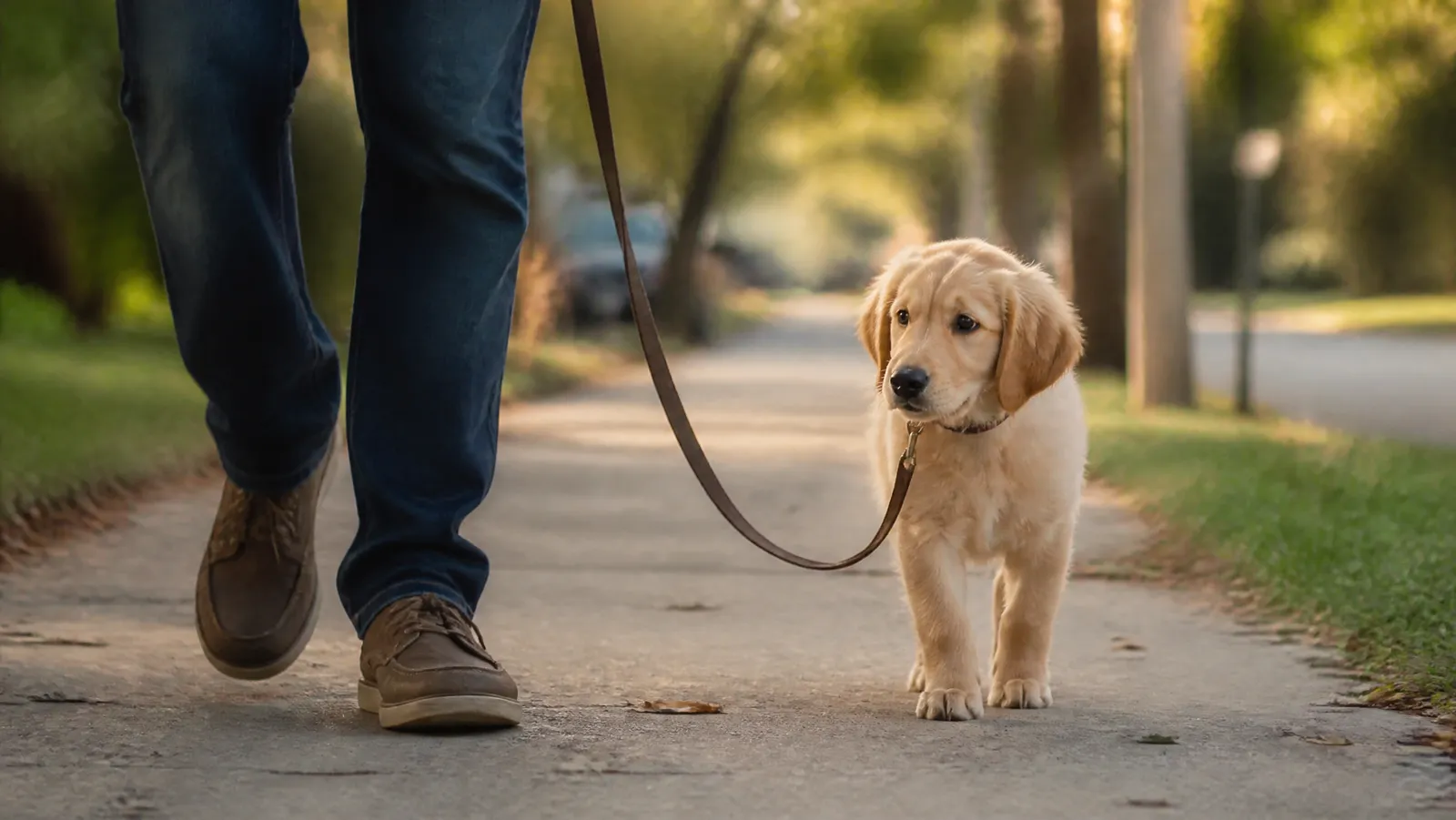
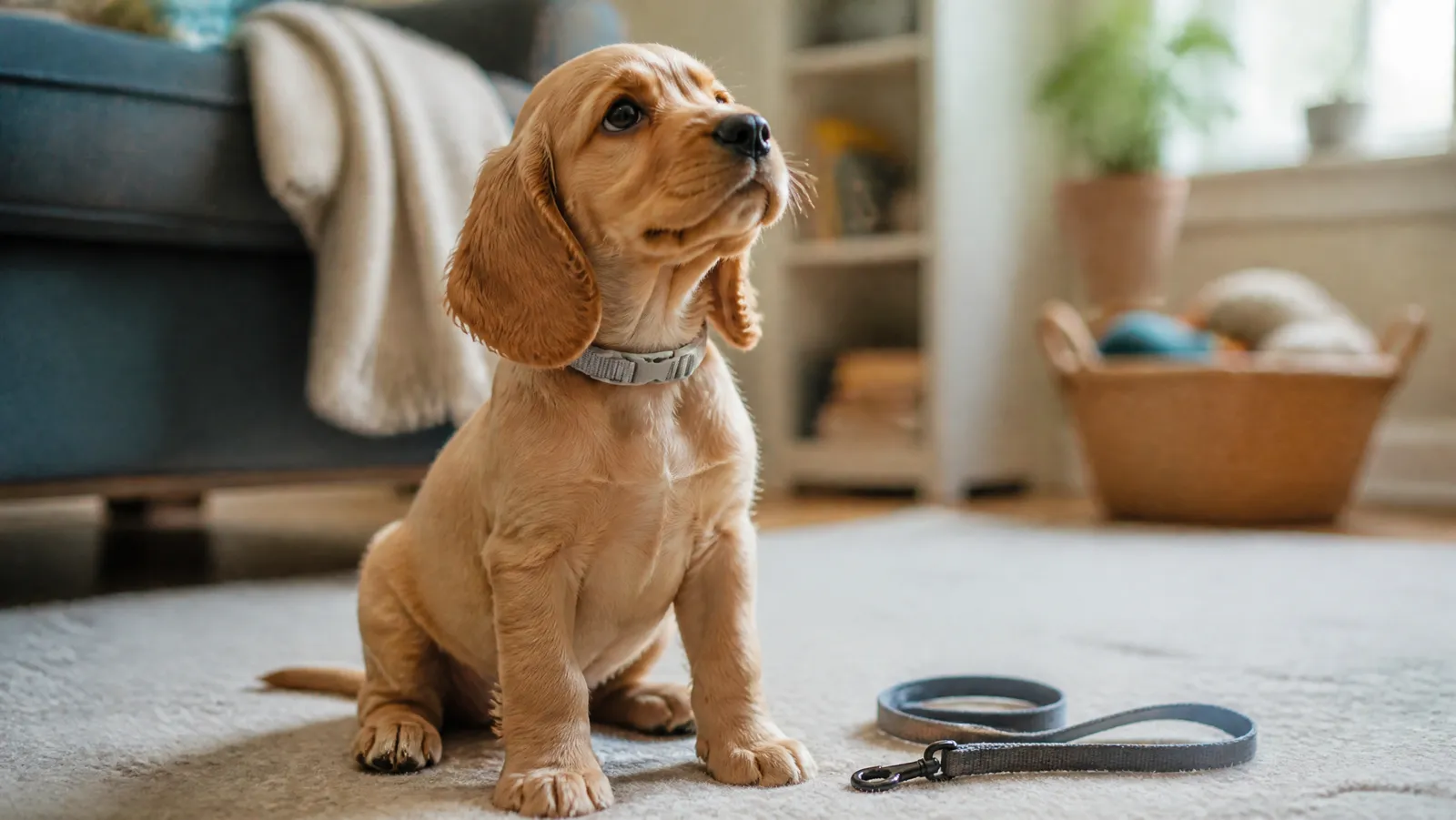
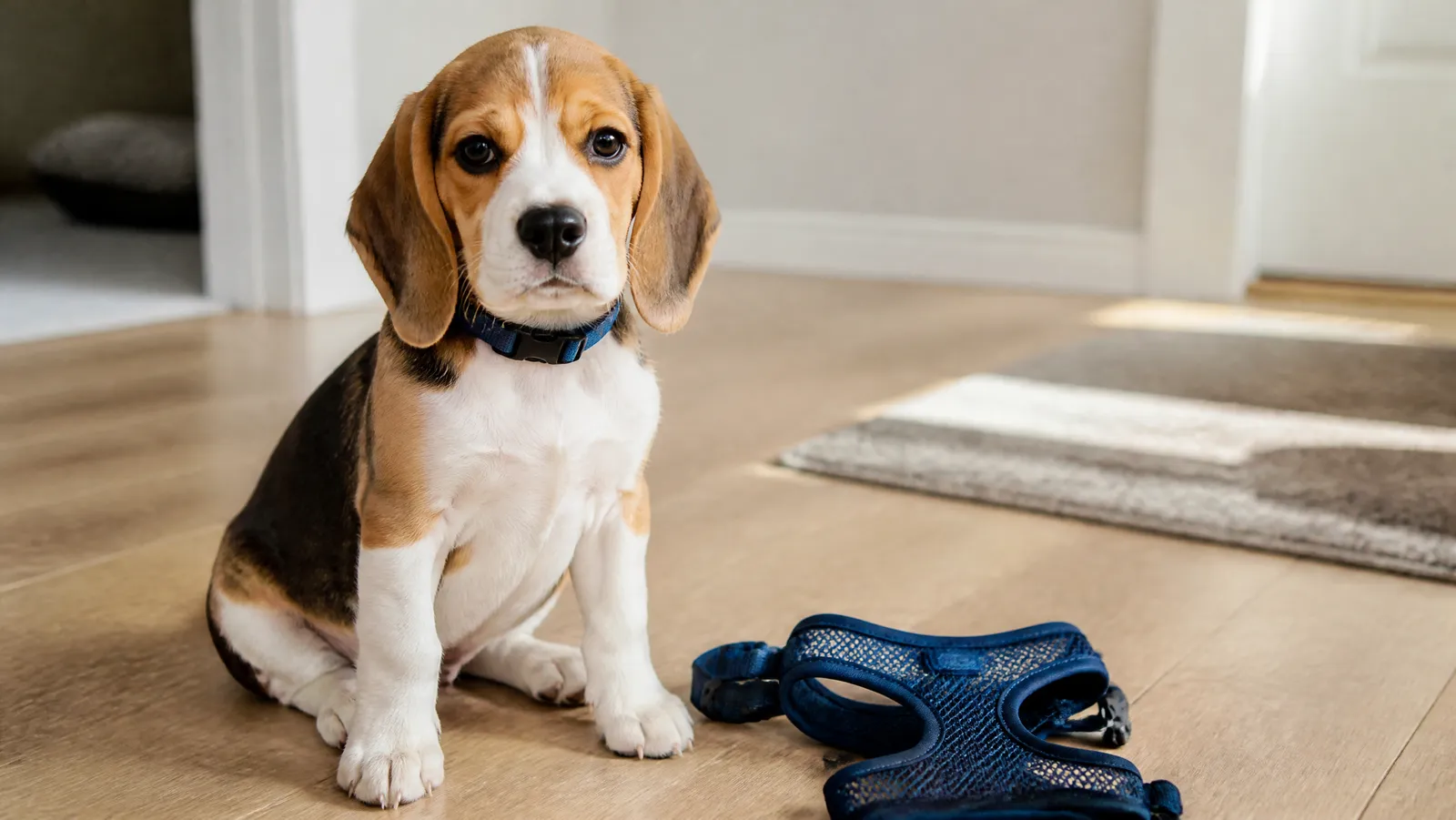
Puppy Will Not Walk on the Leash? Why They Freeze and What Helps
A puppy who plants their feet is telling you something — the harness hurts, the street is too loud, or nobody has shown them that following you pays. Here is how to rule out the physical causes, why dragging them makes it worse, and the short reset that gets a frozen puppy moving again.

Contains affiliate links · our policy
In this guide
A puppy who will not walk on the leash is almost never being stubborn. Usually they are frightened, physically uncomfortable, or nobody has shown them yet that following you pays. Check the body first, lower the difficulty second, and pay generously for one forward step. The one thing the evidence does not support is pulling harder.
We may earn a commission from links on this page, at no extra cost to you.
Most owners searching for why their puppy won't walk on leash have just lived the same five minutes: leash on, door open, three steps down the drive, then a small animal sitting on the pavement. It feels like defiance and almost never is. If you are building the skill from scratch, read this alongside how to leash train a puppy — what follows is the troubleshooting branch.
First, Rule Out the Physical
Freezing is a symptom, not a diagnosis, and the most checkable causes are in your hallway.
The harness is the first suspect. Veterinary surgeon Rebecca MacMillan, writing for PetsRadar, gives the test: you should be able to fit about two fingers under each strap, and if you cannot, it is probably too tight. She warns that a tight harness can cause chafing leading to skin sores, especially in the armpit area — and, the line that matters here, that a dog who is reluctant to walk, or whose movement is being impeded by the harness, may be finding it uncomfortable and too snug. Take it off, look at the skin underneath, then re-measure to the maker's chart rather than the breed name on the box. We worked through the collar-versus-harness question separately.
Then the week they have had. The AVMA says it is common for pets to have mild, short-lasting side effects within hours of a vaccination — soreness or swelling at the injection site, tiredness, a mild fever, reduced appetite — that usually resolve within about 24 hours, and advises calling the vet if they last more than a day or two. VCA Hospitals gives a similar window, saying a less lively dog a day or two after a vaccination should resolve within 24 to 48 hours.
Then the feet. VCA Hospitals' protocol for a limping puppy is to check the legs and feet for swelling, pain, heat, redness, cuts, punctures or items stuck to the feet, then watch quietly for 15 to 30 minutes to see whether the limping improves — without giving medication unless a veterinarian prescribed it.
When this is a vet call, not a training project
VCA Hospitals says to contact your vet right away if your puppy is not putting pressure on the sore leg after 30 minutes, if there is extreme pain or bleeding that will not stop, or if there is an obvious fracture, dislocation or known traumatic injury. Limping alongside trouble breathing, vomiting, overall weakness or swelling anywhere on the body needs emergent attention. Ryane Englar, DVM, adds the behavioural version in PetMD: a sudden change might be a sign of pain, with an infection, an illness, a metabolic disease or organ failure among the possibilities. Her advice, which we would follow: if you notice a marked change in behaviour that does not resolve quickly, book an appointment.
The Overwhelm Explanation
With the body ruled out, the likeliest answer is the dullest: the world is enormous and your puppy has been in it a fortnight.
The AKC's guide to puppies who refuse to go on walks is blunt about the cause: many puppies are frightened, either of the collar and leash or of the great outdoors, whose sights, sounds and smells can overwhelm some puppies. It adds the structural point most owners miss — a leash is a form of restraint, and being on one removes a puppy's ability to walk away from anything frightening, which the AKC calls intimidating. Your puppy is not refusing a walk. They are refusing to leave the only safe thing in sight.
Development plays a part too. The AKC says puppies generally experience a first fear period around 8 to 11 weeks and a second between 6 and 14 months, calls these a normal part of development that can nevertheless be overwhelming, and advises giving puppies space to engage at their own comfort level.
It may also be that nothing has gone wrong and the groundwork has not happened yet — our guide to when to start leash training a puppy covers the indoor stage a frozen puppy has usually skipped. Even the strongest case for early outings has a brake in it. The AVSAB's puppy socialization position statement calls the first three months the primary and most important time for socialization and says puppies should meet as many new people, animals, stimuli and environments as can be achieved safely — then, in the same sentence, "without causing overstimulation manifested as excessive fear, withdrawal or avoidance behavior."
Why You Do Not Drag Them
"Keep walking and they will follow." "Give the leash a tug." A puppy on a six-foot lead cannot opt out, and the evidence on forced exposure runs the other way.
The AKC's position on fear is direct: do not force your puppy to engage in things that scare them, because forcing is far more likely to backfire and create a bigger and possibly long-lasting fear. On the leash specifically, it says a puppy will not learn to love the leash if you use it to pull them around, and that using the collar to grab and pull a puppy teaches them to associate it with negative consequences.
The clinical version is more precise. VCA Hospitals, in a handout authored by Ellen Lindell, VMD, DACVB and colleagues, describes desensitization as gradually and systematically exposing an animal to a trigger until it no longer triggers an emotional response, and counterconditioning as pairing that trigger with something known to create a positive emotional response. Crucially, "desensitization begins with a very low intensity of exposure," and VCA says not to continue a session if your pet shows signs of fear or arousal — because continuing when a pet is uncomfortable can result in an exaggerated response during a future exposure.
That also rules out the hardware some people reach for here. The AVSAB's humane dog training position statement advises that aversive methods should not be used in animal training or for treating behaviour disorders, names prong collars, electronic shock collars and leash jerks among them, and states there is no evidence they are more effective than reward-based methods in any context. We use none of them.
The Reset: Teaching That Following Pays
Go back to a room your puppy is relaxed in and rebuild. The rate of reward is what people get wrong: far more food, far earlier, than feels reasonable.
- 1
Rebuild the gear indoors
Put the harness on while something good is happening, and take it off a few minutes later. The AKC advises introducing the collar and leash at home first with praise, play and delicious treats as a reward, and notes that for some puppies even a collar is upsetting because it feels strange. Then clip the lead on and let it trail under supervision.
- 2
Pay for one step, then move to the doorstep
Drop a treat beside your shoe, then another one step on. You are laying a trail of reasons to move. Keep the lead slack — Kathy Callahan, writing for Whole Dog Journal, advises staying close and keeping the leash from tightening so that it does not create panic at this early stage. VCA's handout is explicit that it is important to use a high value reward. Outdoors the pay rate goes up, not down.
- 3
Borrow the direction of travel
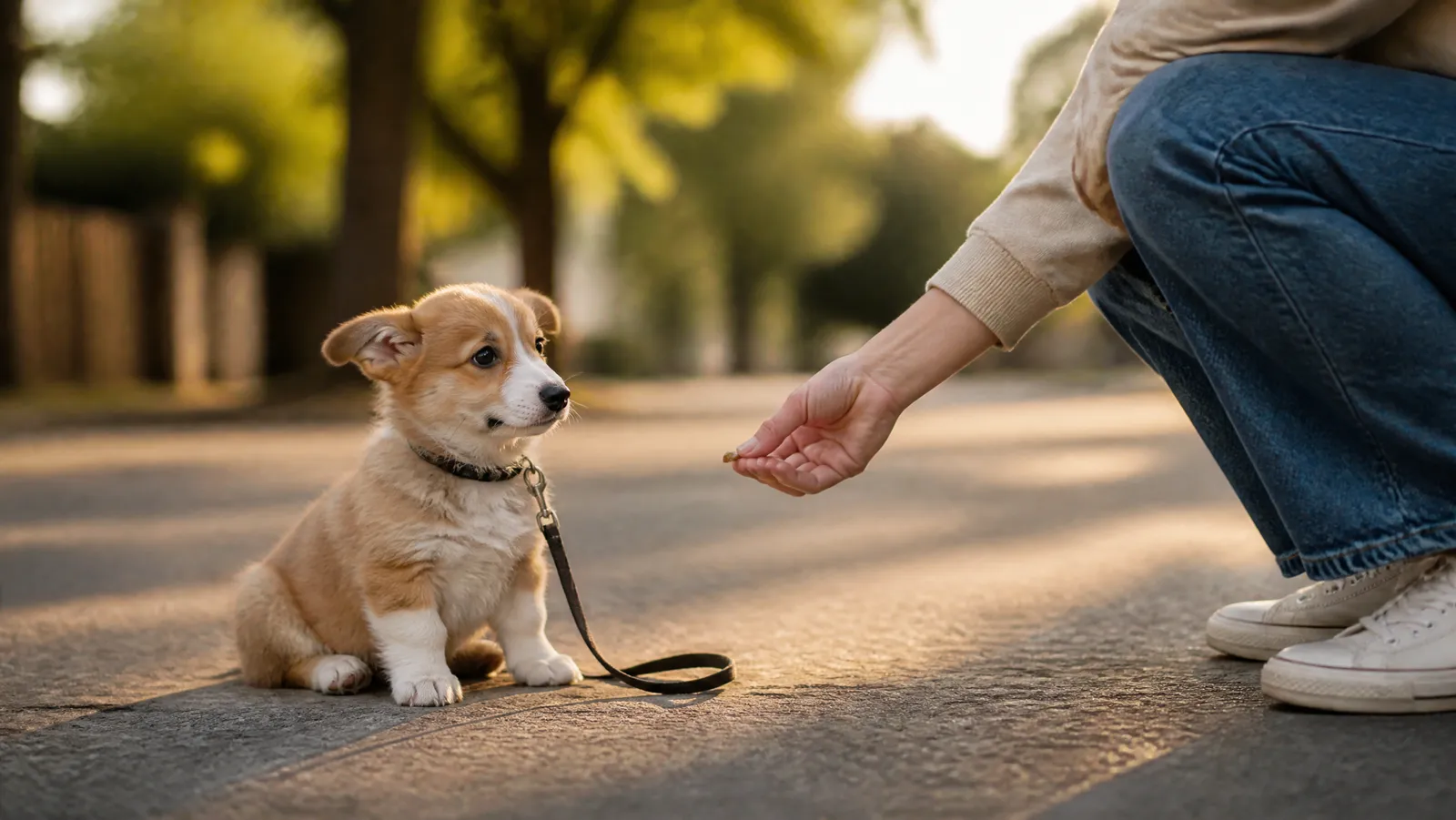
Moving toward safety is easier than moving away from it, which is the logic behind the AKC's best suggestion: carry your puppy 20 or 30 feet from home and let them walk back on their own. The AKC also suggests driving a block away and walking home, and saving a treat or toy that only ever appears on walks.
- 4
Add five metres at a time
Extend the far end of the trip rather than the clock: five more metres than last time, then home. A few minutes can be a full session, and the AKC advises keeping sessions short with frequent praise and rewards and ending every walk on a positive note. If a session goes backwards you went too far — VCA's tell is a pet no longer readily taking treats.
A reward you have to dig out of a coat pocket arrives too late to mean anything. The heouvo magnetic treat pouch is about $10 as of October 2026 and closes itself between grabs. Its honest limitation is the silicone, which holds food odour and needs washing.
Working Up to a Real Walk
The goal for the next few weeks is not distance. It is a puppy who moves willingly.
- Let sniffing be the point. Callahan's advice in Whole Dog Journal is to let the pup sniff to her heart's content, because the aim is exploring rather than a polished walk.
- Walk a loop, not a line. Routes that finish at the door give a hesitant puppy a destination they already like.
- Take the pressure off the schedule. The timing of the first walk after vaccinations is a question for your own vet, not a deadline.
Once your puppy leaves the drive without thinking about it, the problem changes shape: you stop persuading them to move and start deciding where. That is the moment to pick up the loose leash walking protocol, the opposite problem and a happier one to have.
Removing the Physical Reasons
Gear does not fix fear. It removes three physical excuses cheaply. We did not run a testing panel; what follows is what the makers' specifications support.
The harness. For a puppy who flinches at anything going over their head, a step-in vest changes the handling: it lies on the floor, the puppy steps in, you clip. The Voyager step-in plush harness is about $14 as of October 2026, lined with a plush fabric Best Pet Supplies says keeps a pet comfortable on brisk days, with two reflective side bands and three closures the maker calls three layers of security. Two limitations, both from the listing: the leash rings are on the back only, so there is no front clip for the day your puppy becomes a puller, and the plush lining will be warm in summer. Best Pet Supplies also stresses measuring to its chart rather than guessing by breed or weight, which matters more here than anywhere.
The lead. A lighter line is worth more than it sounds on a puppy objecting to sensation. The Mendota Petite Snap leash is about $8 as of October 2026 in the fine 1/8 inch width at 72 inches, hand made in the USA from waterproof nylon and guaranteed by Mendota for the life of your pet. The flip side: Mendota lists the fine width for small dogs and puppies only, so it is not a lead for an adolescent, and a thin cord gives no padded handle and little grip if the puppy bolts.
The pouch. The heouvo treat pouch takes wet or frozen food as well as dry, which matters when the reward has to beat a passing bus. For the rest of the first-week kit, see our must-have toys for a new puppy roundup.
When to Get Professional Help
If a fortnight of short, easy sessions has produced nothing, or if your puppy now freezes at the sight of the harness, this stops being a self-help project. Ask your vet first — to rule out pain, and for a referral.
The ASPCA sets out what the credentials mean. Veterinary behaviourists must complete a residency in behaviour and pass a qualifying examination, and can prescribe medication for behaviour problems. Certified Applied Animal Behaviorists hold a doctoral degree, and most work through veterinary referrals. For trainers, the ASPCA notes that education and experience vary greatly, and that a CPDT must abide by a code of ethics and earn continuing education credits. Its hiring advice is worth underlining: do not hire anyone without interviewing them first, because a good behaviourist or trainer will be happy to discuss their qualifications. Ask what happens when the puppy gets it wrong — if the answer involves a correction or a tool that works by discomfort, keep looking.
The Bottom Line
A puppy who will not walk is giving you information, and it is usually that something hurts or something is too much. Check the harness with two fingers under every strap, look at the skin underneath, and think about what happened at the vet this week. Then make the task smaller than the one they refused, pay far more than feels necessary for one forward step, and let them walk toward the house.
What we would not do is pull. The AKC's warning — that forcing a frightened puppy is far more likely to backfire and create a bigger, possibly long-lasting fear — is the reason this article exists. When the freezing stops, our complete guide has the full sequence in order.
Our top picks


A step-in vest, which is the shape we would reach for with a puppy who ducks away from anything going over their head: you lay it on the floor, the puppy steps in, and you clip. Best Pet Supplies lines it with a soft, warm plush fabric the maker says keeps a pet comfortable on brisk days, and stacks three closures — a hook and loop fastener, a buckle and double D-rings. The maker is emphatic that sizing does not follow breed or weight, so measure the chest and buy to the chart.
What we love
- Step-in design means nothing has to go over a nervous puppy's head
- Plush-lined inside, which Best Pet Supplies says keeps a pet comfortable on brisk days
- Three closures — hook and loop, buckle and double D-rings — which the maker frames as three layers of security
- Two reflective bands on the sides for dark mornings and winter evenings
- Best Pet Supplies frames it as step in, clip and go, which matters when the gear itself is the worry
Keep in mind
- The leash rings are on the back only, so there is no front clip for redirecting a puller later on
- The plush lining is made for brisk days and will be warm in summer heat
About as little leash as you can clip to a worried puppy: a fine 1/8 inch cord, 72 inches long, hand made in the USA from waterproof nylon. Mendota calls the minimalist Petite Snap a favourite among dog owners and trainers, and the point of it here is the absence of weight — nothing swinging, nothing tapping the puppy's legs, nothing to notice.
What we love
- A fine 1/8 inch cord is about as little leash weight as a small puppy can feel
- Seventy-two inches gives you slack to follow a puppy who is still deciding
- Waterproof nylon, hand made in the USA
- Mendota guarantees its gear for the life of your pet
- Folds into a pocket, so the long lead is not a separate trip to the hall cupboard
Keep in mind
- Mendota lists the Fine 1/8 inch width for small dogs and puppies only — it is not a lead for a strong adolescent
- A thin cord has no padded handle and offers very little grip if your puppy bolts

The unglamorous item that decides whether this reset actually happens, because a reward you have to dig for arrives too late to mean anything. Two built-in magnets close the mouth on their own so you can pay a puppy one-handed, and the food-grade silicone, which heouvo states is free from bisphenol, holds dry, wet or frozen food rather than just biscuits. A 5 by 4 by 2 inch body that the maker says takes 1.67 cups is a session's worth of currency.
What we love
- Two strong magnets allow one-hand operation, so the reward lands while the puppy is still moving
- Food-grade silicone heouvo states is free from bisphenol, and it takes dry, wet or frozen food
- The flexible body bends and flips inside out for cleaning
- Adjustable belt fits 25 to 47 inch waists, designed to avoid the plastic clips that break on other pouches
- A training clicker is in the box, which heouvo notes can be used for basic obedience and trick training
Keep in mind
- Silicone holds food odour and needs regular washing
- 1.67 cups is modest if you are training several dogs or running a very long session
Frequently asked questions
Why does my puppy sit down and refuse to walk?
Usually fear, discomfort, or inexperience rather than stubbornness. The AKC says many puppies who refuse to go on walks are frightened, either of the collar and leash or of the great outdoors, and points out that a leash is a form of restraint that takes away a puppy's ability to leave something scary. The AKC also notes that for some puppies even a collar is upsetting because it feels strange. Pain belongs on the list too: in PetMD's guide to leash refusal, Ryane Englar, DVM, says a sudden change might be a sign of pain. Check the body first, then the training.
Should I drag my puppy to get them walking?
No, and this is the one piece of common advice we would ignore outright. The AKC's rule is that a leash is for safety, not for control, and it says a puppy will not learn to love the leash if you use it to pull them around. On fear specifically, the AKC advises against forcing a puppy to engage with things that scare them, warning that forcing is far more likely to backfire and create a bigger and possibly long-lasting fear. VCA Hospitals makes the same point from the clinical side: do not continue a session if your pet shows signs of fear or arousal.
Can a harness make a puppy refuse to walk?
It can, and it is the cheapest thing to check. Veterinary surgeon Rebecca MacMillan, writing for PetsRadar, says you should be able to fit about two fingers under each strap of a dog's harness, and that if you cannot, it is probably too tight. She notes that a tight harness can cause chafing leading to skin sores, especially in the armpit area, and says a dog who is reluctant to walk, or whose movement is impeded by the harness, may be finding it uncomfortable and too snug. Take it off, look at the skin underneath, and re-measure to the maker's chart.
How long does it take for a puppy to stop freezing on walks?
There is no honest timeline, and we would be suspicious of anyone who gives you one. What the sources describe is a pace set by the puppy, not the calendar. VCA Hospitals says desensitization begins with a very low intensity of exposure, and that one sign you are moving too quickly is a pet who is no longer readily taking treats or settling on cue. The AKC's practical advice is to keep walks short and fun and to end every walk on a positive note. Kathy Callahan, writing for Whole Dog Journal, adds the reassurance most owners need: do not get frustrated if that means your walks seem small.
Is it safe to walk my puppy before they are fully vaccinated?
That is a question for your own vet, because two real risks point in opposite directions. The AVSAB's puppy socialization position statement argues that the first three months are the primary and most important time for socialization, that this is the period when sociability outweighs fear, and that behavioral issues rather than infectious diseases are the number one cause of death for dogs under three years of age. It therefore supports socialization before a puppy is fully vaccinated — but it also asks that exposure happen safely and without causing overstimulation. Your vet knows your puppy's vaccine dates and your local disease picture.
About the author
James Martin
I'm an animal lover through and through. I grew up with dogs, my family always had at least one pet, and today I share my home with a rescue who is the love of my life. I started Healthy Puppy Review to help owners cut through the marketing noise and make confident, well-researched choices about their dog's health and happiness.