Puppy Biting the Leash: Turning Tug-of-War Into a Walk
A puppy biting the leash is usually aroused, frustrated or teething — not defiant — and the three causes need three different answers. Here is how to tell them apart, the protocol we would run on the next walk, and the honest line between gear that trains and gear that only hides the problem.

Contains affiliate links · our policy
In this guide
A puppy biting the leash is almost never defiance. It is usually arousal, frustration or teething — three causes that need three different answers. The fix is not to win the tug-of-war. It is to give the mouth a job it is allowed to do, make sure the grab never moves the walk forward, and end the walk before the excitement peaks.
We may earn a commission from links on this page, at no extra cost to you.
Most owners have already tried pulling the leash back out of the puppy's mouth, and it made things worse. It was always going to: a rope that jerks away when you bite it is the best tug toy ever invented, and you are the one making it move. If you are early in all of this, leash training from the beginning is the sequence this sits inside.
Why Puppies Grab the Leash
Three causes that look identical from the end of a six-foot lead. The difference is in the five seconds before the grab.
Arousal: the puppy is over-excited, and the mouth is where it goes
This version starts within a minute of the front door, with the puppy spinning, jumping at your sleeve and grabbing anything that moves. Pat Miller, CBCC-KA, CPDT-KA, writing in Whole Dog Journal about arousal biting, names two ordinary causes: inadequate physical exercise, because there is nothing like excess energy to prompt a young dog to use his mouth in play, and inadequate mental stimulation, which adds boredom on top. Miller also notes the behaviour often erupts after a period of prolonged inactivity — which describes a puppy let out of a crate and clipped onto a leash.
How to tell. It happens at the start of the walk, and the leash is only one of several things being grabbed.
Frustration: the puppy has been stopped, held back, or walked past something thrilling
The AKC's guide to dogs that tug on leashes, by trainer Sassafras Patterdale, CPDT-KA, CTDI, calls leash biting "often a symptom of a dog being frustrated" and describes dogs who bite or tug in an overly arousing environment, upset about being restrained. The same article turns the question back on your hands: keep the leash loose and behind the dog rather than dangling it like a toy.
How to tell. The grab has a trigger and a location — the same corner, or the instant another dog appears. The leash is usually tight a second before the teeth land.
Teething: the least likely of the three, and the easiest to check
Here the sources diverge. VCA Hospitals, in a play-biting handout by Debra Horwitz, DVM, DACVB and Gary Landsberg, DVM, DACVB, says nipping, mouthing and biting in young dogs is generally a form of social play, and that teething is more likely to involve gnawing or chewing on household objects. The AKC, in a staff guide to teething puppies who bite, names teething and overtiredness as two of the primary reasons puppies mouth or nip. Our reading is that the behaviourists are describing the walk and the AKC is describing the living room.
How to tell. Check the calendar. VCA's teething handout says deciduous teeth start falling out at around 12 weeks as the permanent teeth erupt, and the AKC's teething timeline puts the shedding window at weeks 12 to 16 and calls the process painful.
What Not to Do
This is where competing articles go wrong, so we will be blunt.
Do not pull it back out of the mouth. You have joined a tug game and you are losing it politely. The ASPCA's advice for a puppy who ambushes your ankles is the useful inversion: stop moving, wait for the puppy to calm down, then reward that. It says specifically not to jerk your hands or feet away, but to let them go limp.
Do not correct with the leash. The AVSAB's humane dog training position statement concludes that evidence supports reward-based methods for all canine training, says there is no evidence aversive training is necessary, and names leash jerks alongside prong collars, shock collars, shake cans, shouting and alpha rolls. On behaviour problems its line is flat: there is no role for aversive training in behaviour modification plans.
Do not hold the muzzle, grab the scruff, or shout. VCA Hospitals says physical methods are not recommended, and says why plainly: pain can cause aggression and cause the puppy to become anxious, fearful and defensive. The ASPCA is more specific — no slapping, no shaking the scruff, no whacking the nose — and warns these can increase biting or produce fear and aggression.
Do not spray anything at a puppy's face. A taste deterrent is a management aid at best. The ASPCA suggests applying bitter spray to commonly mouthed areas and persisting for at least two weeks, and plenty of puppies do not care. The Wisconsin Humane Society is explicit that bitter apple should never be sprayed into a puppy's mouth.
What to Do Instead
The plan below is deliberately boring, because the behaviour feeds on drama. Our rule: the leash never does anything interesting, and the toy always does.
- 1
Stop moving and go completely still
The moment teeth land on the leash, the walk ends. Hold the handle close to your body so there is no slack to thrash, say nothing, and look away. The ASPCA's freeze-your-feet instruction for ankle-biting puppies is the model: stop moving, wait for the puppy to calm down, then reward. You are removing the two things that make the leash fun.
- 2
Bring a designated tug toy, and bring it out before the grab
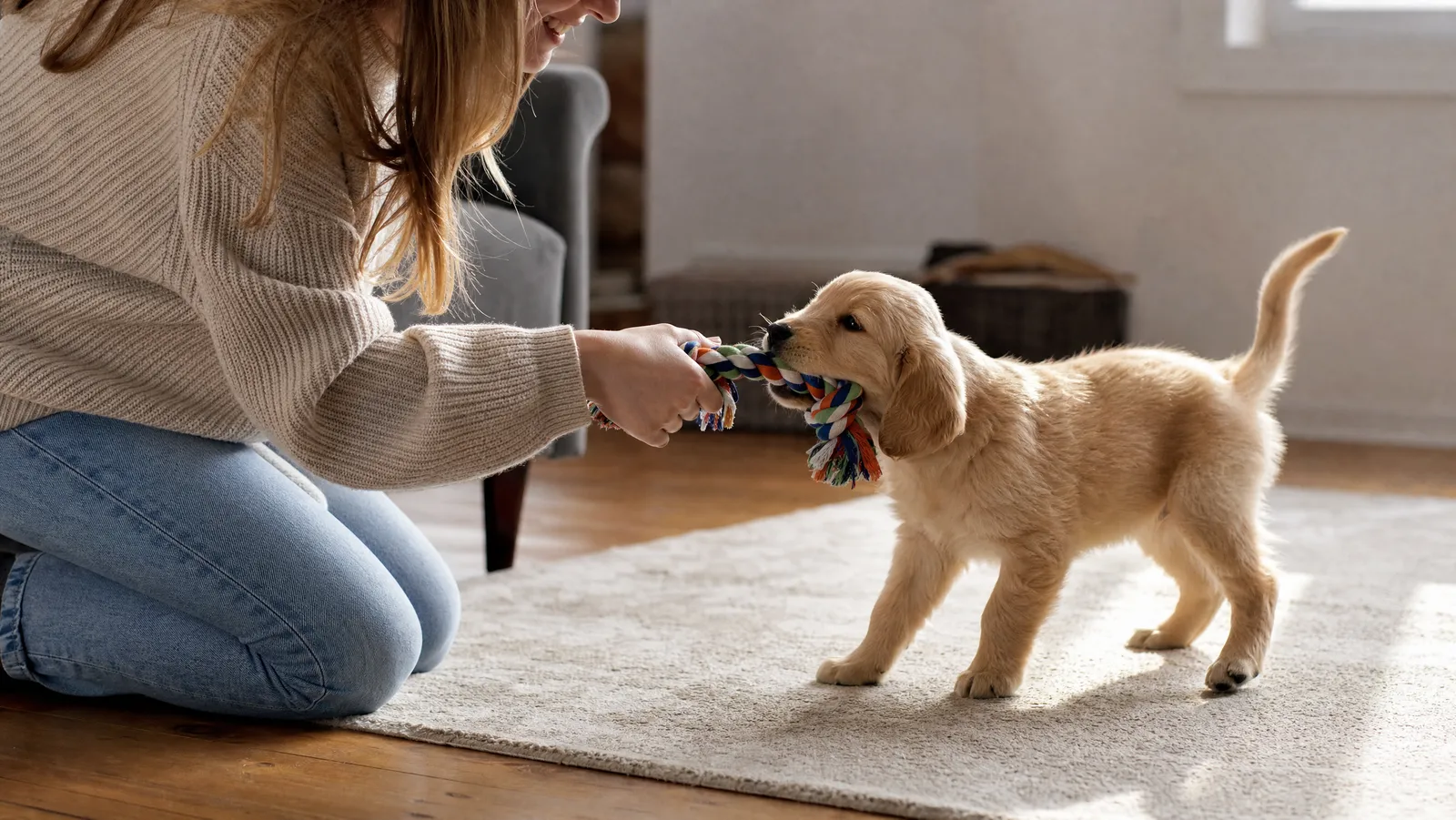
The AKC's suggestion for tug-loving dogs is to carry a tug toy and stop to tug before the dog starts biting the leash. The Coachi Puppy and Mini Tuggi Tug is about $16 as of November 2026, and Coachi says it can help interrupt play biting and chewing.
- 3
Play tug with rules, not with the leash
The AKC's article on tug, quoting trainers Dianna L. Santos, KPA-CTP, CPDT-KA, CNWI and Dr. Erica C. Boling, CCFT, says tug games do not promote aggressive or dominant behaviours, and that letting a dog win does not mean the dog is dominating you — so the old always-win-the-tug advice is dominance framing, and we would ignore it. Santos suggests keeping each tug short, around 10 to 15 seconds, with a trained drop cue, and Boling advises only light resistance with young puppies. VCA Hospitals adds that tug is only acceptable while it stays under your control, and that the game stops the moment teeth touch skin or clothing.
- 4
Pay the empty mouth, generously and fast
A loose mouth has to earn more than a full one. The AKC's guide asks you to carry high-value treats and reward loose-leash walking, staying close, looking at you and checking in — and adds a reward most owners miss, saying that stopping to sniff can be rewarded because it is calming for dogs. Timing is the hard part, which is the argument for a magnetic treat pouch at about $10 as of November 2026, opened and closed with one hand.
- 5
End the walk before arousal peaks
If the grab happens at minute four of every walk, the walk is three minutes long for now. The AKC's broader advice is to reduce conflict rather than punish it, avoiding the situations that trigger leash biting while keeping the dog engaged with treats and play. Miller's point about prolonged inactivity cuts the same way: sniffing in the garden first may be what makes the pavement possible.
- 6
Practise indoors, where the leash is the most boring thing in the room
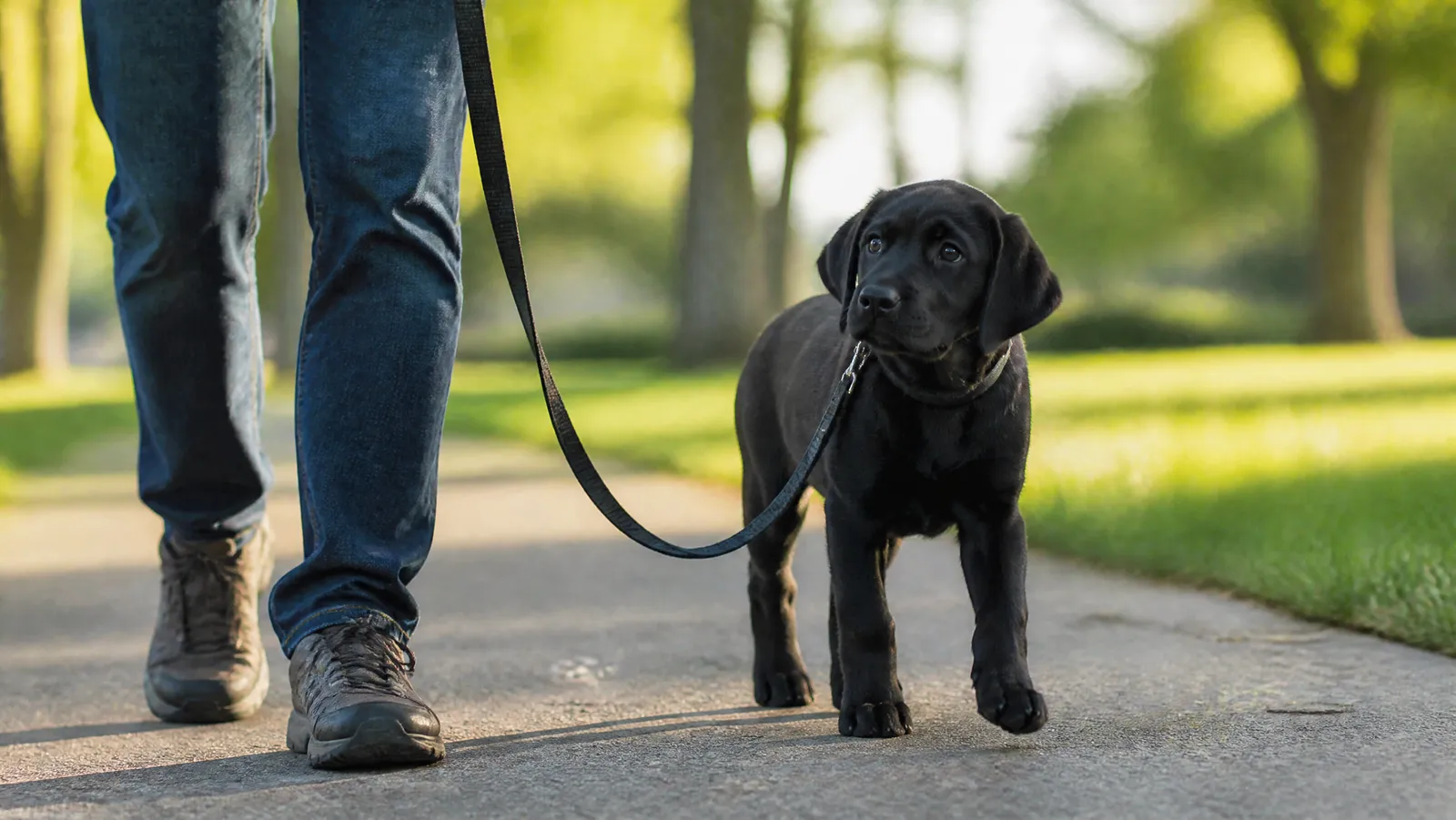
A hallway has no squirrels in it. This is the honest answer to when to start leash training a puppy, because the first stage of leash work has no walking in it: clip the leash on, let it hang, and pay the puppy for standing near your leg while nothing happens. If your puppy cannot keep their mouth off a leash indoors, the street was never going to work.
If It Is Teething
A teething puppy does not need a different rule, just a better thing to chew. VCA Hospitals describes chewing as normal and says it may ease the discomfort of teething, so the job is to make a legal chew available at home, before and after the walk, and keep the lead out of the rotation of things that may be mouthed.
VCA's handout is blunt about the usual chews, saying that because dogs chew nearly everything, nearly everything has been found to cause problems — it names rawhide, pigs' ears, bully sticks, bones, synthetic toys and tennis balls, and points to gastrointestinal blockages, intestinal punctures and choking, while noting that hard objects such as nylon, bones and antlers can break teeth. The rule of thumb it borrows from veterinary dentists is the one to remember: do not let your dog chew anything that will not bend.
Our guides to puppy teething and biting and how to soothe a teething puppy go further on both.
Give the Walk a Job
A walk with no job in it is a walk the puppy has to invent something to do on, and the leash is the nearest available object. That is the real argument for loose leash walking: not the absence of biting, but the presence of something the puppy can succeed at and be paid for every few steps.
VCA Hospitals' play-biting handout makes the same point from the household end, saying the first thing you must do is provide a regular daily routine that includes ample opportunity for play.
The Gear That Helps (and the Gear That Only Hides It)
We did not run a testing panel on these; what follows is how we read the makers' own claims. If you are buying a lead from scratch rather than replacing a chewed one, the best leashes for puppies is the broader comparison.
Coachi Puppy and Mini Tuggi Tug — the one that does training work
The Coachi Tuggi Tug, about $16 as of November 2026, is the only product here with a job in the protocol above. Coachi says it can help interrupt play biting and chewing and also works as a reward for recall and agility. Coachi describes it as a soft, stretchy toy on extra-strength webbing, designed for puppies and smaller mouths. Two limitations: Coachi says to keep it as interactive play only, because a tug left on the floor stops working as a reward, and $16 is real money for a toy that will not grow with a large-breed dog.
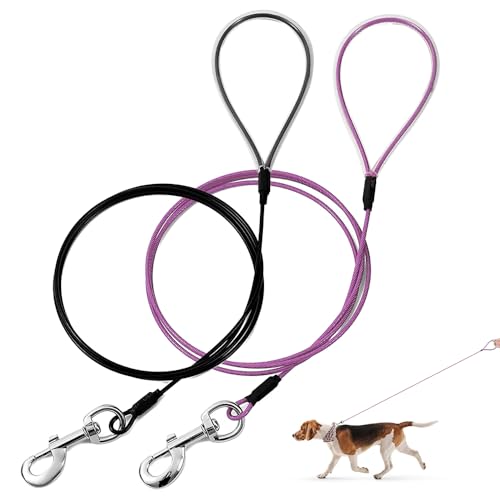
Mighty Paw Anti-Biting Chew-Proof Metal Cable Leash — damage control, bought on purpose
Mighty Paw markets the anti-biting cable leash specifically for teething puppies, and says the steel-braided cable is something even aggressive chewers cannot break through. Mighty Paw lists an ultra-soft padded handle, and rates the aviation aluminium carabiner to 850 lbs of force. About $15 as of November 2026. The limitation is this article's whole point: a chew-proof leash manages the symptom and teaches the puppy nothing instead. The second limitation is physical — steel cable does not flex, so it swings and can knock a small puppy's legs.
Mi Metty Chew-Proof Coated Wire Rope Leash — the cheaper version of the same bargain
The Mi Metty wire rope lead is the same trade at a lower price, about $10 as of November 2026. Mi Metty says the coated wire rope is something heavy chewers and teething puppies cannot break through, in a six-foot length, with a zinc alloy clip that rotates a full 360 degrees so the cable does not wind or knot. The limitations are what the price pays for: no padded handle appears anywhere in the maker's feature list, and a zinc-alloy clip is heavier hardware than a small puppy needs on their collar.
heouvo Magnetic Silicone Treat Pouch — the thing that makes the timing possible
Nothing above works if the reward arrives three seconds late. Two magnets give the heouvo pouch a one-handed open and close, so you can pay in the half-second the puppy's mouth is empty. heouvo says the food-grade silicone is free from bisphenol and takes wet, dry or frozen food, in a 5 by 4 by 2 inch body it lists at 1.67 cups. About $10 as of November 2026. Limitations: 1.67 cups is a session's worth of treats rather than a day's, and the silicone holds the smell of wet food even after rinsing.
When this becomes a vet or behaviourist call
Most leash biting is ordinary puppy behaviour, but some versions belong with a professional. The ASPCA says that if you suspect the biting is aggressive rather than playful, consult a qualified professional such as a CAAB, ACAAB or Dip ACVB behaviourist, and notes that an aggressive dog's body often looks stiff where a playful dog's is relaxed. We would book a vet rather than a trainer if the biting is escalating in force, if your puppy seems painful around the mouth, or if they cannot settle at all. The AKC's teething timeline also asks owners to tell a vet about any baby teeth still in place once the adult teeth are through.
The Bottom Line
Watch the five seconds before the grab, because they tell you which problem you have. A puppy who grabs in the first minute is over-aroused and needs the energy to go somewhere legitimate. A puppy who grabs at the same corner every time is frustrated, and needs the pressure released and a different route. A puppy inside the twelve-to-sixteen-week window the AKC describes who is also chewing the furniture may be teething, and needs a better chew at home.
The answer is the same shape in all three cases: the leash goes dead and boring, a toy you brought on purpose becomes the interesting thing, and the empty mouth gets paid. A chew-proof cable leash is worth the money to stop replacing leads, and it is not training. For the sequence this fits into, start with our full leash training guide.
Our top picks

The only product here that does training work rather than damage control. Coachi says the Tuggi Tug can help interrupt play biting and chewing and works as a reward for recall, and that it is designed for puppies, gentler dogs and dogs with smaller mouths. It is a soft, stretchy toy built on extra-strength webbing, which Coachi positions as an alternative or an addition to food rewards.
What we love
- Coachi says it can help interrupt play biting and chewing — the exact job this problem needs
- Soft and stretchy on extra-strength webbing, so the give is in the toy rather than in the puppy
- Coachi designed it for puppies, gentler dogs and smaller mouths rather than shrinking a big-dog tug
- Also sold as a recall and agility reward, which is why it earns a pocket on every walk
Keep in mind
- Coachi says to keep it as interactive play only — left on the floor it stops working as a reward
- About $16 is a lot for a tug toy, and it is sized for puppies and small mouths rather than growing with a big dog

Damage control, bought on purpose. Mighty Paw markets this one specifically as an anti-biting leash for teething puppies, and says the steel-braided cable is something even aggressive chewers cannot break through. The parts you notice day to day are the ultra-soft padded handle and the aviation aluminium carabiner Mighty Paw rates to 850 lbs of force.
What we love
- Steel-braided cable that Mighty Paw says even aggressive chewers and teething puppies cannot break through
- Ultra-soft padded handle, which matters more than it sounds once the walk runs long
- Aviation aluminium carabiner Mighty Paw rates to 850 lbs of force
- Doubles as a tie-out, so it is not a single-purpose purchase
Keep in mind
- It manages the symptom — it does not teach the puppy what to do with their mouth instead
- Steel cable does not flex, so it swings and can knock a small puppy's legs
The cheaper way to stop replacing leashes. Mi Metty says the coated wire rope is something heavy chewers and teething puppies cannot break through, in a standard six-foot length. The detail worth paying for is the high-grade zinc alloy clip, which rotates a full 360 degrees so the cable does not wind or knot behind a puppy who keeps changing sides.
What we love
- Coated wire rope that Mi Metty says heavy chewers and teething puppies cannot break through
- Clip rotates 360 degrees, so the cable does not corkscrew on a puppy who weaves
- Six feet long, which is the everyday walking length rather than a specialist one
- Mi Metty describes itself as a factory producing wire-rope leashes in a range of sizes, so the line can match the dog
Keep in mind
- No padded handle appears anywhere in the maker feature list
- A zinc-alloy clip is heavier hardware than a small puppy needs hanging off their collar

Unglamorous, and it decides whether any of the above actually happens. Two built-in magnets give a one-handed open and close, so the reward lands while the puppy's mouth is still empty rather than three seconds later. heouvo says the food-grade silicone is free from bisphenol and takes wet, dry or frozen food, in a 5 by 4 by 2 inch body the maker lists at 1.67 cups.
What we love
- Magnetic one-handed closure, so you can pay a loose mouth in the half-second it is loose
- Food-grade silicone heouvo says is free from bisphenol and takes wet, dry or frozen food
- A training clicker is in the box, so the marker and the payment live in the same place
- Waist belt adjusts from 25 in to 47 in rather than relying on a plastic belt clip
Keep in mind
- 1.67 cups is a session's worth of treats, not a day's
- Silicone holds the smell of wet food even after rinsing
Frequently asked questions
Why does my puppy bite the leash?
Usually one of three things, and credentialed sources weight them differently. The AKC's guide to dogs that tug on leashes, written by trainer Sassafras Patterdale, CPDT-KA, CTDI, calls leash biting "often a symptom of a dog being frustrated" and also names boredom, attention-seeking, and dogs who have not yet learned what leash walking involves. VCA Hospitals, in a handout by Debra Horwitz, DVM, DACVB and Gary Landsberg, DVM, DACVB, says nipping and mouthing in young dogs is generally a form of social play. Teething is the third candidate, and VCA links it more to household objects than to leashes.
Should I pull the leash out of my puppy's mouth?
We would not, because a rope that pulls back is a tug toy. The ASPCA's advice for a puppy who ambushes your ankles is the same mechanic in reverse: stop moving, wait for the puppy to calm down, and reward that. It also says not to jerk your hands or feet away, and to let them go limp instead. The AVSAB's humane dog training position statement goes further on the general principle, naming leash jerks among the aversive methods it says should not be used in canine training.
Is my puppy biting the leash because they are teething?
Possibly, but it is the least likely of the three causes on a walk. VCA Hospitals says nipping and mouthing in young dogs is generally social play, and that teething is more likely to involve gnawing or chewing on household objects. The timing is checkable. VCA's teething handout says deciduous teeth start falling out at around 12 weeks as permanent teeth erupt, and the AKC puts the shedding window at weeks 12 to 16 and calls the process painful. If the leash biting started inside that window and your puppy is chewing everything else too, teething is a reasonable guess.
Does playing tug make leash biting worse?
Played with rules, the evidence does not support that worry. The AKC's article on tug, which quotes trainers Dianna L. Santos, KPA-CTP, CPDT-KA, CNWI and Dr. Erica C. Boling, CCFT, says tug games do not promote aggressive or dominant behaviours, and that letting a dog win does not mean the dog is dominating you. Santos suggests keeping tugs relatively short, around 10 to 15 seconds, with a trained drop or out cue. Boling advises only light resistance with young puppies. VCA Hospitals adds the condition that tug games are only acceptable if they remain under your control.
Will my puppy grow out of biting the leash?
The AKC says leash biting is a phase many puppies go through and usually grow out of, while also noting it can develop at any age — so it is a tendency, not a promise, and we would not wait it out. VCA Hospitals says excessive chewing in general often eases at around 18 months but may continue to some degree for life. What you do in the meantime still matters, because a grab that reliably stops the walk or starts a game is a grab the puppy is being paid for.
About the author
James Martin
I'm an animal lover through and through. I grew up with dogs, my family always had at least one pet, and today I share my home with a rescue who is the love of my life. I started Healthy Puppy Review to help owners cut through the marketing noise and make confident, well-researched choices about their dog's health and happiness.