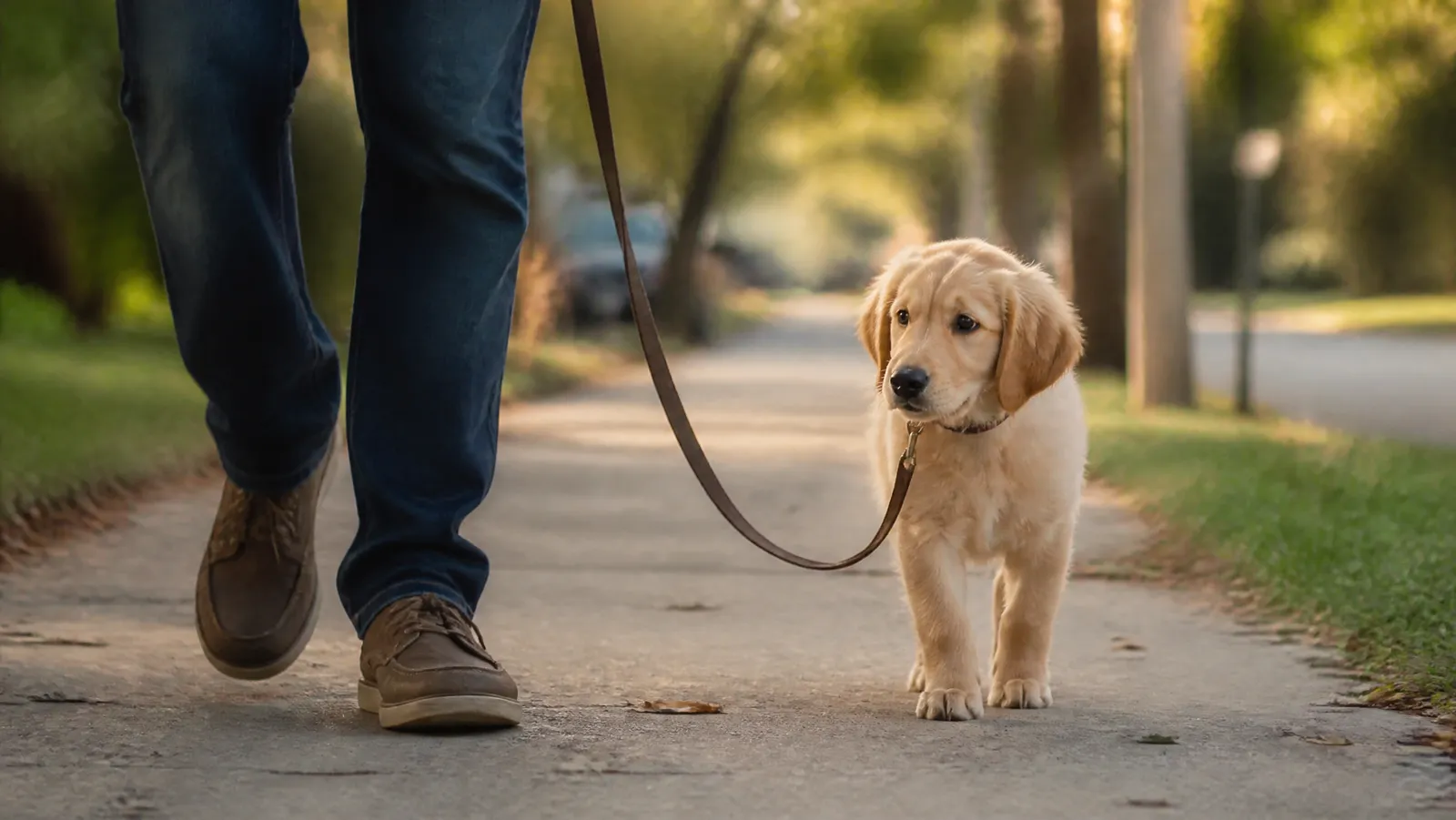
Puppy Collar vs Harness: Which Should You Start With?
A flat collar carries the ID tag. A harness takes the leash. That split is what the evidence actually supports, and it is cheaper than it sounds. Here is the case for each, what the research does and does not show, how to fit both, and the five we would buy.

Contains affiliate links · our policy

In this guide
- The Case for Starting With a Collar
- The Case for Starting With a Harness
- What the Evidence Actually Supports
- Our Verdict: Both, With Different Jobs
- Puppy Leash Training: Collar or Harness for the First Walks?
- Getting the Fit Right
- The Collars We Would Buy
- The Harnesses We Would Buy
- The Bottom Line
- Our Top Picks
- FAQ
For most puppies, the puppy collar vs harness question has a boring answer: both, with different jobs. A flat collar carries the ID tag and lives on the neck all day. A harness takes the leash, because the leash is where the force goes. Here is the reasoning on each side, and how to fit either one.
We may earn a commission from links on this page, at no extra cost to you.
That split is not a dodge, and it is not expensive — about $6 for a collar and $16 to $22 for a harness as of October 2026. It stops you asking one piece of nylon to do two unrelated jobs: carrying ID, and absorbing a 12-week-old's lunge at a pigeon. If you are starting from zero, read this next to leash training a puppy from scratch — the gear is a small part of the outcome and the training is the rest.
The Case for Starting With a Collar
A flat collar is the simplest thing you will ever buy for a dog, and simplicity is most of the argument. It goes on in two seconds, it stays on, and it holds the tag that gets your puppy home. The AKC describes standard flat collars as among the most readily available dog products, and as easy to put on and take off, comfortable and long-lasting; it also says that depending on your dog's size a collar may give you better control and require less physical strength than a harness.
The AKC is also more conservative about early leash work than harness marketing suggests. For puppies just learning to walk on a leash, it says, it is best to stick with a standard dog collar, and it notes that many trainers recommend beginning with a four-foot leash and a flat collar. If you are hunting for the best collar for puppy leash training, that is the entire specification: flat, standard, and wide enough not to dig in.
The honest limitation. A collar is a single point of contact on a vulnerable part of a dog's body, and it is escapable. The AKC notes that dogs whose heads are smaller than their necks — Greyhounds, Whippets — can slip straight out of one. Puppies back out too, usually at the worst moment.
The Case for Starting With a Harness
The argument for a harness is about where force lands.
Carter, McNally and Roshier, in Veterinary Record in 2020, put seven collars and a slip lead on a pressure-sensored model of a dog's neck and applied forces representing a firm pull of 40 newtons, a strong pull of 70 newtons and a jerk of 141 newtons. The collars exerted between 83 and 832 kPa, and the researchers reported that no single collar tested provided a pressure low enough to mitigate the risk of injury when pulling on the lead. Their recommendation: train the dog to walk on a loose lead, or use a harness that applies no pressure to the neck.
So is a harness better than a collar for a puppy? For the leash specifically, probably. The AKC agrees in practice, saying that if your dog tends to tug on their leash a harness may be a better and more comfortable option, and that a back-attachment harness suits small dogs because it can prevent potential throat damage if your dog pulls and makes it less likely the leash will catch under the legs. A well-fitted harness is also harder to back out of, though the AKC notes that one which is too big lets a dog wiggle out.
The honest limitation. The AKC points out that harnesses can be harder to put on and take off, and that one which is too tight can be painful or uncomfortable, especially in hot weather. Too big, and the dog wiggles out.
What the Evidence Actually Supports
This topic attracts confident claims in both directions.
"Collars crush a puppy's windpipe." Overstated, but not invented. The 2020 study measured pressure on a plastic cylinder, not injuries in living dogs, and we found no research quantifying how often pet dogs are actually hurt by flat collars. What it supports is narrower: the forces in a hard pull are higher than people assume, and no tested design engineered them away. A puppy who never hits the end of the leash is exposed to none of it, which is why the researchers put loose-lead training first.
"Harnesses teach dogs to pull." We found no peer-reviewed study testing this. The usual explanation is the opposition reflex — the BC SPCA quotes trainer Lynn Gagnon describing dogs as pulling against whatever pulls them, and trainer Carol Millman noting that leash pulling is a habit that usually starts in puppyhood. That reflex does not care what the leash is clipped to. Our reading: a back clip makes pulling more comfortable, not more likely.
The real case against harnesses is about gait. Lafuente, Provis and Schmalz, in Veterinary Record in 2019, measured shoulder extension in nine dogs on a treadmill. Both harness types significantly reduced it compared with no harness — the one exception being the restrictive harness with added weights — and, in the authors' words, perhaps not in the way originally anticipated: the non-restrictive design reduced extension more, by 2.6 degrees at walk and 4.4 at trot. A 2024 study by Dowdeswell and Churchill of University Centre Reaseheath, published in the undergraduate research journal Reinvention, filmed 30 dogs in six harness types and found the front-clip design allowed the least shoulder and elbow movement.
Veterinary sports medicine specialist Christine Zink, who argues that front-clip straps sit over the biceps and supraspinatus tendons, told Whole Dog Journal: "I do not believe that there is a harness on the market that is nonrestrictive and that also helps the dog not to pull." Trainer Pat Miller answers in the same piece: "An owner can't train a dog to walk on leash if she is getting dragged off her feet."
Both are right. These are small studies measuring a few degrees, none of them linked to an injury in a pet dog and none run on puppies. The evidence is thin, and it does not override the force argument.
We will not hedge on aversive hardware, though. The AVSAB's 2021 humane dog training position statement holds that reward-based methods should be used for all canine training and that aversive methods should not be used, adding that there is no evidence aversive methods are more effective in any context. Prong, choke, slip and shock collars are out of this comparison.
Our Verdict: Both, With Different Jobs
Buy a flat collar and never clip the leash to it while your puppy is learning. It wears the tag, and it is what you grab if a door opens unexpectedly.
Buy a harness and clip the leash to that. For a puppy who cannot yet out-pull you, a back clip on a well-fitted harness is plenty. Move to a front clip when you genuinely need steering — if you are being towed, the PetSafe Easy Walk at about $22 as of October 2026 is the design most trainers know how to fit.
The limitation of our verdict. Two purchases, two things to fit, two things to outgrow. And because of the gait research, we would take a no-pull harness off at home rather than leave it on all day — which is exactly why the collar stays. For the rest of the first-week kit, see our must-have toys for a new puppy.
Puppy Leash Training: Collar or Harness for the First Walks?
Whichever you buy, the gear goes on indoors first, long before you need it. Battersea's approach is to offer the collar in your hand or place it on the floor and reward any calm sniffing or interest, and to keep sessions short; if your dog freezes, panics or growls, it says to stop and seek support. Then you buckle it for a minute during something good — dinner, a game — and build from there. A harness takes longer, because it involves legs and a head. For the timing question in full, see when to start leash training a puppy.
The outdoor timing is genuinely contested, and we are not going to flatten it. The AVSAB's puppy socialization position statement argues that it should be the standard of care for puppies to receive socialization before they are fully vaccinated, on the basis that behavioral problems — not infectious disease — are the leading cause of death in dogs under three years of age. The same statement says puppies can start socialization classes as early as seven to eight weeks of age, with a minimum of one set of vaccines at least seven days before the first class and a first deworming. Plenty of vets still prefer to keep puppies off public ground until the course is finished. That call belongs to your own vet.
A puppy who grabs and shakes the leash is usually just mouthing, and the fix lives in how to stop puppy biting. The collar-and-leash habit itself forms fastest on garden potty trips, which are already in your puppy potty training schedule.
Getting the Fit Right
Fit matters more than brand, and most owners set it once and never revisit it.
- 1
Measure the puppy standing up
Two numbers: neck girth where the collar sits, and chest girth at the widest part of the rib cage just behind the front legs. Take both with the dog standing: PetMD advises standing your dog straight up with the head facing forward, because sitting or lying down bunches the skin and shifts the rib cage.
- 2
Buy to the maker's chart, not to the breed
Sizing bands are not standardised. PetSafe stresses measuring to its chart rather than guessing by breed or weight, and makers set their own bands — BINGPET's step-in is a 14.5 to 16 inch chest in S.
- 3
Run the finger test
The AKC's check is one finger between skin and collar on a small dog, two on a large breed, and it applies the same rule to harnesses. BINGPET says to leave one to two fingers of space. Test at the neck and again at the chest strap.
- 4
Check the escape angle before you go out
With the harness on, pull gently backwards the way a startled puppy would. The AKC warns that a harness which is too big lets a dog wiggle out.
- 5
Re-check weekly
Every strap on an adjustable harness is one that can be out of date.
Puppies outgrow gear faster than you will remember to check
Puppy sizing bands are narrow. Joytale's X-Small collar covers an 8 to 12 inch neck; BINGPET's small step-in covers a 14.5 to 16 inch chest. A growing puppy crosses a band like that in weeks, and the AKC notes that a harness which is too tight can be painful or uncomfortable, especially in hot weather. Run the finger test weekly, and accept that you will buy the cheap collar twice.
The Collars We Would Buy
Our method, briefly: we did not run a testing panel, and we are not going to tell you we fitted forty collars. We took the fit criteria above, read what each maker claims, and kept the products sold in genuine puppy sizes with their limitations stated on the listing. Prices are approximate, as of October 2026.
The Joytale Feather-Light Puppy Collar, about $6, is what we would put on a brand-new puppy: 3/8 inch of high-density nylon Joytale calls soft and lightweight, with burr-free edges to prevent chafing, a one-second quick-release buckle and a weatherproof metal D-ring. The 360-degree double-sided reflective stitching still shows when the collar has rotated. Joytale's own listing makes our argument for us: it says the collar is not recommended for heavy pullers or tie-outs, and advises a harness instead.
The BOOMIBOO Reflective Adjustable Puppy Collar is the same roughly $6 with a longer runway — six sizes from a 3/8 inch XXS to a 1 inch XL, so one brand can follow a Labrador to adulthood. You get highly reflective threads, a curved quick-release ABS buckle, a chrome-coated D-ring and a separate loop for tags. The catch: the bands overlap, with XXS and XS both covering an 8 to 12 inch neck, so you have to measure rather than guess.
The Harnesses We Would Buy
Three harnesses, three different problems — not a ranked list.
The PetSafe Easy Walk, about $22, is the front-clip standard, created by a veterinary behaviorist in 2004 according to PetSafe. A patented martingale loop that PetSafe says applies gradual pressure to the shoulders pairs with a front attachment that turns the dog back toward you, and the strap rests across the chest rather than the throat — which PetSafe says stops the gagging and choking you get when a dog pulls against a collar. Two caveats: it works by tightening, so we would take it off at home, and this listing is the Medium, with PetSafe emphatic about measuring to its chart.
The PoyPet No-Pull Harness, about $16, is the pick for a puppy who objects to things going over their head: a lockable quick-snap buckle on the neckline means it does up around the dog instead. You get both attachment points — a front clip the maker says discourages pulling, a back clip for relaxed walks — plus mesh padding, dual elastic belly straps to absorb jerks, and four-way adjustment with room for growth. The trade-off is setup: three buckles and four adjustment points is fiddly, and all need re-checking as the puppy grows.
The BINGPET Step-In Harness, about $17, removes the head from the equation — the puppy steps in, and the straps close with a hook-and-loop fastener. It comes as a set with a 5ft anti-tangle swivel leash and a 24 to 32 inch car tether, and the mesh is machine washable. Watch the bands: S fits a 14.5 to 16 inch chest, M fits 16 to 18 inches, and BINGPET says it is not recommended for large dogs.
The Bottom Line
Buy both, and give each one job. The collar wears the tag and never takes the leash while your puppy is learning. The harness takes the leash, because a 2020 Veterinary Record study found no collar it tested kept neck pressure low enough to mitigate the risk of injury when a dog pulls on the lead.
A Joytale puppy collar at about $6 plus a PoyPet harness at about $16 is a complete kit for roughly $22 as of October 2026. Then do the part the hardware cannot: measure before you buy, run the finger test every week, and teach a loose lead. That work is laid out in our full guide to leash training.
Our top picks


BOOMIBOO Reflective Adjustable Puppy Collar with Quick-Release Buckle (Small)
A deliberately minimal first collar: 3/8 inch of high-density nylon that Joytale describes as soft and lightweight, with smooth burr-free edges meant to stop chafing on a neck that has never worn anything. The 360-degree double-sided reflective stitching is the detail we like, because it still shows if the collar rotates. A one-second quick-release buckle and a weatherproof metal D-ring cover the only two jobs we want a puppy collar doing.
What we love
- Burr-free edges on high-density nylon the maker calls soft and lightweight
- 360-degree double-sided reflective stitching stays visible even if the collar twists
- One-second quick-release buckle and a weatherproof metal D-ring for ID tags
- Smooth slider adjustment, and Joytale suggests looping the excess strap back through the slider to lock the size
Keep in mind
- Joytale explicitly says it is NOT recommended for heavy pullers or tie-outs and advises a harness instead — which is exactly the split we recommend, but it does mean this is not your walking gear
- X-Small is 3/8 inch wide for an 8 to 12 inch neck, a narrow band that a fast-growing breed passes through quickly
The same money as our first pick, with a much wider size ladder behind it — six widths from a 3/8 inch XXS up to a 1 inch XL. BOOMIBOO describes the webbing as high-density nylon that is smooth and soft against pet skin, with highly reflective threads for low light, a curved quick-release ABS buckle and a chrome-coated metal D-ring. A separate loop keeps tags and a leash clip from fighting for the same ring.
What we love
- Six sizes from XXS to XL, so the brand follows a puppy up rather than being outgrown in a month
- Highly reflective threads for night and low-light visibility
- Curved quick-release ABS buckle, described as shaped for comfort
- A separate loop for tags, so the D-ring is not doing two jobs at once
- High-density nylon webbing the maker describes as smooth and soft against pet skin
Keep in mind
- The size bands overlap — XXS and XS both cover an 8 to 12 inch neck at different widths — so BOOMIBOO's instruction to measure the neck before ordering is not optional
- Sizing is driven by measurement rather than age, which means a fast-growing puppy moves up the chart and you buy again

The front-clip design most trainers will have handled, created by a veterinary behaviorist in 2004 according to PetSafe. A patented martingale loop that PetSafe says applies gradual pressure to the shoulders works with a front leash attachment to steer the dog back toward you, and the strap rests across the chest rather than the throat — which PetSafe says stops the gagging and choking that happens when a dog pulls against a collar. Quick-snap shoulder straps and a differently coloured belly strap make the first fitting less of a puzzle.
What we love
- Front leash attachment that guides the dog back toward the handler rather than letting it lean forward
- Rests across the chest rather than the throat, which PetSafe says stops gagging and choking if the dog pulls
- Quick-snap shoulder straps and a colour-coded belly strap to make fitting easier
- Less coverage than many harnesses, so it is lightweight and breathable
- Designed by a veterinary behaviorist in 2004, per PetSafe
Keep in mind
- The no-pull action comes from a martingale loop that tightens under pressure, so it is a pressure-based design rather than a plain flat harness — we would use it for walks and take it off at home
- PetSafe stresses measuring to its sizing chart rather than guessing by breed or weight, and this listing is the Medium, which is too much harness for a very small puppy

The pick for a puppy who hates things going over their head: a lockable quick-snap buckle on the neckline means this one opens right up and does up around the dog instead. You get two metal attachment points — a front clip the maker says discourages pulling and a back clip for relaxed walks — which is the flexibility we want while a puppy is still learning. It is mesh padded with pressure distributed across the body, and the belly straps use dual elastic to absorb jerks.
What we love
- Lockable quick-snap neck buckle, so nothing has to go over the puppy's head
- Two metal leash points: front clip to discourage pulling, back clip for relaxed walks
- Mesh padded, with pressure the maker says is distributed across the body to prevent choking
- Four-way adjustable straps with room for growth
- Padded handle and reflective stitching
Keep in mind
- Three buckles plus four-way adjustment makes the first fitting fiddly, and every strap is one more thing to re-check as the puppy grows
- The dual elastic on the belly straps is there to absorb jerks, which also means the fit gives a little under load — worth a mid-walk check

A step-in vest where nothing goes over the puppy's head, sold as a three-piece set: the harness, a 5ft anti-tangle swivel leash with a padded handle, and an adjustable 24 to 32 inch car tether. The neck and chest straps adjust with a hook-and-loop fastener, the mesh is breathable and quick-dry, and the whole thing is machine washable — which matters more in the first month than anyone expects.
What we love
- Step-in design means nothing passes over the puppy's head
- Breathable quick-dry mesh and machine washable
- Reinforced D-rings and reflective stitching
- Three-in-one set: harness, 5ft anti-tangle swivel leash and a 24 to 32 inch car tether
- Adjustable neck and chest straps, and the maker says to leave one to two fingers of space
Keep in mind
- Tight size bands — size S fits a 14.5 to 16 inch chest and M fits 16 to 18 inches — and BINGPET says it is not recommended for large dogs, so a big breed outgrows the range fast
- The adjustment relies on a hook-and-loop fastener rather than buckles, which is one more thing to check before every walk
Frequently asked questions
Should a puppy wear a collar or a harness?
Most owners end up using both, and the AKC's guidance splits them by job rather than naming a winner. The AKC says a collar may give you better control and require less physical strength depending on your dog's size, and that if your dog tends to tug on their leash a harness may be a better and more comfortable option — adding that a back-attachment harness can prevent potential throat damage if your dog pulls. On leash training specifically the AKC is more conservative, advising that for puppies just learning to walk on a leash it is best to stick with a standard dog collar. Our own split is collar for the tag, harness for the leash.
Can a collar hurt a puppy's throat?
It can apply more pressure than most owners expect. Carter, McNally and Roshier, writing in Veterinary Record in 2020, tested seven collars and a slip lead on a pressure-sensored model neck at forces representing a firm pull, a strong pull and a jerk. The collars exerted between 83 and 832 kPa on the model, and the authors reported that no single collar tested provided a pressure low enough to mitigate the risk of injury when pulling on the lead. That was a plastic model rather than a live dog, so treat it as a measure of force, not an injury rate.
Do harnesses teach puppies to pull?
We could not find a peer-reviewed study testing that claim either way, which is itself worth knowing. Trainers generally explain pulling through the opposition reflex: the BC SPCA quotes trainer Lynn Gagnon saying that when dogs feel something pulling them, they just pull against it, and trainer Carol Millman saying that leash pulling is a habit that usually starts in puppyhood. A puppy will lean into a collar for the same reason it leans into a harness. The equipment changes where the force lands; the training is what changes the habit.
What size collar or harness does a puppy need?
Measure, then buy to the maker's chart. The AKC's fit check is that you can slip one finger between the skin and the collar on a small dog, or two fingers on a large breed, and it applies the same rule to harnesses. Makers set their own bands: PetSafe stresses measuring to its sizing chart rather than guessing by breed or weight, and BINGPET says to fit by measurement and leave one to two fingers of space. Measure the puppy standing up, because a sitting dog gives a smaller chest reading.
When can a puppy start wearing a collar and going out on a leash?
The gear can go on indoors well before the first walk, in short sessions paired with treats, which is how Battersea suggests introducing a collar. The outdoor timing is the contested part. The AVSAB's puppy socialization position statement argues it should be the standard of care for puppies to receive socialization before they are fully vaccinated, on the grounds that behavioral problems are the leading cause of death in dogs under three years old, and the statement itself says puppies can start socialization classes as early as seven to eight weeks of age, with a minimum of one set of vaccines at least seven days before the first class. Other vets prefer to wait for the full course. Ask yours.
About the author
James Martin
I'm an animal lover through and through. I grew up with dogs, my family always had at least one pet, and today I share my home with a rescue who is the love of my life. I started Healthy Puppy Review to help owners cut through the marketing noise and make confident, well-researched choices about their dog's health and happiness.