Loose Leash Walking: Teaching It From Day One
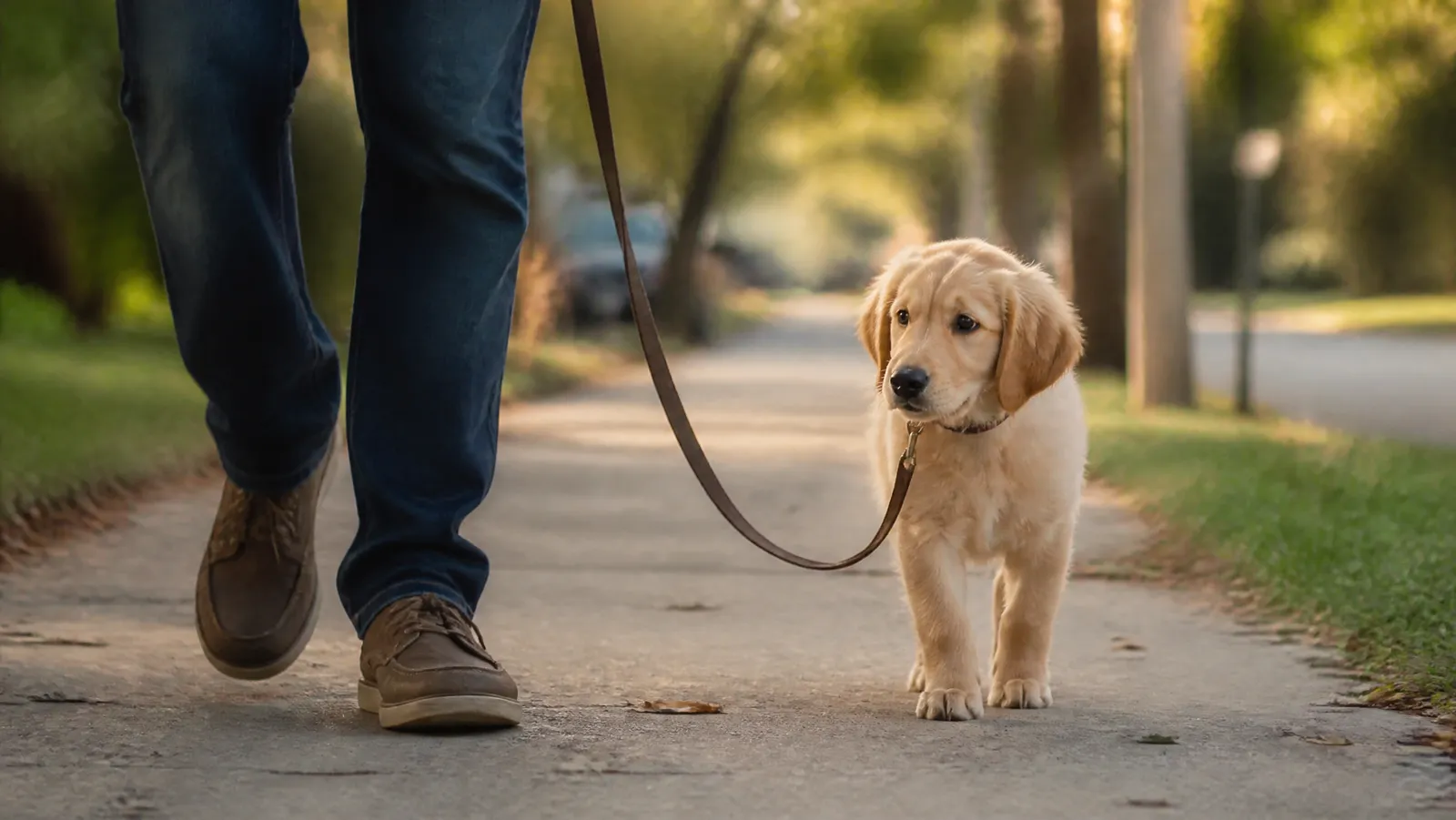
Loose leash walking is one rule applied without exception: slack gets paid, tension stops the walk. Here is the criterion you are actually reinforcing, the indoor foundation that has to come first, and a day-one protocol short enough to run in your hallway tonight.

Contains affiliate links · our policy
In this guide
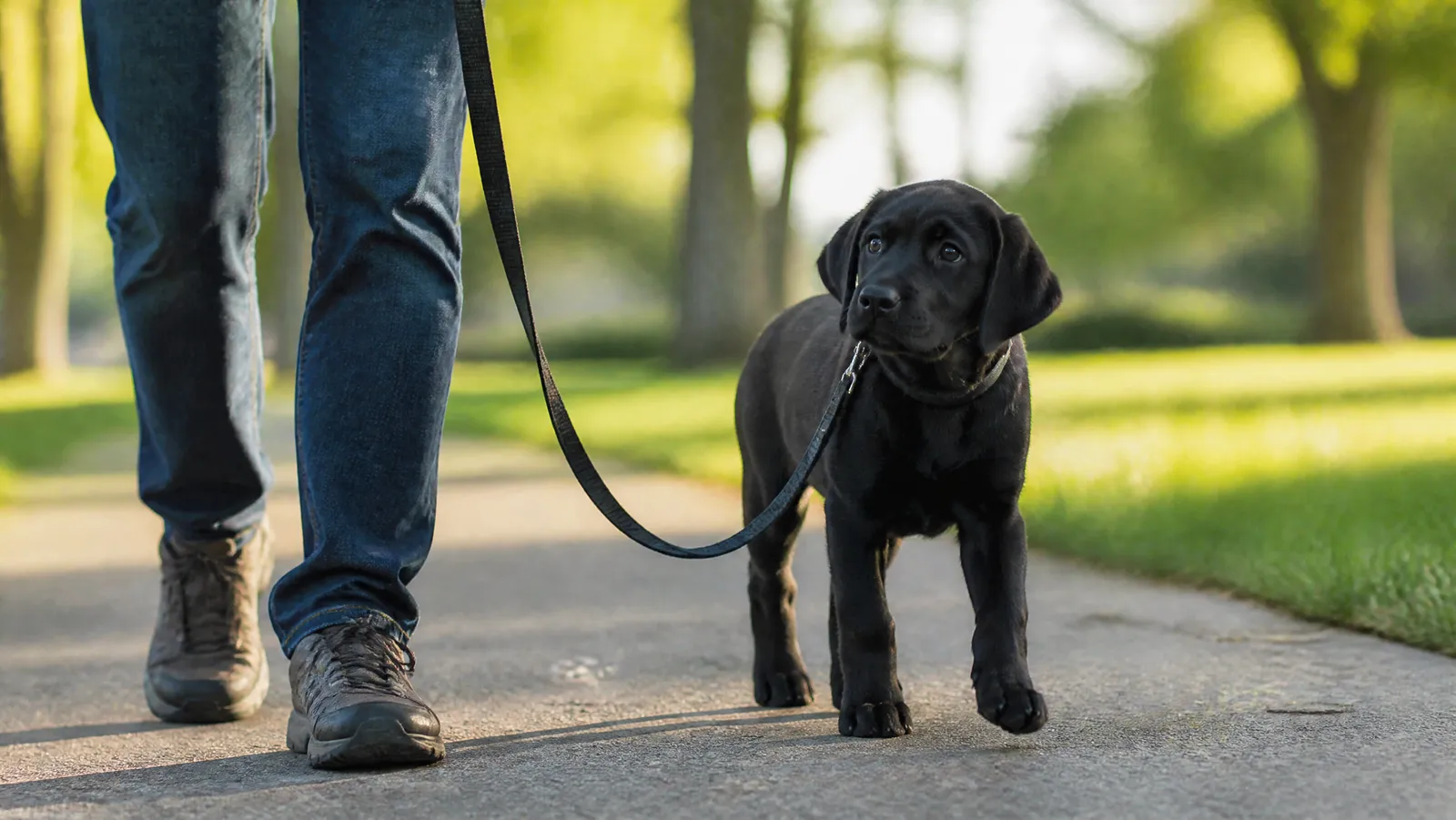
Puppy loose leash training comes down to one rule, applied without exception: you pay for slack, and you stop for tension. A tight leash never produces forward movement. A loose leash produces food. Every drill below teaches that one contingency before the street teaches your puppy the opposite.
We may earn a commission from links on this page, at no extra cost to you.
This is slow work. The AKC calls leash walking a trained skill you will need to teach and keep reinforcing as your puppy grows, and says it can take time for puppies to fully understand, especially around distractions. What follows is the criterion, the indoor foundation and a protocol short enough to run in your hallway tonight. For the whole topic, start with how to leash train a puppy.
What "Loose Leash" Actually Means
Loose leash walking is a position with a tolerance, and most owners never define the tolerance. The AKC's goal is a dog who stays near you and is able to walk at or near your side without pulling — relaxed about geometry, strict about one thing. The Dumb Friends League animal behavior department, in its loose leash walking handout, makes it judgeable mid-step: reward for no tension on the leash, and do not allow pulling a little bit, because it is too difficult for a dog to learn the difference between pulling a little and pulling a lot.
It is not heeling. The same handout calls loose leash walking more relaxed than a formal heel, and says heeling requires the dog to be intensely focused on you, which is very tiring and denies the freedom to sniff and explore that matters for a dog's well-being. Save a heel cue for crossing a street.
Why Puppies Pull in the First Place
Pulling is not defiance. VCA Hospitals, in a handout by Monique Feyrecilde, BA, LVT, VTS (Behavior), Debra Horwitz, DVM, DACVB and Gary Landsberg, DVM, DACVB, gives the plain version: dogs pull to get where they are going. Three facts sit underneath it.
- Your pace is wrong for them. VCA's phrasing is that dogs want to engage with the environment, and from a dog's perspective, humans can be slow.
- The arrangement is artificial. Wearing a leash and being tethered to a human, VCA notes, is not a natural behaviour for dogs.
- Pressure invites leaning. Many dogs will naturally lean in and strain forward when they feel pressure on their collar, VCA adds.
Then the learning starts. Dogs repeat behaviours that have a favourable or meaningful result, VCA says, and a puppy who leans toward a lamp post and arrives at the lamp post has been paid. The encouraging half of the handout is that most pulling can be prevented or reversed using a positive-reinforcement-based training approach. The day-one job is narrow: make sure pulling has never once worked.
Before You Leave the House
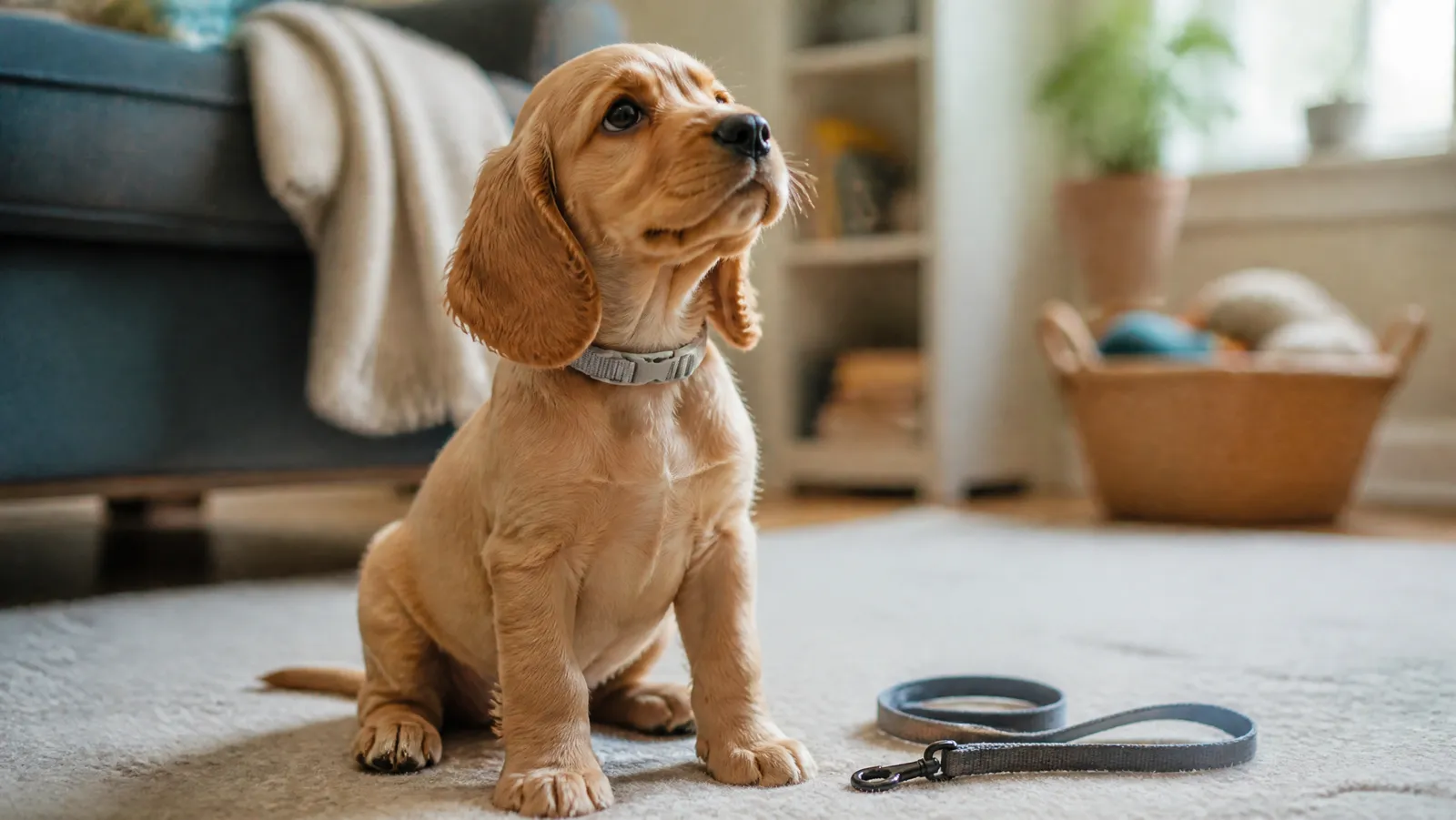
None of this is teachable on a pavement. The answer to when to start leash training a puppy surprises people, because the first stage has no walking in it — the AKC quotes trainer Michele Miller, CPDT-KA, saying they start leash training before even taking a walk.
- 1
Make the harness boring
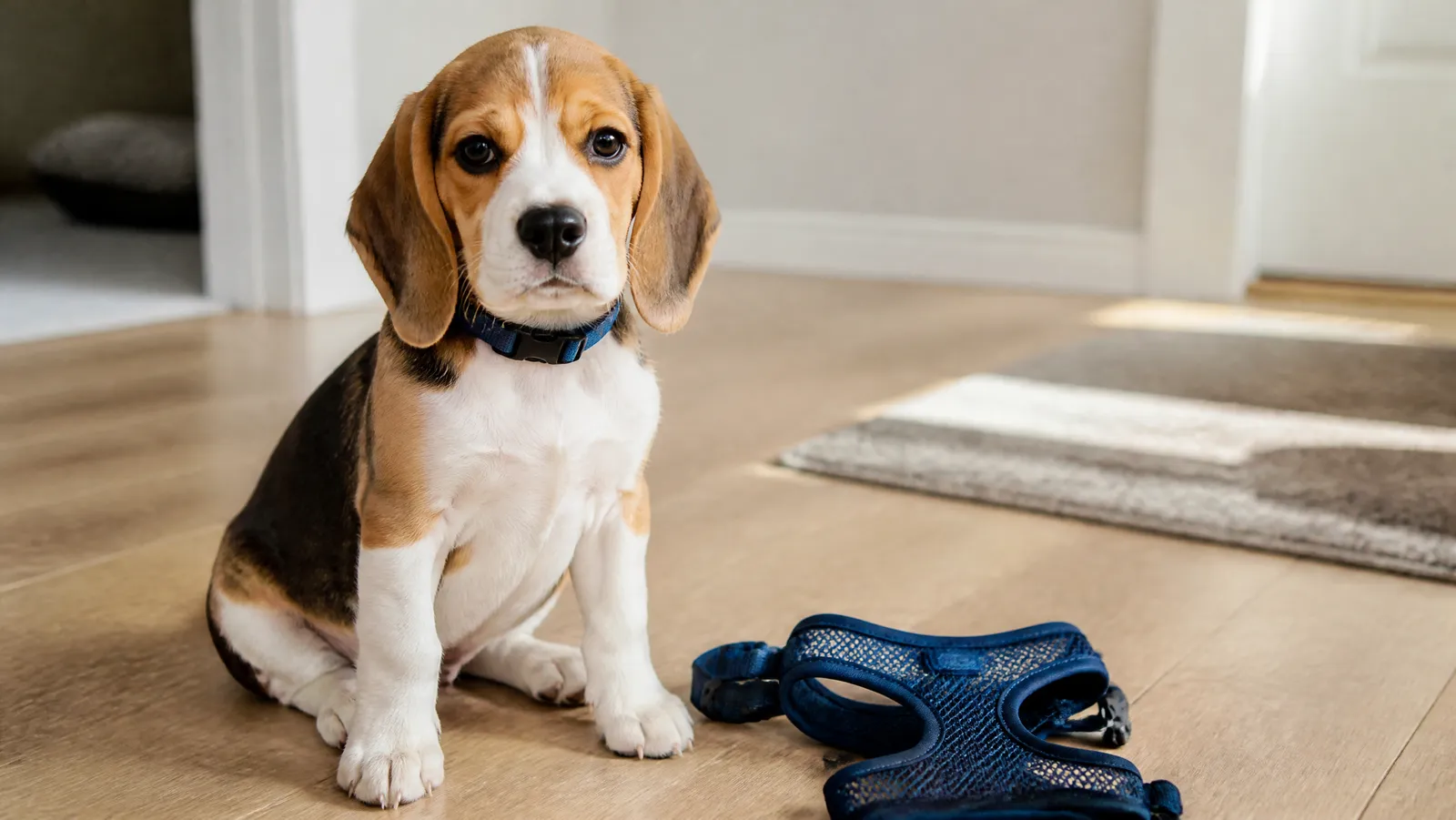
Put the gear on just before something good happens, and take it off after a few minutes for the first several repetitions. The AKC generally prefers a harness for puppies so there is no pressure on the neck if they pull, and says it has to fit well enough that the puppy cannot slip out. The rabbitgoo no-pull harness is about $17 as of October 2026; rabbitgoo asks you to measure rather than guess.
- 2
Load a marker word
Pick a clicker or one short word. The AKC's instruction is to click or say your marker word in a quiet area and immediately give your puppy a treat, and to only use the marker when you have a treat and can reward your puppy. A treat pouch with a clicker in the box, about $10 as of October 2026, keeps marker and payment in one place.
- 3
Pay the spot beside your leg
Before any walking, make the position worth money. Stand still and drop treats beside your shoe, always the same side. The space next to your leg should be dispensing food before the leash ever asks the puppy to be there.
- 4
Get a few steps of following, on a slack leash
The Dumb Friends League calls this magneting: with the puppy on leash, show them a good treat, walk backwards in a safe clear space, coax them along in a happy voice, and click and treat every couple of steps. Once they follow reliably, turn so you both face the same way and walk forward. The leash hangs slack throughout — a safety line, not a steering wheel.
Puppy care guides commonly report that an overtired puppy has little learning left in them, so a nap routine may do as much for leash work as any drill. If that is a fight, crate training is the lever.
The Day-One Protocol
Three minutes, in a hallway, several times a day rather than one long attempt.
- 1
Set the room, then the start position
Start where there are few or no distractions, says the Dumb Friends League, because you will not hold your dog's attention if other pets, children or squirrels are running around. Begin with the puppy beside you and the clip already hanging straight down — the handout starts the dog sitting at your side, then has you step forward and slap your thigh to encourage her to walk with you.
- 2
Pay every one or two steps
Step off, and click and treat every one or two steps as long as your dog is not pulling — the Dumb Friends League's own rate. It feels ridiculous, and it is the whole mechanism: at that rate the puppy never has time to discover that six feet away is interesting. Deliver each treat at the seam of your trousers, not in front of your knee.
- 3
Name the direction, do not steer it
The AKC suggests a cue such as "Let's go" or "With me" to show the puppy you want them to walk with you, plus a cue such as "Turn" so they understand a direction change is coming. Say it, then move. A turn the puppy hears coming does not tighten the leash.
- 4
Red light: when the leash goes tight, nothing happens
This half does the work. The Dumb Friends League's red light, green light method: if she darts out to the end of the leash, stop — do not pull back on the leash, just stop. Wait for your dog to ease up or look back at you. At that second, click, and wait for her to come to you for the treat. Mark the slack, not the stop, or you teach a two-part trick in which the puppy pulls in order to release.
- 5
Stop while it is still going well
The Fear Free Happy Homes handout hosted by the AVSAB says three minutes is plenty long for most dogs, that dogs new to training should get even shorter sessions, and that puppies might only be able to train for one minute at a time because their attention spans are very short. Set a timer for two to three minutes, or pre-count ten to twenty treats. End with your dog wanting more.
Measure the treats out of the day's food rather than adding them to it. VCA Hospitals advises limiting treats to about 10 percent of a dog's daily calorie intake, taking 10 percent of the requirement as a treat budget and feeding the other 90 percent as regular food. At a treat every two steps that goes fast, which is an argument for paying in kibble.
Raising the Bar Without Breaking It
Three things get harder from here: distance from your leg, distraction around you, duration between rewards. The usual failure is raising all three at once by opening the front door.
Karen Pryor's Ten Laws of Shaping state the discipline. The first: raise criteria in increments small enough that the subject always has a realistic chance of reinforcement. The second is the one to tape to the door — "Train one aspect of any particular behavior at a time. Don't try to shape for two criteria simultaneously." The fourth covers the trade: when introducing a new criterion, temporarily relax the old ones.
One variable at a time, and pay for the new one
Moving from the hallway to the yard raises distraction, so everything else comes back down: a treat every step instead of every two, two minutes instead of three, no duration goal. Expect your reward rate to rise outdoors, because the yard competes with you. The Dumb Friends League's troubleshooting rule holds throughout: if your dog continues to pull, you probably need a less distracting environment.
Distance is the last variable we would touch, and it does not belong on a pavement. Real freedom work has its own safety rules, so long line training gets its own article.
The Mistakes That Create a Puller
Most pullers are made by a few repeatable errors, not by temperament.
- Walking while the leash is tight. Every step taken against tension pays the pull.
- Marking the stop instead of the slack. A click that lands on the halt rather than on the line softening reinforces a chain that starts with pulling.
- A reward rate too low to compete. One treat a minute cannot outbid a hedge.
- Sessions that run past the puppy. Karen Pryor's tenth law is to quit while you are ahead.
- Making the walk the only place sniffing is allowed. The AKC quotes Miller advising that dogs get somewhere several times a week where they can just sniff and go wherever they want.
If the habit is already in place the mechanics are identical and the timeline is not. The Dumb Friends League puts it plainly: with a puppy these methods will work fairly quickly if you are consistent, but with an adult dog who has been successfully pulling for months or even years, this is going to take longer. Our guide for a puppy who already pulls covers the retraining.
What we will not do is reach for a correction. The AVSAB's 2021 humane dog training position statement concludes that the evidence supports reward-based methods for all canine training, says aversive methods relying on force, pain or emotional or physical discomfort should not be used, and names leash jerks alongside prong and electronic shock collars among those methods. It also reports no evidence they are more effective in any context.
The opposite failure mode frightens owners more: the puppy who plants all four feet. That is usually a confidence problem rather than defiance, and you never win it by pulling back — we cover a puppy who freezes instead separately. If the leash becomes the toy, the AKC's fix is a treat, the cue "drop", a reward once the leash leaves their mouth, and then keeping the leash loose but with less slack so it is less distracting; the wider version lives in how to stop puppy biting.
When a walking problem is a body problem
A puppy who suddenly stops walking, limps, winces or seems lethargic rather than frightened is a veterinary question before it is a training project. For dogs who lunge to the end of the leash and bark while trying to reach other animals, people, cars or bicycles, VCA Hospitals advises talking to your veterinarian for a referral to a professional behaviour consultant and trainer for individualised coaching. Rule out pain first.
What We Would Have in Hand
Our method, stated plainly: we did not run a testing panel. We took the requirements of the protocol above — one-handed treat delivery, a plain six-foot lead, a harness that loads the chest — and read what each maker claims. Prices are approximate, as of October 2026. Full comparisons of the best puppy harnesses and the best leashes for puppies live elsewhere.
The heouvo magnetic treat pouch, about $10, is the item we would not skip: two built-in magnets allow one-hand operation so you can reach a reward quickly, which is what a treat-every-two-steps rate demands. Two honest limitations: the silicone holds food odour and needs regular washing, and 1.67 cups is modest if you are training two dogs.
The PetSafe 6ft nylon leash is about $4, and plain flat nylon is the whole specification: the AKC advises avoiding retractable leashes and opting for lightweight six-foot leashes instead, which makes sense once you notice a retractable pays out line in response to pulling. Two limitations: there is no padded handle, and the 3/8 inch webbing is sized for small and medium dogs.
For a genuinely tiny puppy the Mendota Petite Snap Leash at about $8 is lighter: a hand-made waterproof cord Mendota says is a favourite among owners and trainers, guaranteed for the life of your pet. The flip side of that design: the Fine 1/8 inch width is for puppies and small dogs only, and a thin cord gives little grip if your puppy bolts.
The rabbitgoo no-pull harness at about $17 is a plain padded vest with two metal leash loops. rabbitgoo says the back clip suits casual walks and the front clip creates a gentle redirection force to reduce tugging, so run the protocol on the back clip and save the front one for days you need steering. It goes over the head, which some head-shy puppies object to, and the small size starts at a 13.8 inch chest.
The Bottom Line
Loose leash walking is not a trick you install, it is a contingency you maintain. Pay for slack at a rate that feels excessive, stop dead for tension every time, and end sessions before your puppy does. The criterion to keep in your head is the Dumb Friends League's: no tension, not a little tension, with the clip hanging straight down.
Three things this week. Load a marker word until the sound clearly means food. Run one three-minute hallway session a day at a treat every one or two steps. And say the household rule out loud: when the leash goes tight, nobody moves. As the Dumb Friends League puts it, walking tools may stop a dog pulling as hard but they will not teach a dog to walk on a loose leash. For the rest of the sequence, go back to the leash training basics.
Our top picks


The piece of kit that decides whether a one-treat-every-two-steps rate is actually possible. Two strong built-in magnets close the mouth for you, so you can mark and pay one-handed without unzipping anything, and heouvo makes the body from food-grade silicone it states is free from bisphenol, which means wet or frozen food works as a reward rather than just biscuits. A training clicker comes in the box, so the marker and the payment live in the same place.
What we love
- Two strong built-in magnets allow one-hand operation, so you can reach a reward quickly
- Food-grade silicone that heouvo states is free from bisphenol, and is designed to store dry, wet or frozen food rather than only dry treats
- Compact 5 by 4 by 2 inch body that the maker says holds 1.67 cups, with a smaller mouth and a stronger magnetic closure designed to stop snacks spilling
- Includes a training clicker, which the maker notes can be used for basic obedience and trick training
- Adjustable waist belt fits 25 to 47 inch waists, designed to avoid the plastic clips that break or fall off on other pouches
Keep in mind
- The silicone holds food odour and needs regular washing, which is the price of carrying wet food in it
- 1.67 cups is modest if you are training several dogs or running a very long session
A plain padded vest with two metal leash loops, which is all we want while a puppy is learning. rabbitgoo says the back clip suits casual walks and the front clip creates a gentle redirection force to reduce tugging during walks and training, so you can start on the back clip and keep the front one in reserve. Four fully adjustable straps and two quick-release buckles leave room for growth.
What we love
- Two sturdy metal leash loops: a back clip for ordinary walks and a front clip rabbitgoo says creates gentle redirection to reduce tugging
- Durable fabric with breathable mesh and soft padding, which rabbitgoo says distributes pulling pressure evenly with no rubbing or irritation
- Slips over the head and closes with two quick-release buckles, with four fully adjustable straps for a fit with room for growth
- Bright reflective strips for early-morning and late-night walks, plus a top handle
- Small covers a 13.8 to 23.5 inch chest, and rabbitgoo asks you to measure neck and girth carefully before ordering
Keep in mind
- It goes on over the head, which some head-shy puppies object to at first
- The small size starts at a 13.8 inch chest, so it will be loose on a brand-new 8-week-old toy breed
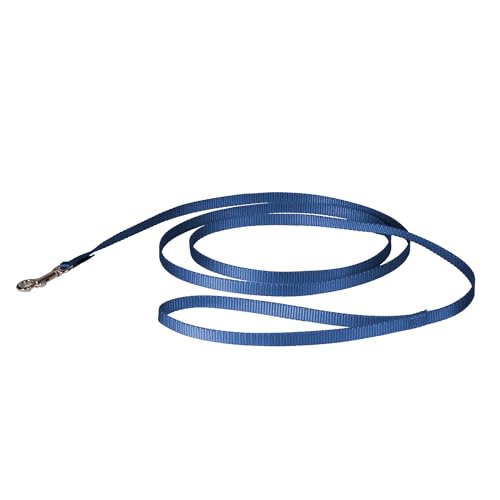
Six feet of plain flat nylon, which is the whole specification for early leash work. The bolt snap hook goes on and off a harness without a fight, and PetSafe sells the same leash in several lengths and widths, so one brand can follow a puppy up. PetSafe has been a US manufacturer of pet behaviour, containment and lifestyle products since 1991.
What we love
- An easy on, easy off bolt snap hook that makes securing the leash to a collar or harness effortless
- Available in multiple lengths and widths, so you can choose the size that works best for your dog
- Made by PetSafe, a US manufacturer of pet behaviour, containment and lifestyle products since 1991
Keep in mind
- It is a plain flat lead with no padded handle, so it can bite into your hand if a bigger puppy lunges
- The 3/8 inch webbing is sized for small and medium dogs, not a large-breed adolescent

The lead for a puppy small enough that ordinary hardware is a weight on their neck. Mendota describes the Petite Snap Leash as a favourite among dog owners and trainers, minimalist, easy to use and small enough to fit in your pocket, and it is hand made in the USA from premium durable nylon. The waterproof cord is the practical detail in a wet autumn.
What we love
- Minimalist cord that Mendota says is simple, convenient, easy to use and fits in your pocket
- Three width options, Fine 1/8 inch, Medium 1/4 inch and Heavy 3/8 inch, with several lengths up to 72 inches
- Hand made in the USA from premium durable nylon
- Waterproof nylon, which matters more than it sounds on wet grass
- Mendota guarantees its gear for the life of your pet
Keep in mind
- The Fine 1/8 inch width is for small dogs and puppies only, so it is not a lead for a strong adolescent
- A thin cord has no padded handle and offers very little grip if your puppy bolts
Frequently asked questions
What is loose leash walking?
It is a position, not a formal exercise. The AKC describes the goal as a dog who stays near you and can walk at or near your side without pulling, and calls it a trained skill you have to teach and keep reinforcing as the puppy grows. The Dumb Friends League animal behavior department makes the criterion measurable in its loose leash walking handout: reward for no tension on the leash, and do not allow a little bit of pulling, because it is too hard for a dog to learn the difference between pulling a little and pulling a lot. Its visual check is that the leash clip hangs straight down.
Is loose leash walking the same as heeling?
No, and the difference matters for a puppy. The Dumb Friends League handout describes loose leash walking as a more relaxed behaviour than a formal heel, and notes that heeling requires the dog to be intensely focused on you, which is very tiring and does not allow the freedom to sniff and explore that is important for a dog's mental and emotional well-being. Its suggestion is to save a heel cue for moments when you need extra control, such as crossing a street or walking through a crowd.
How long should a puppy loose leash training session be?
Shorter than almost anyone expects. A Fear Free Happy Homes handout on training session length, hosted by the AVSAB, says that as a general guideline three minutes is plenty long for most dogs, that dogs new to training should get even shorter sessions, and that puppies might only be able to train for one minute at a time because their attention spans are very short. It suggests setting a timer for two to three minutes or pre-counting ten to twenty treats, and says it is always best to end with your dog wanting more rather than working them to fatigue.
How often should I reward my puppy for a loose leash?
At first, constantly. The Dumb Friends League handout says to click and treat every one or two steps as long as your dog is not pulling, then gradually increase the number of steps before each reward. Karen Pryor's Ten Laws of Shaping frame the same idea as a rule: raise criteria in increments small enough that the subject always has a realistic chance of reinforcement. A rate that feels absurd for the first few sessions is the reason the puppy stays beside you long enough to discover that the spot pays.
Will all those training treats make my puppy overweight?
Only if they sit on top of the day's food instead of inside it. VCA Hospitals advises limiting treats to about 10 percent of a dog's daily calorie intake, and its method is to find the daily calorie requirement, take 10 percent of those calories as a treat budget, and then feed only 90 percent of calories as regular food. VCA also suggests checking with your veterinary care team if you are unsure of your dog's daily requirement. For leash work we would measure the training allowance out of breakfast, so the pouch is paid for before the session starts.
About the author
James Martin
I'm an animal lover through and through. I grew up with dogs, my family always had at least one pet, and today I share my home with a rescue who is the love of my life. I started Healthy Puppy Review to help owners cut through the marketing noise and make confident, well-researched choices about their dog's health and happiness.