Teething Puppy Not Eating? Why It Happens and What to Do
A teething puppy usually eats less, not nothing — sore gums can make hard kibble unpleasant anywhere in the 12-week-to-six-month teething window. Here is how to tell ordinary fussiness from a puppy who needs a vet, what the evidence actually says about teething and diarrhea, and seven things to try at tonight's meal.

Contains affiliate links · our policy
In this guide
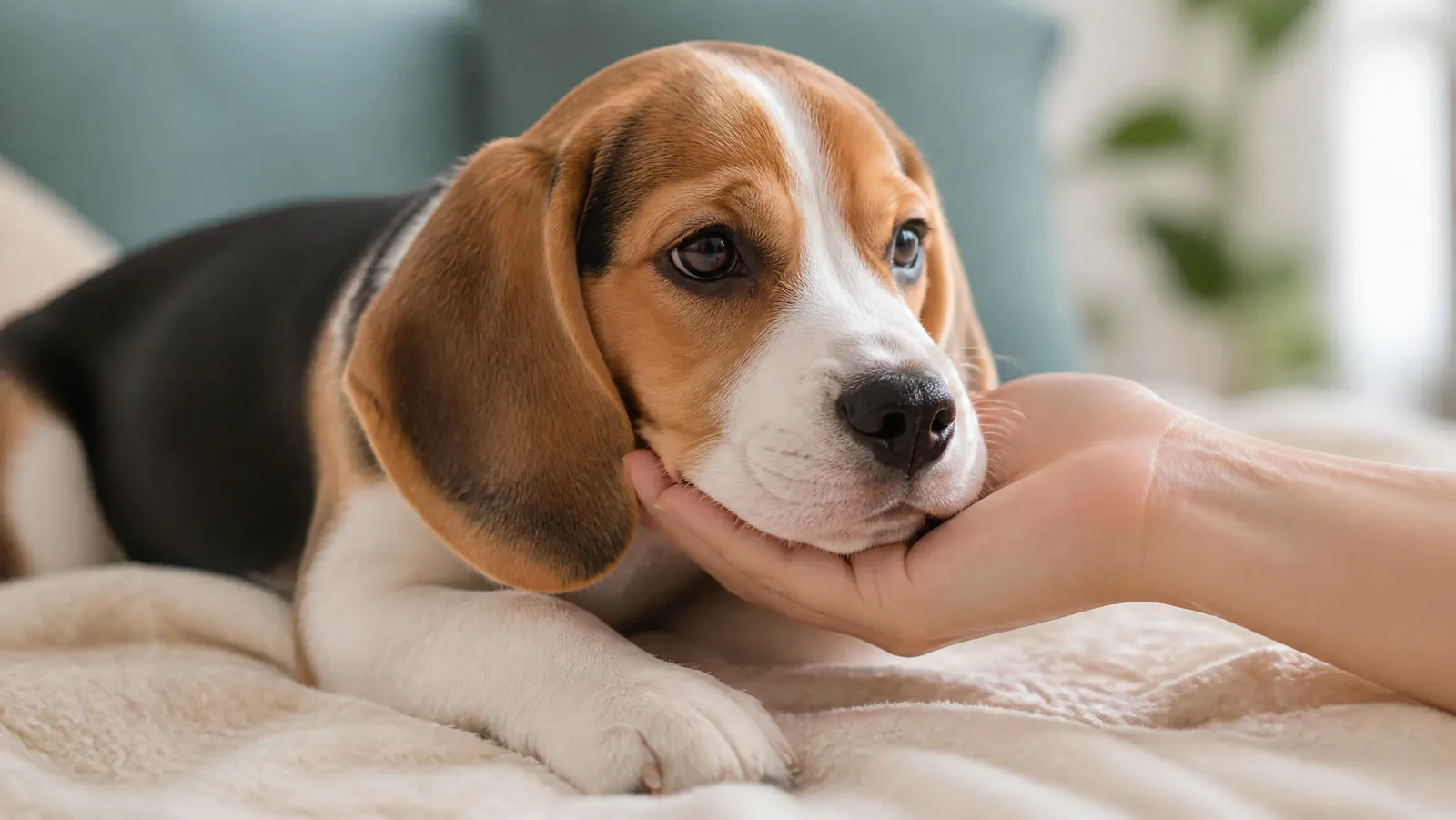
Yes — a teething puppy often eats less. Sore gums can make hard kibble unpleasant, so many puppies somewhere in the 12-week-to-six-month teething window pick at meals, eat slowly, or leave a little behind. What teething does not usually do is stop a puppy eating altogether. A full refusal is a different problem, and it needs a vet, not a softer bowl.
We may earn a commission from links on this page, at no extra cost to you.
That distinction — a dented appetite versus a deleted one — is the whole article. Teething can reshape a puppy's chewing, sleeping and temper for about three months, and we cover how teething affects everything else in the main guide. Here we are only doing the bowl: why the appetite dips, how to tell a sore mouth from a sick puppy, and what to try at the next meal.
Why Teething Puts a Puppy Off Their Food
The phrase people search at 9pm is teething puppy not eating, and the mechanism behind it is unglamorous: your puppy is being asked to crush dry food with teeth that are loose, erupting, or gone.
According to VCA Animal Hospitals, dogs have 28 deciduous teeth and up to 42 permanent teeth, and at around 12 weeks the deciduous teeth begin to fall out while the permanent teeth erupt behind them. Normally, VCA says, all permanent teeth have erupted by six months. The AKC's teething timeline puts the visible stage at weeks 12 to 16 and does not soften the description — anyone who has cared for a teething baby, it notes, knows the process is painful.
VCA is careful with the inference rather than the fact: chewing, it says, seems to alleviate what is assumed to be the discomfort associated with teething. Soreness is the assumption that best explains the chewing.
Better documented is how a sore mouth behaves at a bowl. VCA's signs of dental pain in a puppy include difficulty eating and dropping food, disinterest in eating, pawing at the mouth, head shaking, chattering the jaw and excessive drooling — almost word for word what owners describe during teething.
One honest limitation: we found no veterinary source that quantifies how much appetite teething costs, and the tidy percentages online do not trace back to anything.
Normal Fussiness vs. a Puppy Who Is Actually Unwell
The test we use is not about the bowl. It is about everything around it.
Probably teething. Slow or fussy at meals, but still interested in food, still drinking, still playing in bursts, still chewing anything in reach. Eating is harder, not impossible, and something soft or warm usually still gets taken. The full list of normal is in puppy teething symptoms.
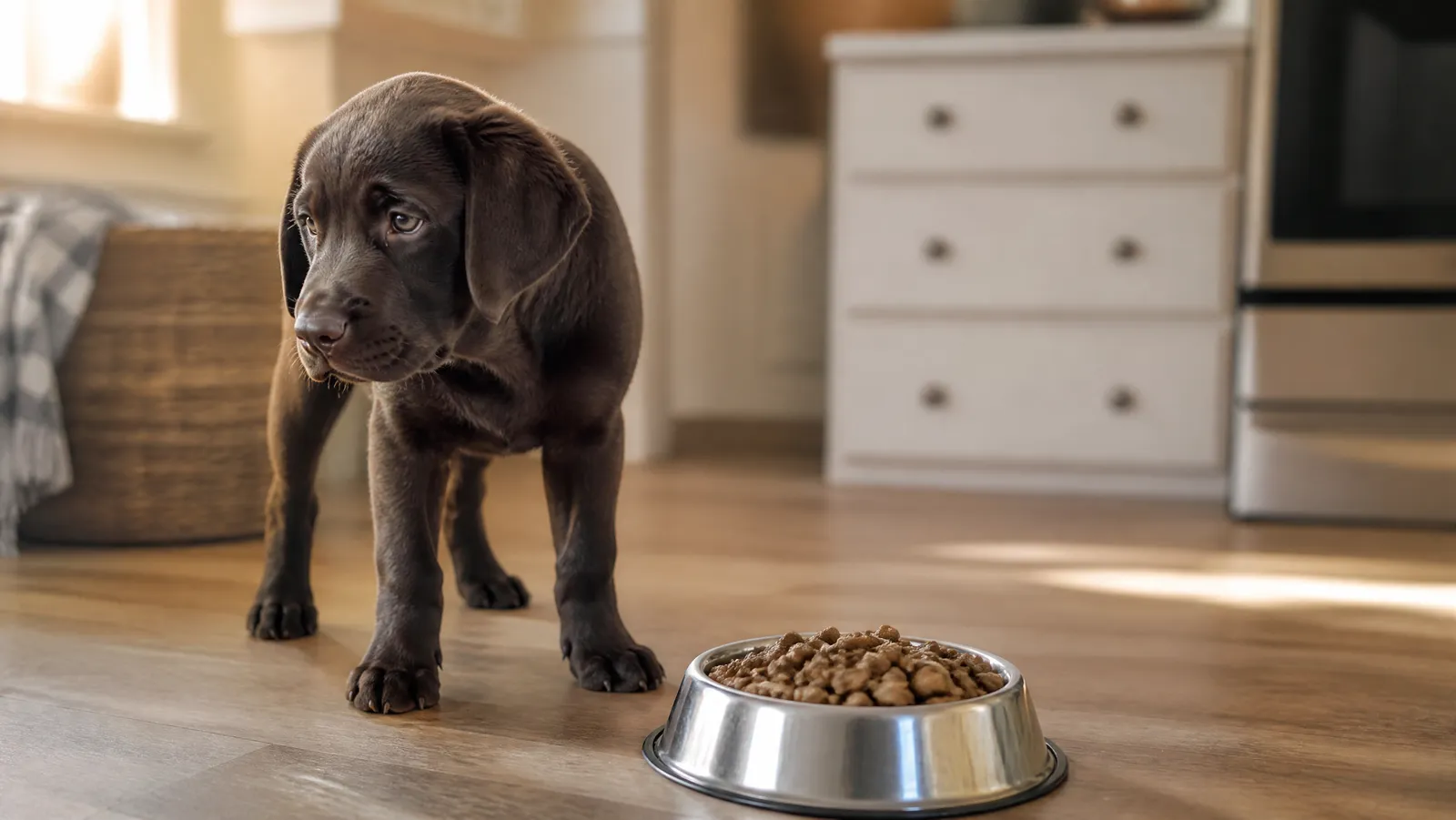
Probably not teething. Everything gets turned down, soft food and high-value treats included. Or the appetite is one item on a list: flat, wobbly, vomiting, loose stools, hiding. A puppy who will not eat chicken is not complaining about texture.
Two timing points sharpen this. VCA puts the start of the shedding stage at around 12 weeks, so a nine-week-old who has gone off food is unlikely to be teething, whatever a forum says. And teething discomfort waxes and wanes with whichever tooth is moving — an appetite that drops further every day, in a straight line, is not following that pattern.
When this becomes a vet call
Call your veterinarian the same day — sooner for a very small puppy — if your puppy refuses two or more consecutive meals, is lethargic or weak, is vomiting, has bloody or persistent diarrhea, has pale gums, is trembling, has a swollen or painful face or jaw, has bad breath with drooling, or is under 12 weeks old and skipping meals.
Two reasons this list is short on patience. The AKC notes that hypoglycemia can occur in very young or very small puppies, especially young toy puppies, who can deplete their available glucose between meals — especially if they are active, cold, or stressed. Its listed signs include drowsiness, weakness, muscle tremors, lack of balance, collapse and seizures, and AKC chief veterinarian Dr. Jerry Klein, quoted there, cautions that none of these conditions suggest home remedies.
The second reason is what a teething puppy does all day. Cornell University's Riney Canine Health Center describes a gastrointestinal obstruction as a swallowed, non-digestible foreign body too large to move out of the stomach or small intestine, and calls these obstructions emergencies that often require surgery. The ASPCA asks owners to discourage consumption of significant pieces that could cause choking or obstruction, and notes obstruction may be more likely in smaller dogs.
Does Teething Cause Diarrhea in Puppies?
Not according to the sources that matter, and it is worth being specific, because the claim is everywhere.
The AKC's guide to puppy diarrhea lists six causes: diet change or food intolerance, bacterial infection, viral infection, ingestion of garbage, toxins or foreign bodies, parasites, and stress. Teething is not among them. VCA Animal Hospitals' list covers similar ground — bacteria, viruses, coccidia or parasites, non-infectious irritants, diet changes and food intolerances, dietary indiscretion, and stress after travel or a change of environment. Teething is not on that one either.
The belief is understandable. The teething window sits on top of several real causes at once: puppies in that stretch are often changing foods, settling into a new home, finishing a vaccination series, and — the genuine connection — putting everything they find into a sore mouth. The AKC's line about ingestion of garbage, toxins or foreign bodies is where teething actually touches diarrhea. The chewing does it. The teeth do not.
So investigate loose stools on their own terms. The AKC advises calling a vet immediately for bloody diarrhea, black tarry stools, fever, pale gums, vomiting, a suspected swallowed foreign body or toxin, or diarrhea lasting more than one day, and for any puppy with diarrhea who is not fully vaccinated. It warns that parvovirus causes diarrhea in puppies and is a potentially lethal infection requiring immediate veterinary attention. VCA's threshold is two days. If a recent food change is in the frame, start with whether puppy food can cause diarrhea.
Seven Things to Try Tonight
Work down the list. The first four cost nothing.
- 1
Soften the kibble
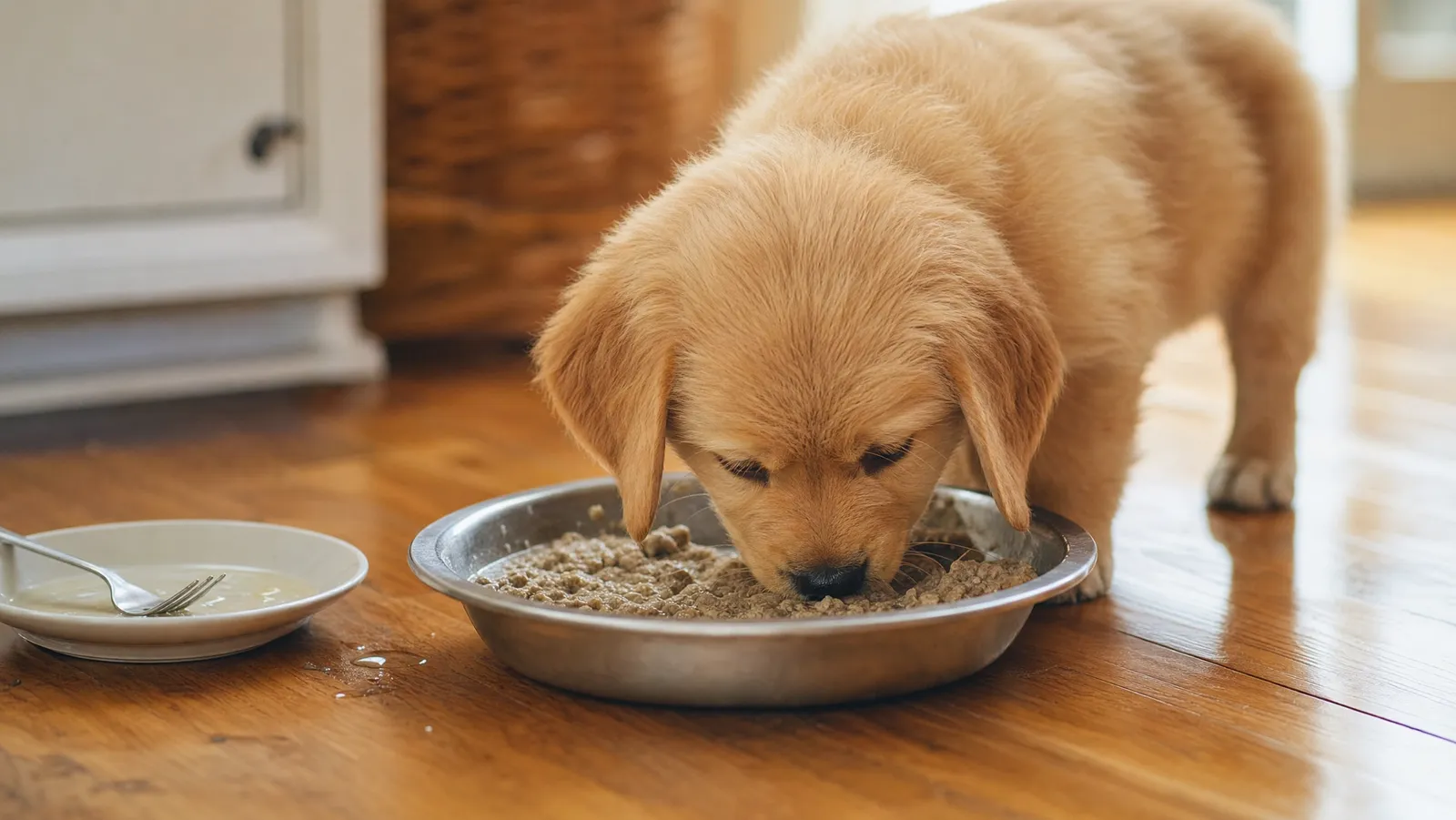
The highest-return change, and it is free. The AKC's puppy feeding guidance says kibble can be moistened with warm water or unsalted broth, and that although unnecessary, it may make kibble more appealing. Give it ten minutes to absorb rather than serving kibble still hard in the middle. Our full method is in softening your puppy's food.
- 2
Serve it slightly warm
Warmth lifts the smell. Writing for the AKC, veterinarian Dr. Seth Colman says gently warming food can enhance aroma and palatability, which may help picky eaters or dogs with a decreased appetite, and that it should never be hot to the touch. The AKC's own softening wording is warm water or unsalted broth, so this is the same step done deliberately. Test it against your wrist and err cool.
- 3
Add a topper, not a new food
Keep the recipe and change what sits on top of it: a spoonful of the wet version of the same food, or a squeeze of meat puree stirred through. Swapping the whole diet during a bad week adds a second variable at the worst moment, and diet change is the first item on the AKC's list of puppy diarrhea causes.
- 4
Split the same food into smaller, more frequent meals
The AKC's feeding timeline has puppies dropping from four feedings a day to three somewhere in the three-to-six-month stretch — the teething window exactly. Going back up to four smaller servings is not a step backwards; it is the same daily total in portions a sore mouth can face. For a toy breed it matters more: the AKC advises making sure tiny puppies do not go too long between meals, especially if they are active, stressed, or cold.
- 5
Put dinner on a frozen lick mat
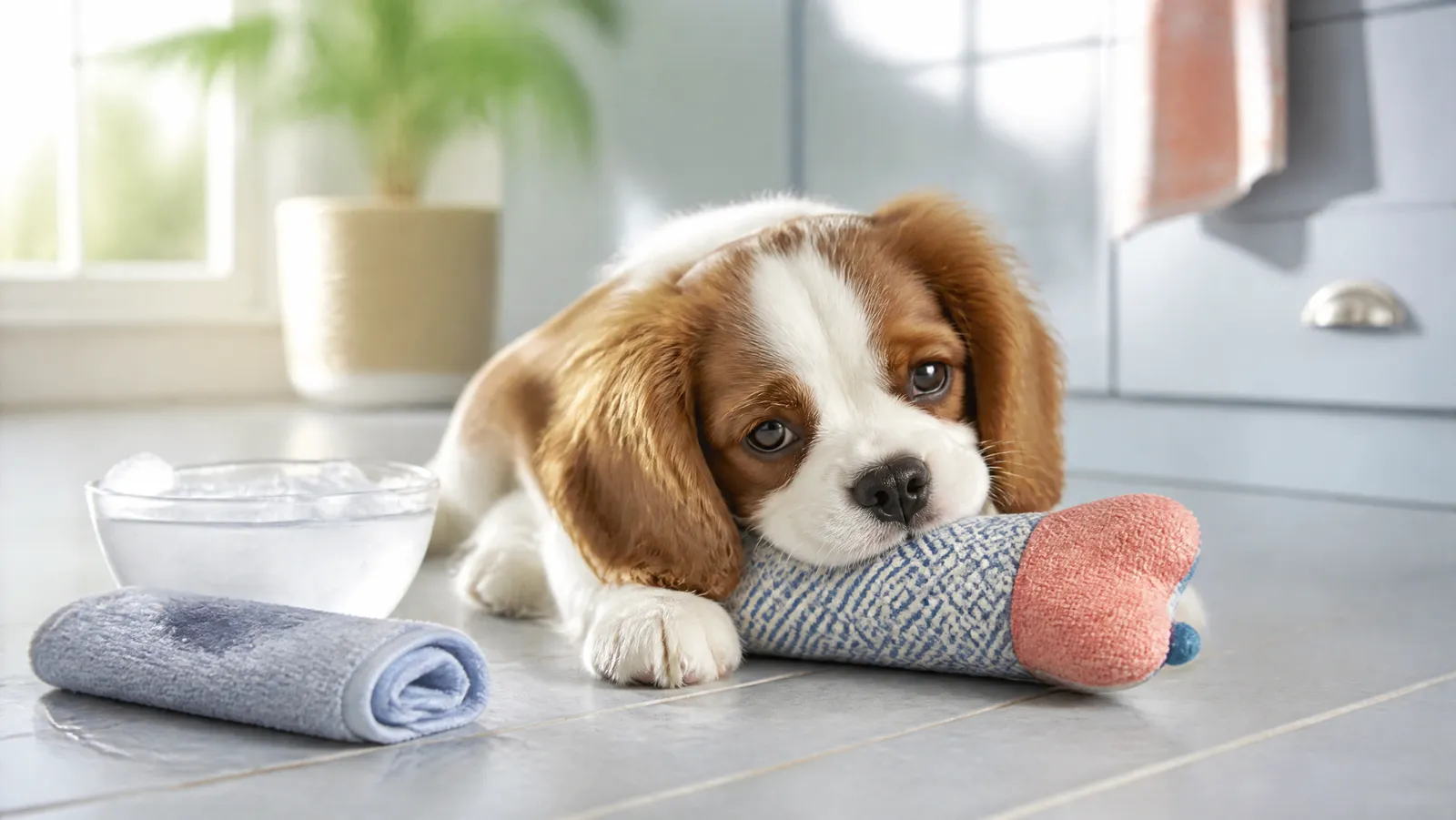
Licking is not crushing, and that is the whole idea. Spread the wet or softened food across a mat, freeze it, and the meal becomes slow and cold instead of a crunch. VCA Animal Hospitals makes the general version of this point when it suggests feeding a puppy from puzzle toys rather than a bowl. Stay in the room: VCA says to supervise your puppy even when chewing recommended toys, as no toy is 100 percent safe.
- 6
Hand-feed the first few mouthfuls
Some puppies stall at the bowl and start again the moment food comes from a hand. Offer five or six pieces, then set the bowl down while they are eating. A puppy who eats from your hand but not the bowl has an interest problem; one who refuses both has a different one.
- 7
Offer something cold first, then hold the schedule
Ten minutes with a chilled chew toy before dinner may take the edge off the mouth that is about to work; our cold options are in how to soothe a teething puppy. Then feed at the normal time. The AKC advises feeding at regular times in regular amounts and not leaving food down for more than 15 minutes. Pick the bowl up, note the skip, try again at the next meal.
Gear That Helps a Sore-Mouthed Puppy Eat
None of this is necessary — softened kibble and patience cover most teething weeks. But cold food, and licking instead of crushing, are easier with the right surface. Prices are approximate, as of October 2026.
Wholesome Pride Nature's Puree — our pick. The most flexible item here: feed it by hand, in a dish, as a topper over softened kibble, or spread on a mat. Wholesome Pride says the savory puree helps keep a dog hydrated and calls it ideal for pups who struggle with traditional chews. An eight-pouch box of Wholesome Pride Nature's Puree is about $11 as of October 2026. The limitation: eight 1.4-ounce pouches is a topper supply, not a meal plan.
Evenco Lick Mat — best for sore gums. Freeze-friendly silicone with raised dots and a smooth groove Evenco built around a dog's licking instinct. Load it with wet food, yogurt or puree, freeze it, and Evenco says the result is extended eating time. The Evenco Lick Mat runs about $12 as of October 2026. Two caveats: the suction cups need a smooth surface, and Evenco says to keep it out of the dishwasher's heated dry cycle.
Chewise Pick & Lick — best budget. The cheap way to find out whether your puppy will eat off a mat. It is two-sided: a harder food-pattern side Chewise says extends lick time, and an easier side you can use while the mouth is sore. The Chewise Pick & Lick mat is about $10 as of October 2026. It is silicone, so it is not chew-proof: supervise it rather than leaving it down.
Bestalk Wobbly Freeze Bowl — best freezable bowl. For the puppy who wants a bowl rather than a flat mat. Bestalk says the raised nubs massage the tongue and slow eating speed, and the bowl is made to be filled and frozen. The small Bestalk Wobbly Freeze Bowl is about $18 as of October 2026. The wobbling base that makes it a toy cuts both ways: it is a poor bowl for anything runny you have not frozen.
Techphardo Stainless Steel Lick Mat — best chew-proof. Some puppies answer a sore mouth by attacking the mat. This one is 304 double-layer stainless steel Techphardo describes as chew-proof, with a 5mm maze the company says freezes quickly, held down by 600 grams and four non-slip feet. The Techphardo lick mat is about $22 as of October 2026 — the most expensive pick here, and at 9.65 inches square it is sized for medium and large dogs.
When Their Appetite Should Come Back
The reassuring part of this stage is that it has an end date built in. VCA Animal Hospitals says that normally, by six months of age, all permanent teeth have erupted and all deciduous teeth have fallen out, and the AKC's timeline agrees. The appetite comes back the way it left — in waves that track whichever tooth was bothering them, until the waves stop.
Inside that window, expect a fussy day or two, then a normal week. Steady weight gain is the metric we would watch: weigh your puppy weekly and write it down, because a dip that shows on the scale is a different conversation from one that does not.
What would change our mind that this is teething at all: an appetite that has not recovered after a few days of softened food, weight that is flat or falling, or a puppy eating strangely — chewing on one side, dropping food, pawing at the mouth. VCA lists those under dental pain and notes that most causes of toothaches in young dogs will require professional dental intervention. The AKC adds the last check: if any baby teeth remain once the adult teeth are in, let your veterinarian know, as they may need to be removed.
The Bottom Line
A teething puppy who is eating less is doing something normal. One who is eating nothing is not, and the difference shows in the rest of the puppy rather than in the bowl — the fussy one is still bright, still drinking, still chewing the table leg, and will still take something soft.
So soften the kibble, warm it slightly, split the day into smaller meals, and put dinner on something cold. Hold the 15-minute rule and the weekly weigh-in. If you buy one thing, make it the cheap one: a mat like the Chewise Pick & Lick at about $10 changes a meal more than a new bag of food will.
And keep the escalation line where it belongs: two refused meals, lethargy, vomiting, blood, pale gums or trembling is a phone call, not a wait-and-see. For the rest of what this stage does to your puppy and your furniture, our guide to puppy teething and biting covers the whole three months.
Our top picks

Wholesome Pride Nature's Puree Creamy Lickable Dog Treats, 1.4 oz, 8-Count

Evenco Lick Mat for Dogs, Freeze-Friendly Silicone Licking Mat with Suction Cups (8.0" x 1.4")

Chewise Pick & Lick 2-Sided Dog Lick Mat & Slow Feeder, 2 Difficulty Levels
A squeezable meat puree you can use four ways — by hand, in a dish, as a topper over softened kibble, or spread on a lick mat — which makes it the most flexible thing on this list for a puppy who will still lick but will not crunch. Wholesome Pride says the savory puree helps keep a dog hydrated and calls it ideal for pups who struggle with traditional chews. It is made with organ meats and prebiotic fiber, with added glucosamine and chondroitin.
What we love
- Four ways to feed: by hand, in a dish, as a topper, or on a lick mat
- The maker says the puree helps keep a dog hydrated, which matters when meals get skipped
- Made with prebiotic fiber the maker says supports digestion, plus glucosamine and chondroitin
- Made with organ meats, with no meat by-products, grain, artificial flavors, colors or preservatives
- Eight pouches across four flavors, so a fussy puppy gets four chances
Keep in mind
- Eight 1.4 oz pouches is a topper supply, not a meal plan — it comes out of the day's food budget rather than on top of it
- Four flavors in one box means three can go unused if your puppy only likes one
A freeze-friendly silicone mat with raised dots and a smooth central groove, built around the licking instinct rather than the chewing one — which is the point when crunching hard food is the part your puppy is avoiding. Evenco says you can load it with wet food, yogurt or puree and freeze it for extended eating time, and the curved edge is there to keep dinner on the mat instead of on the floor.
What we love
- Freeze-friendly, which turns a meal into a cold, slow lick session
- Raised dots and a smooth groove designed around a dog's licking instinct, per Evenco
- Food-grade, non-toxic silicone that is top-rack dishwasher safe
- Multiple suction cups hold it to a smooth surface
- Curved edge designed to contain food and prevent spills
Keep in mind
- The suction cups only grip a smooth surface — on a rug or rough tile the mat travels
- Evenco says to avoid the dishwasher's heated dry cycle, so cleanup needs a little attention
The cheapest way to find out whether your puppy will take dinner off a mat at all. It is two-sided — a harder food-pattern side Chewise says extends lick time, and an easier side for a quicker treat — so you can serve the easy side while the mouth is sore and switch over once the adult teeth are through.
What we love
- Two difficulty levels on one mat, so dinner can be made easier during a bad week
- Lowest price of our five picks
- Four suction cups on each side, for tile, glass, stainless steel and bathtubs
- Freezable with a favorite spread for a longer-lasting challenge
- BPA-free food-grade silicone that can be rinsed, hand washed or put in the dishwasher
Keep in mind
- Like any suction-cup mat, it needs a smooth surface to stay put
- Silicone is not chew-proof, so it is a supervised item rather than something to leave with a puppy

A silicone bowl made to be filled and frozen, with raised nubs Bestalk says massage the tongue and slow eating speed. For a puppy who still wants to eat out of a bowl rather than off a flat mat, this is the way to get the cold into the meal, and the wobbling base turns the empty bowl into a rocking toy afterwards.
What we love
- Fills and freezes for an extended, cooling lick session
- Raised nubs the maker says massage the tongue and slow eating speed
- 100 percent food-grade silicone with zero BPA
- Raised rim designed to keep food inside the bowl
- The wobbling base doubles as a rocking toy once the bowl is empty
Keep in mind
- The wobble that makes it a toy also makes it a poor bowl for anything runny that has not been frozen first
- Priced above the silicone mats, and the small size limits how much of a meal it holds

A stainless steel mat with a raised maze pattern, for the puppy whose answer to a sore mouth is to eat the mat. Techphardo describes the 304 double-layer steel as chew-proof, says the 5mm maze freezes quickly, and swaps suction cups for 600 grams of weight on four non-slip feet.
What we love
- 304 food-grade double-layer stainless steel the maker describes as chew-proof
- Raised maze pattern with 5mm raised height that the maker says freezes quickly
- 600 grams on four non-slip feet, so it stays put without needing a smooth surface
- Seamless polished surface, hand-wash or dishwasher safe
Keep in mind
- At 9.65 inches square it is sized for medium and large dogs, which is a lot of mat for a small puppy
- The most expensive pick here, at a little over twice the price of the budget silicone mat
Frequently asked questions
Is it normal for a teething puppy to stop eating?
Eating less is normal. Stopping is not. VCA Animal Hospitals lists disinterest in eating, along with difficulty eating and dropping food, among the signs of dental pain in a young dog, so a puppy who picks, chews slowly or leaves a few pieces behind during the 12-week-to-six-month window has a plausible explanation. The AKC's feeding guidance is relaxed about the occasional miss too: if your puppy occasionally skips a meal or picks at food, it says, do not worry. A puppy who refuses two meals in a row, or who is off food and also flat, is a call to your veterinarian the same day.
How long does a teething puppy's reduced appetite last?
It usually comes in waves rather than one long slump, because it tracks whichever tooth is moving. VCA Animal Hospitals puts the start of the shedding stage at around 12 weeks, with all permanent teeth normally erupted by six months of age, and the AKC's teething timeline has the baby teeth going between weeks 12 and 16 and the adult set in by about six months. Inside that window, a day or two of fussiness around a particular tooth is ordinary. A dip that runs longer than a few days, or a puppy who is not gaining weight week to week, is worth a vet's opinion rather than more patience.
Does teething cause diarrhea in puppies?
The veterinary sources do not support it. The AKC's guide to puppy diarrhea lists six causes — diet change or food intolerance, bacterial infection, viral infection, ingestion of garbage, toxins or foreign bodies, parasites, and stress — and teething is not among them. VCA Animal Hospitals' list of causes covers similar ground and also omits it. The AKC advises calling a veterinarian immediately for bloody diarrhea, black tarry stools, fever, pale gums, vomiting, or diarrhea lasting more than one day, and notes that parvovirus causes diarrhea in puppies and is a potentially lethal infection that requires immediate veterinary attention. Treat diarrhea as its own problem.
Should I switch my teething puppy to wet food?
Change the texture before you change the recipe. The AKC says kibble can be moistened with warm water or unsalted broth, and that although it is unnecessary, it may make kibble more appealing as puppies get used to eating it — which is most of what wet food would do for you, without introducing a new ingredient list. The AKC's own timeline already has large breed puppies on unmoistened dry food by 9 or 10 weeks and small dogs by 12 or 13 weeks, so going back to a softened bowl for a few weeks is a step you can simply undo. The AKC also advises not leaving food down for more than 15 minutes.
When should I call the vet about a puppy who is not eating?
Sooner than it feels necessary. We would call the same day for refusal of two consecutive meals, lethargy or weakness, vomiting, bloody or persistent diarrhea, pale gums, trembling, a swollen or painful face, or any puppy under 12 weeks old who skips meals. The AKC notes that hypoglycemia can occur in very young or very small puppies, especially young toy puppies, who can deplete their available glucose between meals, particularly if they are active, cold, or stressed, and it lists drowsiness or lethargy, weakness, muscle tremors, lack of balance, collapse and seizures among the signs. AKC chief veterinarian Dr. Jerry Klein, quoted in that guidance, cautions that none of these conditions suggest home remedies.
About the author
James Martin
I'm an animal lover through and through. I grew up with dogs, my family always had at least one pet, and today I share my home with a rescue who is the love of my life. I started Healthy Puppy Review to help owners cut through the marketing noise and make confident, well-researched choices about their dog's health and happiness.