How to Soothe a Teething Puppy: Relief That Actually Works
Cold does most of the work: a frozen wet washcloth, a freezable toy, or a rubber toy stuffed and frozen solid. Here's the relief playbook in order of how well it works, plus the short list of things never to put in a teething puppy's mouth.

Contains affiliate links · our policy
In this guide
- Start With Cold — It Does the Most Work
- Stuff It, Freeze It, and Buy Yourself Twenty Minutes
- Match the Chew to the Tooth Stage
- Rotate the Toys So Novelty Does the Work
- Make Meals Easier When Gums Are Sore
- Schedule Naps, Because Overtired Puppies Chew Harder
- Redirect, Don't Correct
- What Not to Do for a Teething Puppy
- When Teething Is a Reason to Call Your Vet
- What to Do Tonight
- Our Top Picks
- FAQ
Cold is the relief most mainstream sources point to first for a teething puppy: a wet washcloth wrung out and frozen, a chew toy made to be soaked and frozen, or a rubber toy stuffed with something soft and frozen solid. Everything after that — chew hardness, a toy rotation, softer meals, more sleep, redirection over correction — makes the next few months survivable.
We may earn a commission from links on this page, at no extra cost to you.
Teething is not a short phase, which is why one trick won't carry you. The AKC says puppies get their baby teeth as early as two weeks old, that at about three to four months those puppy teeth begin to fall out to make room for 42 adult teeth, and that teething "can last for up to six months." So when owners ask how to help a teething puppy, they're really asking how to get through a months-long stretch. Relief has to be a routine. If the biting is the louder problem right now, we cover that side separately in our guide to puppy teething and biting.
Start With Cold — It Does the Most Work
Cold is the one intervention almost every mainstream source lands on. The AKC's chewing-safety guide puts it plainly: "Providing cold chews can help ease the pain in your pup's tender gums," and "ice cubes or frozen wet washcloths are cheap and easy options." The ASPCA frames it more cautiously — "some recommend giving puppies ice cubes, special dog toys that can be frozen or frozen wet washcloths to chew, which might help numb teething pain."
In the order we'd actually reach for them:
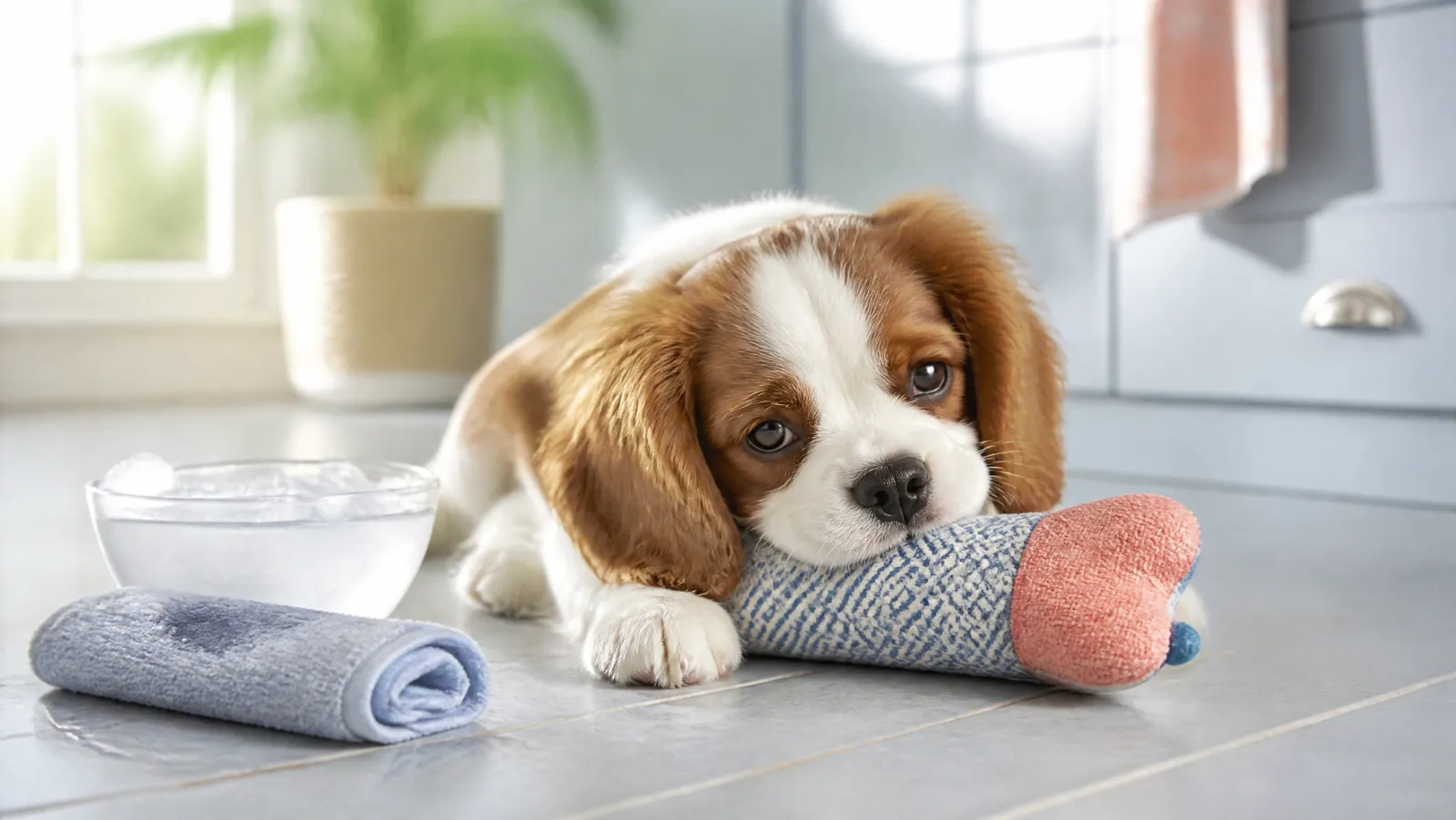
- A frozen wet washcloth. Soak a clean cloth, wring it out, twist it into a rope, freeze it. Costs nothing, and you can keep three going.
- A soak-and-freeze chew toy. Same principle, built to be chewed — easier to hand to a puppy who treats laundry as prey.
- A stuffable rubber toy, filled and frozen. The AKC's version: a "food-stuffable puppy toy can be filled with mushy kibble or broth and frozen for a cold, soothing treat."
One distinction matters more than it sounds: chilling the water bowl with ice is not the same as handing over a cube as a chew. Ice as a chew is genuinely debated. Cornell University's Riney Canine Health Center says to not let your dog chomp on ice cubes, while adding that licking, chasing and playing with them is okay. PetMD's teething-care guide, written by veterinary dentist Dr. Mallory Kanwal, DVM, DAVDC, also cautions against ice cubes while recommending frozen toys and chilled produce. Our read: use cold, but use it soft. A frozen cloth or rubber toy flexes under a puppy's jaw; a rock-hard cube doesn't. Supervise anything frozen, and take it away as it breaks down.
The Pupstages Cool Teething Stick is the simplest commercial version of the washcloth trick — about $5 as of October 2026. Pupstages describes it as a soak-and-freeze toy meant to comfort teething pups and refresh them on hot days, and says it helps redirect chewing away from furniture and shoes. It's a soft stuffed polyester shell with fringe, so treat it as a supervised toy: Pupstages itself says no toy is indestructible, and to remove and replace it if damaged.
For cold that lasts longer, the Pawaboo Freezable Cooling Teether set (around $8.50 as of October 2026) is filled with water and frozen for at least four hours before use. The triangular nubs are meant to massage gums and clean teeth, and the grooves hold pumpkin puree, mashed potato or peanut butter — though Pawaboo says to add the filling after freezing. Two limits worth respecting: Pawaboo states these suit small and medium dogs but not aggressive chewers, and the shapes are small, with the watermelon 4 inches long and the pineapple 2.8 inches.
Stuff It, Freeze It, and Buy Yourself Twenty Minutes
A frozen washcloth is relief. A stuffed, frozen rubber toy is relief plus a job, and the job is what saves your evening.
The default here is the KONG Puppy in natural rubber, about $7.50 as of October 2026 for the small. KONG makes it from a softer natural rubber developed for a growing puppy's teeth and calls it gentle on their 28 baby teeth — the right stiffness for this stage, and a clear signal that it's a baby-teeth toy rather than something to keep using once the adult set is in. It's stuffable with kibble, snacks or paste, and it bounces, so it does double duty on days when your puppy needs to run. KONG's own caution: no dog toy is indestructible, so supervise play and remove it if damaged.
What we'd put inside: plain mushed kibble, a spoon of plain pumpkin, or a little unsalted broth, frozen overnight. Keep it boring, and count it as part of the day's food.
Match the Chew to the Tooth Stage
Hardness is the variable owners get wrong most often, and it's the one with teeth at stake. PetMD's teething guide from Dr. Kanwal gives a test you can run in a shop aisle: "stay away from very hard toys or bones (ones that are so hard you can't indent them with your fingernail)." Cornell's Riney Canine Health Center is blunter still — "avoid antlers, hooves and bones, which may break a tooth, or splinter and cause stomach problems."
Run that test and most of the chew aisle disqualifies itself. What's left, staged roughly:
- Baby teeth in, roughly 8 to 16 weeks. Soft rubber, soak-and-freeze toys, frozen cloths, soft stuffed toys under supervision.
- Shedding and adult teeth arriving, roughly 3 to 6 months. Firmer rubber as the jaw gets stronger, still passing the fingernail test.
- Full adult set. Reassess everything: toys built for baby teeth are no longer the right tool.
Individual variation beats any chart, and the AKC says as much: "A power chewer might tear chunks off a softer rubber toy, whereas a gentle dog might prefer a squishier texture." Watch what your puppy does to a toy in the first ten minutes and believe it. We go deeper in the best puppy teething toys, and the age-by-age picture lives in the puppy teething timeline. Edible options are a separate question we cover in our guide to the best puppy teething chews.
Rotate the Toys So Novelty Does the Work
Six toys out all the time is roughly as useful as two: a toy that's always there stops being interesting. The ASPCA says it directly: "It's ideal to introduce something new or rotate your dog's chew toys every couple of days so that he doesn't get bored with the same old toys."
In practice we'd keep two-thirds of the toys in a cupboard and swap a couple every other day. A toy that's been out of circulation for four days comes back as a new toy, and a frozen toy is novel by definition. If you're still building the collection, must-have toys for a new puppy covers the base set.
Make Meals Easier When Gums Are Sore
Plenty of owners notice their puppy slows down at the bowl during the worst teething weeks, leaves a few kibbles, or chews on one side. We can't tell you that's definitely gum pain — but softening the food is low-risk and reversible.
- Soften dry food. Warm water for ten minutes turns hard kibble into something that needs less crunching. Walkthrough: how to soften puppy food.
- Split the day into more, smaller meals. Less to get through in one sitting.
- Slow the mouthfuls. Some owners find a slow feeder helps, because spreading kibble out stops a puppy scooping a big hard mouthful at once. We compare options in slow feeder bowls for puppies.
A puppy who eats slowly but finishes is a different situation from a teething puppy who is not eating at all. The second is a phone call to your vet, not a feeding experiment. To work out whether what you're seeing is normal, puppy teething symptoms lays out the usual picture.
Schedule Naps, Because Overtired Puppies Chew Harder
This is the step owners skip, and it's probably the highest-leverage one on the list. The AKC is explicit: "Overtired puppies are often mouthier puppies. Like young children, puppies can become cranky and impulsive when they don't get enough rest." It also notes most puppies need up to 18 hours of sleep per day.
The AKC's sleep guide puts the range at 18 to 20 hours and says a puppy "may nap every hour or so, sleeping from 30 minutes to as long as two hours." If your 14-week-old is awake for four-hour blocks and chewing like a woodchipper, sleep debt is a reasonable suspect. We'd run short cycles — 30 to 60 minutes of activity, then a quiet crate nap with a frozen toy — rather than wait for the puppy to crash.
Redirect, Don't Correct
Relief and behaviour run together here: a puppy with sore gums is going to chew something, and your job is to decide what. The ASPCA's advice is to substitute a toy or chew bone when your puppy tries to gnaw on fingers or toes, and the AKC adds the logistics: keep toys or a container of treats in every room, because "the faster you offer an acceptable alternative, the easier it is for your puppy to learn what behavior earns attention and rewards."
Correction is where this goes wrong. The ASPCA warns that slapping or hitting puppies for playful mouthing can cause them to bite harder, and that physical punishment "can also make your puppy afraid of you—and it can even cause real aggression." On the chewed table leg you find an hour later, the ASPCA is equally clear: don't show your dog the damage and scold or punish after the fact, because he can't connect it with something he did minutes or hours ago.
What Not to Do for a Teething Puppy
This is the part we'd most like you to remember.
- No human teething gels or oral numbing products. Pet Poison Helpline warns that the risk of giving a dog a benzocaine-containing product like Orajel "relates to a medical condition known as Methemoglobinemia," which "affects the blood and its oxygen-carrying capacity, leading to potentially life-threatening consequences." It says dogs are at risk after prolonged oral use, and that effects can appear shortly after exposure, especially at high concentration or in a smaller breed. Pet Poison Helpline also notes many such gels contain xylitol, which "can cause a life-threatening drop of blood sugar as well as liver failure." The FDA has separately published safety warnings about methemoglobinemia and benzocaine oral products in people.
- No human pain relievers, ever, as a guess. The FDA warns that an NSAID meant for people may not be safe or effective in dogs, because the drug can last longer, be processed differently, be absorbed faster and reach higher blood levels. It lists serious side effects including "ulcers in the stomach and intestines, perforations (holes) in the stomach and intestines, kidney failure, liver failure, and even death in some cases." Its instruction: "Before giving any NSAID to your dog or cat, talk with your veterinarian." VCA Animal Hospitals says ibuprofen and other NSAIDs can be extremely harmful in dogs, and that small doses can cause adverse effects and poisoning. Pain medication is a veterinary decision.
- No human toothpaste. The AKC warns it "can include ingredients like xylitol that are toxic or even deadly to dogs."
- No alcohol-based anything rubbed on the gums. We have found no veterinary source that recommends it, which is reason enough to skip it.
- No bones, antlers or hooves. Cornell's fracture guidance covers this: avoid them, because they may break a tooth or splinter and cause stomach problems.
- Nothing frozen, left unsupervised. Frozen items can develop sharp edges and shed small pieces as they break down. Cold relief is a sit-with-them activity.
When Teething Is a Reason to Call Your Vet
None of the following means something is wrong. Each one means it's worth someone qualified looking in that mouth rather than you reading another article.
- A baby tooth still sitting beside an erupted adult tooth. PetMD defines a retained baby tooth as one still present despite the eruption of the permanent tooth, with permanent teeth erupting between three and seven months of age, and says early recognition and prompt dental care matter to prevent lasting damage.
- Bad breath, or gums that look swollen, red or bleeding around a baby tooth. PetMD lists those among the signs associated with retained baby teeth.
- Baby teeth still present after six months. The AKC's marker is that by six months a puppy's baby teeth should have fallen out and the adult teeth should have grown in.
- A sudden refusal to chew, or dropping food. A damaged tooth is one of the things a vet checks for, and it's not something to assess at home.
- Heavy bleeding, obvious pain, or a puppy who stops eating. Any of those is a call today, not a wait-and-see.
What to Do Tonight
Three things, in this order. Put a wrung-out washcloth in the freezer, twisted into a rope. Pack a soft rubber stuffable toy with mushy kibble and freeze it overnight. Then look at your puppy's day and find two more naps in it.
Then the boring part: run the fingernail test on every chew you already own and bin anything that fails. That single pass does more for your puppy's adult teeth than any toy you could buy this week.
For the bigger picture — what's erupting when, why the biting peaks where it does, and when it finally stops — the full teething and biting timeline puts the whole phase on one page.
Our top picks
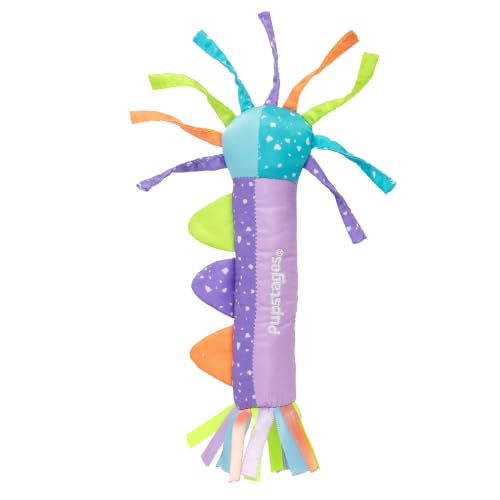
The cheapest version of the soak-and-freeze idea: wet it, freeze it, and hand over a cold chew for sore gums. It's a soft stuffed toy with a fringed shell, so it belongs in the supervised pile rather than the all-day pile.
What we love
- Soak and freeze for a cold chew on sore gums
- Cheapest way to try the soak-and-freeze approach
- Helps redirect chewing away from furniture and shoes
Keep in mind
- Soft stuffed shell, not a durable chew
- Pupstages says to remove and replace it once damaged

Fill these with water and freeze them, and the cold can hold longer than a frozen cloth manages. Pawaboo says they suit small and medium dogs but not aggressive chewers, so size and supervise accordingly.
What we love
- Fill with water and freeze for longer-lasting cold
- Surface nubs massage gums while cleaning teeth
- Grooves hold pumpkin puree or peanut butter, added after freezing
- Rinses clean under running water and floats
Keep in mind
- Pawaboo states it is not for aggressive chewers
- Needs at least 4 hours in the freezer before each use
- Small shapes: 4 in and 2.8 in long

Soft natural rubber shaped for a puppy's baby teeth, with a hollow middle you can pack with mushy kibble and freeze overnight. Cold plus a job to do buys you the quietest twenty minutes of the day.
What we love
- Soft natural rubber made for a puppy's 28 baby teeth
- Stuffable with kibble, snacks or paste, so it lasts longer
- Bounces, so it doubles as a fetch toy
Keep in mind
- Built for the baby-teeth stage, not for adult teeth
- KONG says to supervise play and remove it if damaged
Frequently asked questions
What can I give my teething puppy for pain?
Cold, chewable things — and nothing from the medicine cabinet. The AKC's chewing-safety guide says cold chews can help ease the pain in a puppy's tender gums, and lists ice cubes or frozen wet washcloths as cheap and easy options alongside freezable toys. For actual pain medication, the FDA's guidance is to talk with your veterinarian before giving any NSAID to a dog. There is no safe over-the-counter guess here.
Can I use baby teething gel on my puppy?
No. Pet Poison Helpline warns that the risk of giving a dog a benzocaine product like Orajel relates to methemoglobinemia, a condition that affects the blood's oxygen-carrying capacity with potentially life-threatening consequences, and says dogs are at risk after prolonged oral use. It also notes many gels contain xylitol, which can cause a life-threatening drop in blood sugar as well as liver failure. Keep human oral products away entirely.
Are ice cubes safe for a teething puppy to chew?
This one is genuinely debated, so we err on the cautious side. Cornell University's Riney Canine Health Center says not to let your dog chomp on ice cubes, though licking, chasing and playing with them is fine. PetMD's teething-care guide, written by veterinary dentist Dr. Mallory Kanwal, DVM, DAVDC, likewise cautions against ice cubes while recommending frozen toys and chilled produce. A frozen cloth or frozen rubber toy gives; a hard cube doesn't.
How long does teething discomfort last?
Longer than most owners expect. The AKC says a puppy's baby teeth begin falling out at about three to four months old to make room for 42 adult teeth, that by six months the puppy teeth should have fallen out and the adult teeth grown in, and that teething itself can last up to six months. Plan relief as a routine for that whole stretch rather than a one-week fix.
Why is my teething puppy eating more slowly?
Sore gums are a reasonable explanation, and many owners notice slower, fussier meals during the hardest weeks. Softening dry food with warm water and serving smaller, more frequent portions are low-risk things to try. But a puppy who stops eating altogether, seems lethargic, or has a swollen or bleeding mouth is a reason to call your vet rather than keep experimenting with the bowl.
About the author
James Martin
I'm an animal lover through and through. I grew up with dogs, my family always had at least one pet, and today I share my home with a rescue who is the love of my life. I started Healthy Puppy Review to help owners cut through the marketing noise and make confident, well-researched choices about their dog's health and happiness.