How to Soften Puppy Food (and When to Stop)
Softening puppy food is a five-minute job: warm water, a 10–15 minute soak, a fork. The real questions are whether your puppy's age calls for it, what never to add to the bowl, and how to taper back to dry kibble on schedule. Here's the full weaning-to-crunching timeline, with AKC and veterinary sourcing.

Contains affiliate links · our policy
In this guide
- Should Puppy Food Be Softened? It Depends Entirely on Age
- How to Soak Puppy Kibble: The 15-Minute Method
- Weaning Puppies Onto Kibble: The Week-by-Week Timeline
- What NOT to Soften Puppy Food With
- How Long Can Softened Puppy Food Sit Out?
- When (and How) to Stop Softening Puppy Food
- When a Soft-Food Preference Is a Red Flag
- The Bottom Line
- Our Top Picks
- FAQ
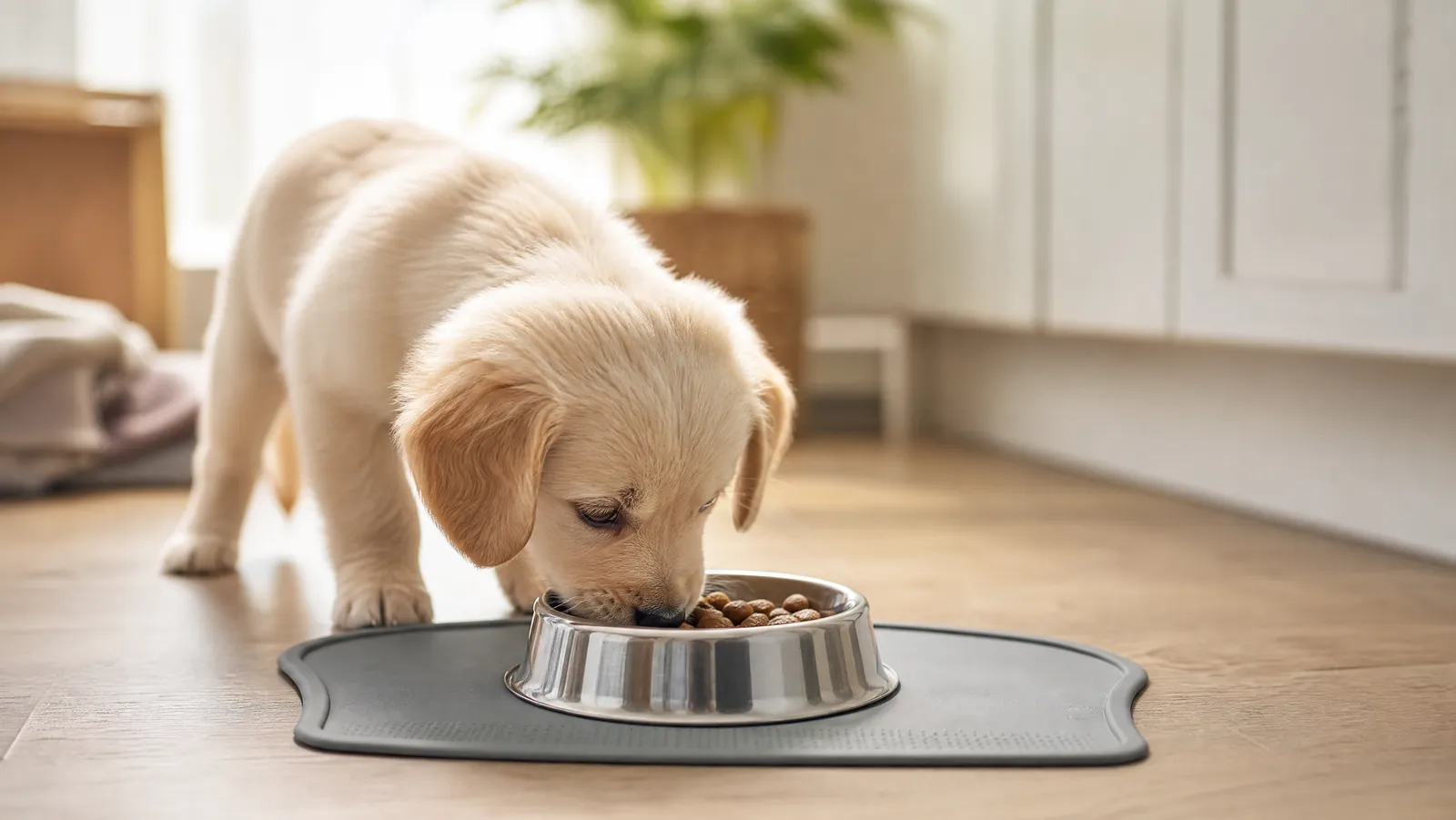
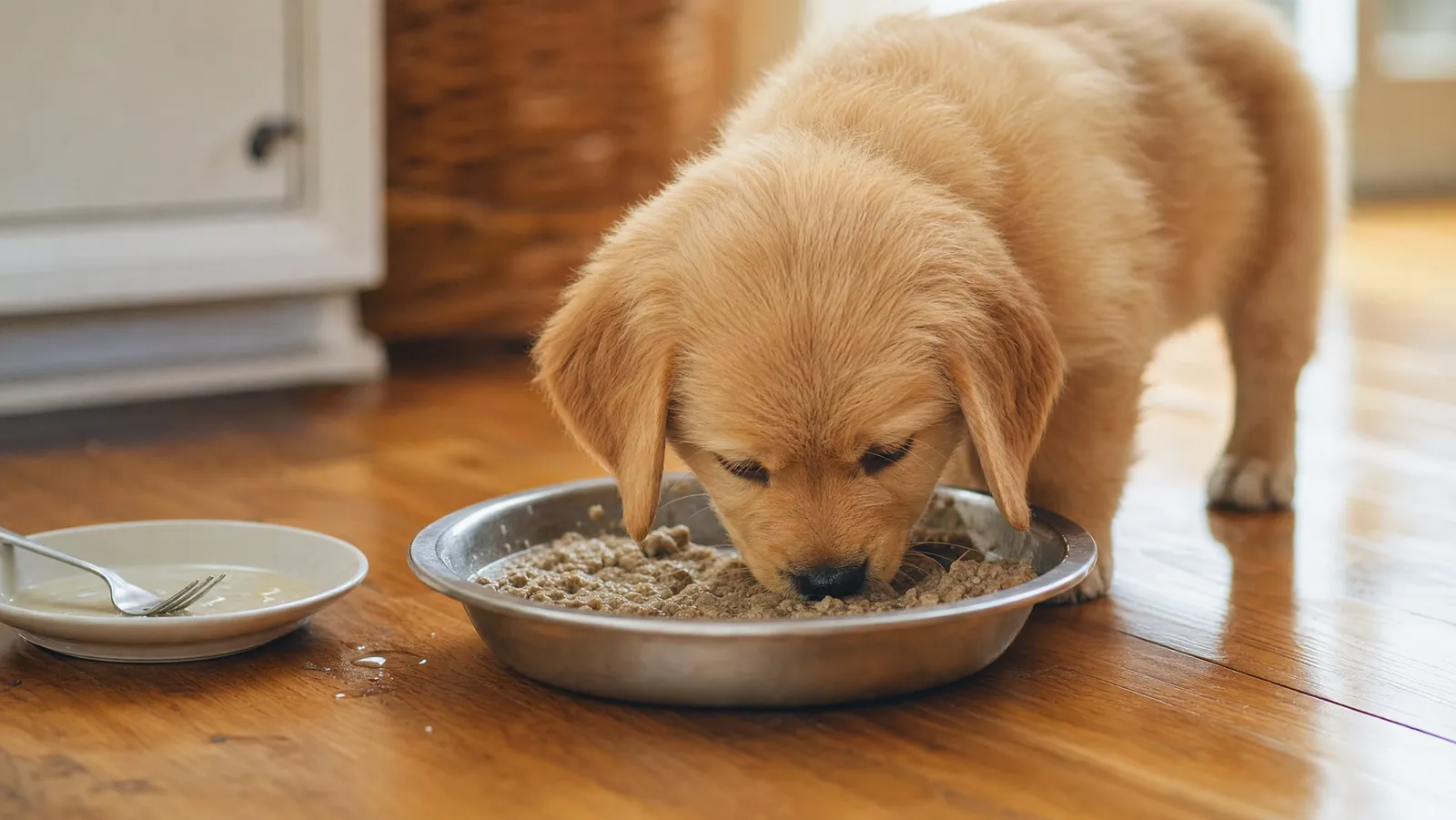
To soften puppy food, cover dry kibble with warm — never hot — water, wait 10 to 15 minutes, and mash it with a fork. That's the entire technique. Use plenty of water for a soupy weaning gruel, or just enough to cover for the oatmeal-thick mash a new 8-week-old handles well.
What takes more judgment is everything around the soak: whether your puppy actually needs softened food, what you should never soften it with, how long a moist bowl can safely sit out, and how to work back to plain dry kibble on schedule. Age answers most of those questions, which is why this guide slots into our puppy feeding schedule by age. Below, we walk the whole timeline — from a litter's first gruel at three weeks to a puppy crunching dry kibble a couple of months later — with the softening method we'd use at each stage.
Should Puppy Food Be Softened? It Depends Entirely on Age
There are three situations where softened food genuinely earns its place, and one where it's mostly optional.
Weaning litters, roughly 3–6 weeks old. This is the non-negotiable case. According to the AKC, puppies can be introduced to supplemental food between 3 and 4 weeks of age — offered as a soupy gruel of dry food and warm water, several times a day, in a large shallow bowl. The timing isn't arbitrary: VCA Animal Hospitals notes that puppy teeth begin erupting at around three weeks, with all 28 baby teeth in by about six weeks. A three-week-old simply has no equipment for crunching.
Newly homed puppies, roughly 8–10 weeks old. Most puppies arrive home able to eat dry puppy food, but a moistened bowl smooths the transition — new house, new food, small teeth. We cover that first-week routine in detail in our 8-week-old puppy feeding schedule.
Any puppy your vet has told you to feed soft food — after a procedure, during an illness, or for a specific medical reason. Follow the vet's instructions over anything in this article.
For everyone else, softening is a palatability trick, not a requirement. The AKC's feeding guidance notes that kibble can be moistened with warm water or unsalted broth, but calls the step unnecessary for typical puppies past the transition window. We agree — and we'd rather you save the effort (and the dish soap) once your puppy is crunching happily.
How to Soak Puppy Kibble: The 15-Minute Method
Here is the sequence we use. It works for a single 8-week-old or a whole litter — only the water amount changes.
- 1
Measure the kibble dry
Always measure before the water goes in — soaked kibble swells, so a "cup" of soft food is much less actual food than a cup of dry. Portions in our puppy feeding chart all assume dry measure. A dedicated set of stainless measuring scoops (we like the Navona 4-piece set, which runs from 1/4 cup to 1 cup) keeps the ratio identical meal to meal, which matters when several family members share feeding duty.
- 2
Add warm water — not hot
For a weaning litter, aim for the soupy, thin-oatmeal gruel the AKC describes; in practice we find that takes roughly three parts warm water to one part kibble. For an 8-week-old, pour just enough warm water to barely cover the kibble. Warm water softens faster than cold and smells more appealing to a puppy; hot water risks scalding an eager face-first eater and buys you nothing.
- 3
Wait 10–15 minutes
Purina's kibble-softening guidance is to let the food sit for about 15 minutes before serving. Ten minutes usually does it for small puppy kibble; give dense large-breed formulas the full fifteen. Resist the urge to microwave the bowl to speed things up — you'll create hot pockets.
- 4
Mash to the right texture
Mash with a fork — the same technique PetMD recommends for 5-to-6-week-old puppies moving onto softened kibble. For the youngest puppies, keep thinning with warm water until it's nearly lappable. For a puppy 8 weeks or older, a rough, chunky mash is fine and speeds the trip back to dry food.
- 5
Serve, then clear the bowl
Put the bowl down, give your puppy 15–20 minutes, then pick up and discard whatever is left. Moistened food spoils quickly — more on the exact time limits below — and a washed bowl at every meal is cheap insurance.
That's it. No blender, no soaking overnight, no special ingredients. The most common mistake we see isn't technique — it's using the wrong liquid, which is where we're headed next.
Weaning Puppies Onto Kibble: The Week-by-Week Timeline
If you're raising a litter (or your breeder is, and you want to know what "weaned" should mean), this is the spine of the whole process.
Weeks 3–4: first gruel. The AKC's breeder guidance introduces supplemental food between 3 and 4 weeks: a soupy gruel of dry puppy food and warm water, several times a day, in a large shallow pan. A purpose-built weaning bowl earns its keep here — the SOUJOY pan's 1.3-inch rim lets short snouts reach the food, and its raised center keeps puppies from sitting in it, which anyone who has weaned a litter will recognize as a real problem. PetMD suggests a first gruel can also be wet puppy food mixed with a little milk replacer for extra appeal. If you go that route, use an actual puppy milk replacer — Esbilac powder ($30.98 as of July 2026) mixes 1 part powder to 2 parts warm water per the label — never milk from the fridge.
Weeks 4–6: thicken the mash. The AKC notes mother dogs typically begin weaning their puppies themselves between 4 and 6 weeks. Follow her lead: soak kibble in warm water, mash with a fork, and gradually use less water so the texture moves from soup toward oatmeal. By 6 weeks, per the AKC, puppies should be eating puppy food exclusively and nursing very little, if at all.
Weeks 6–8: mostly food, barely moist. PetMD notes the weaning process usually isn't complete until 6–8 weeks. Through this window, keep stepping the water down — damp, then barely damp.
Weeks 9–13: dry kibble. The AKC's target: large-breed puppies eating unmoistened dry puppy food by 9 or 10 weeks, small breeds by 12 or 13 weeks.
Softened or dry, meals still follow the normal clock — softening changes texture, not timing. Our guide to how often to feed a puppy covers the meals-per-day schedule by age.
What NOT to Soften Puppy Food With
Cow's milk. This is the big one. According to the AKC, many dogs digest lactose poorly, and milk can trigger diarrhea and digestive upset — in a five-pound puppy, that's not a small problem. The instinct is understandable (milk plus cereal is how we soften our own breakfast), but water does the softening job just as well with zero risk.
Anything but a true puppy milk replacer, if milk is needed at all. For weaning-age puppies — roughly newborn to six weeks — a formulated replacer like Esbilac is the only milk product we'd put in a bowl. Follow the label: whisk or shake rather than blending, and refrigerate anything mixed.
Hot water or broth from tonight's dinner. Hot water risks a burned mouth on a puppy that dives in immediately. And while the AKC allows unsalted broth as a moistener, the word unsalted is doing heavy lifting — seasoned pan drippings and salty stock cubes have no place in a puppy bowl. Plain warm water remains our default: free, safe, and it works.
How Long Can Softened Puppy Food Sit Out?
Shorter than you'd hope. Dry kibble is shelf-stable in the bowl; add water and you've made a warm, moist bacterial playground. Vet-reviewed guidance at Dogster puts the limit for wet or moistened food at roughly 2–4 hours at room temperature — and as little as an hour in hot, humid weather.
Our house rule is simpler: serve softened food, allow 15–20 minutes, then discard the leftovers and wash the bowl. A puppy that hasn't finished in twenty minutes wasn't that hungry; a bowl of mush riding out a summer afternoon is a stomach upset waiting to happen.
Two storage notes worth pinning to the fridge:
- Reconstituted milk replacer keeps 24 hours, refrigerated. Esbilac's manufacturer says to mix only what will be consumed in 24 hours and refrigerate after reconstituting. Mix small batches.
- Soak fresh for each meal. Ten minutes of lead time per meal beats pre-soaking a day's worth and gambling with spoilage.
When (and How) to Stop Softening Puppy Food
The goal was always dry kibble. The AKC's timeline gives you the finish line — unmoistened dry food by 9–10 weeks for large breeds, 12–13 weeks for small breeds — and the method is simple: taper, don't quit cold.
PetMD's advice is to gradually reduce the amount of water you add to dry puppy food until your pup is crunching away at plain kibble. In practice, we'd run it as a one-week step-down: soak with the usual water for two days, then half the water and half the soak time for two days, then a splash of warm water stirred through for two days, then dry. If your puppy stalls at any step, hold there an extra day or two — this is a taper, not a race.
One worry you can cross off: softened kibble is not ruining your puppy's teeth. You'll sometimes hear that dogs need crunchy food to scrape their teeth clean, so a softened bowl is doing dental harm. Veterinary dentists are skeptical that everyday kibble cleans teeth much at all — the Animal Medical Center of Chicago counts the belief that dry food is better for dental health among its common pet dental myths, noting that food texture does not make a dramatic difference in tartar buildup. Brushing and vet dental care protect teeth; the moisture content of a few weeks of puppy meals does not decide them.
When a Soft-Food Preference Is a Red Flag
A weaning puppy needing soft food is biology. A five-month-old — or any adult dog — who suddenly refuses dry food but eats soft food eagerly is a different story. Veterinary sources consistently flag dental pain as one of the most common and most overlooked causes: a sore gum, a broken tooth, or an erupting adult tooth can make crunching genuinely painful while soft food stays comfortable. Remember the VCA teething timeline — baby teeth start falling out around 12 weeks, and all 42 adult teeth are in by about six months — so some tender-mouthed days in that window are normal. A pattern that persists is not.
When to call your vet
Get a veterinarian involved rather than reaching for the soaking bowl if: your puppy refuses food (soft or dry) for more than a day; you see weight loss, lethargy, vomiting, or diarrhea alongside a texture preference; a puppy past the AKC's dry-food window (9–13 weeks by breed size) still won't touch unmoistened kibble; or you're hand-rearing or weaning a litter without the mother — that deserves professional guidance from day one. And if your dog has any diagnosed health condition, ask your vet before changing food texture at all.
The Bottom Line
Softening puppy food is the easiest skill in dog ownership: warm water, 10–15 minutes, fork. The judgment lives in the calendar. Gruel at 3–4 weeks, a thickening mash through week six, lightly moistened kibble for the first days home, and — per the AKC — plain dry food by 9–13 weeks depending on breed size. Use water, never cow's milk; clear moist bowls within a couple of hours at most; and treat any lasting refusal of dry food as a question for your vet, not a reason to soak forever.
Softening is one small piece of getting puppy meals right. For portions, meal counts, and food transitions from eight weeks through the first year, start with our complete feeding guide.
Our top picks


A powdered milk replacer with added prebiotics, probiotics, vitamins, and minerals, intended for puppies from newborn to six weeks old. It mixes at 1 part powder to 2 parts warm water — whisk or shake it rather than using a blender — and stirs easily into a weaning gruel.
What we love
- PetAg positions it close to mother's milk in protein, fat, and carbohydrates
- Added prebiotics, probiotics, and a fiber blend for easy digestion
- Simple 1:2 powder-to-warm-water mix
Keep in mind
- Formulated for newborn-to-six-week puppies — most puppies past weaning only need warm water, not milk replacer
- Reconstituted formula must be refrigerated and used within 24 hours, so you can only mix small batches

A 10-inch stainless steel pan with a low 1.3-inch rim, so short weaning-age snouts can reach soft gruel without a bowl wall in the way. The raised center pushes food to the outer ring and keeps puppies from climbing or sitting in dinner.
What we love
- Low 1.3-inch rim suits puppies just learning to lap
- Raised center stops littermates from wading into the food
- Food-grade stainless steel; dishwasher safe
Keep in mind
- At 10 inches across, it is sized for a litter — a single puppy outgrows the need for it quickly
Four stainless steel scoops — 1 cup, 1/2 cup, 1/3 cup, and 1/4 cup — so the kibble half of your kibble-to-water ratio stays identical at every meal. The natural wood handles have a hanging hole, and the smooth, burr-free edges wipe clean or go in the dishwasher.
What we love
- Four fixed sizes make repeatable kibble-to-water ratios easy
- Stainless steel bowls with smooth, burr-free edges
- Doubles as a kitchen measure for rice and flour
Keep in mind
- Nothing smaller than 1/4 cup, so toy-breed portions may still need a kitchen measuring spoon
Frequently asked questions
How long should I soak puppy kibble in water?
Ten to fifteen minutes in warm water covers almost every situation — Purina's softening guidance is to let kibble sit in water for about 15 minutes, then mash it up. A longer soak just makes a soupier texture, which is useful for the youngest weaning puppies but unnecessary for an 8-week-old. We would not soak kibble overnight, even in the fridge: moistened food spoils far faster than dry, and a fresh 15-minute soak before each meal takes almost no planning. Skip hot water entirely — warm is all the job requires, and an eager puppy dives in face-first.
Is puppy food soft enough without soaking?
Dry puppy kibble is not soft — it is simply smaller than adult kibble. Whether that matters depends on age. A 3-to-6-week-old cannot handle it at all and needs a soaked gruel or mash. Most 8-week-olds can physically eat dry puppy food but often eat more willingly when it is moistened for the first week or two; the AKC notes kibble can be moistened with warm water or unsalted broth, mainly as a palatability boost. Past roughly 9–13 weeks depending on breed size, the AKC expects puppies to be eating unmoistened dry food, so soaking becomes genuinely unnecessary.
Can I soften puppy food with milk?
Not with cow's milk. According to the AKC, many dogs digest lactose poorly, and milk can trigger diarrhea and stomach upset — the last thing a small puppy needs. If you are weaning a litter young enough to benefit from a milk product (roughly newborn to six weeks), use a commercial puppy milk replacer such as Esbilac, mixed per the label, and stir that into the gruel. For any puppy already eating solid food, plain warm water does the same softening job with zero digestive risk, and it is free. Water is our default in every case.
When should a puppy stop eating softened food?
Sooner than most owners expect. The AKC's guidance is that large-breed puppies should be eating unmoistened dry puppy food by 9 or 10 weeks, and small breeds by 12 or 13 weeks. Get there gradually: PetMD recommends reducing the amount of water you add over time until the puppy is crunching plain kibble, which in our experience takes about a week of stepping down the water at each meal. If a puppy past that window still refuses dry food but eats soft food eagerly, book a vet visit — dental pain is a common, checkable cause.
About the author
James Martin
I'm an animal lover through and through. I grew up with dogs, my family always had at least one pet, and today I share my home with a rescue who is the love of my life. I started Healthy Puppy Review to help owners cut through the marketing noise and make confident, well-researched choices about their dog's health and happiness.