Can Puppy Food Cause Diarrhea? Causes, Fixes, and When to Call the Vet
Yes — abrupt food switches, oversized portions, and rich or unfamiliar foods are among the most common causes of puppy diarrhea. But parasites and parvovirus can look identical from the outside. Here's how to tell a mild food problem from a call-the-vet problem, and what actually helps at home.

Contains affiliate links · our policy
In this guide
Yes — puppy food can cause diarrhea, and it does so constantly. The usual trigger isn't a "bad" food, though. It's an abrupt switch to a new food, a bowl that's simply too full, or something rich the food never should have shared the plate with. If you're second-guessing portions, our guide to how much to feed a puppy is the place to sanity-check, because chronic overfilling is one of the most fixable causes on this list.
But here's the part we'd want every new owner to read twice: food is only one column on the ledger. Parasites, viruses like parvo, and plain stress cause puppy diarrhea too, and from the outside they can look identical to a food problem. So this article does both jobs — the food-related causes and fixes, and the red flags that mean you stop troubleshooting and call the vet.
Puppy Diarrhea After a New Food: Why Switches Backfire
Start with the single most common food-related cause: the switch itself. According to the American Kennel Club, changing a dog's food abruptly can cause gastrointestinal upset — vomiting, diarrhea, and a drop in appetite. It's not that the new bag is defective; it's that the gut wasn't consulted. Preventive Vet explains that a gradual change gives the intestinal enzymes and resident gut bacteria time to adapt to a new diet. Swap 100% of the food overnight and you've asked a digestive system — one that's still developing — to improvise. Loose stool is how it complains.
The fix is pace. The AKC's sample schedule mixes 25% new food with 75% old on day 1, reaches 50/50 by day 3, 75% new by day 5, and 100% by about day 7 — and the AKC notes that dogs with sensitive stomachs or other gastrointestinal issues may need a longer runway than that. If your puppy's diarrhea started within a few days of a food change, this is almost certainly your culprit, and the answer is to step back a ratio and slow down.
This applies to every switch your puppy will ever make, including the eventual move off puppy food entirely — a milestone worth timing correctly, as we cover in when to stop feeding puppy food.
Other Food Culprits: Portions, Rich Foods, and Sensitive Stomachs
If nothing about the food changed recently, look at these next:
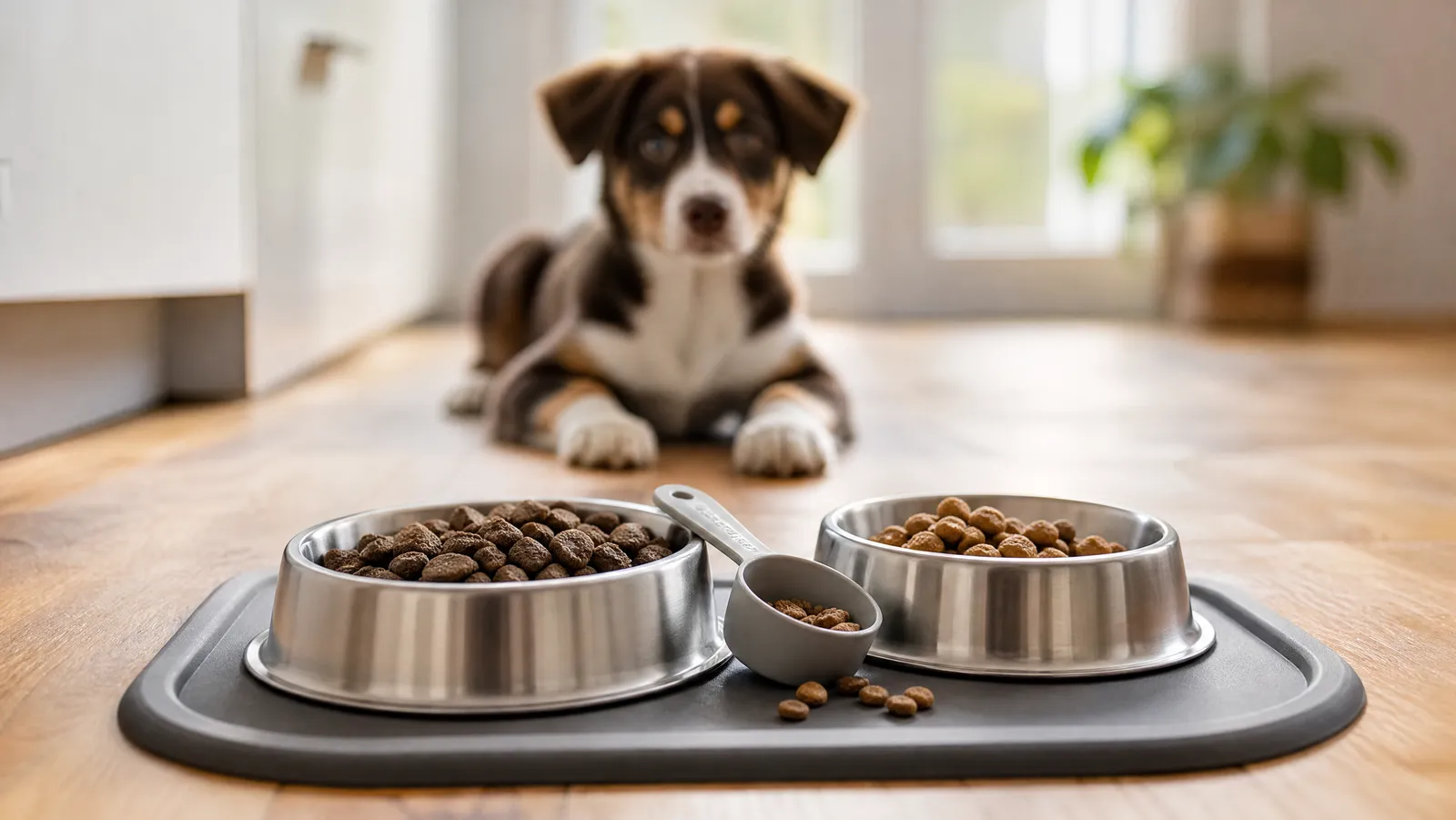
- Too much food. Overfeeding is a commonly cited cause of loose stool in puppies — a small gut can only process so much at a sitting. If your puppy's portions have drifted upward, or a well-meaning family member free-pours, measured meals are the fix. Softer stool that shows up alongside a rounder puppy is a portion problem until proven otherwise.
- Rich, fatty extras. Table scraps, bacon grease on kibble, and high-fat leftovers are classic gut-bombs for a puppy. So are very rich or novel diets generally — and if you've been curious about raw feeding, read our take on whether raw dog food is safe for puppies first, because raw diets add pathogen risk on top of richness for a young immune system.
- Dietary indiscretion. Puppies eat garbage, mulch, socks, and mystery objects on walks. Sometimes "the food caused diarrhea" really means "the thing eaten alongside the food caused diarrhea."
- Intolerances and sensitivities. Some puppies genuinely handle certain ingredients poorly. Worth knowing before you spiral: true food allergies appear to be less common in dogs than owners tend to assume, and the two things often get conflated. VCA Animal Hospitals draws the line this way — a food allergy is an immune-system reaction to a protein, while food intolerance covers adverse food reactions that don't involve the immune system and generally cause digestive issues. An intolerance is the likelier explanation for food-linked loose stool. So before you go shopping for the best puppy food for a sensitive stomach, rule out the pace, portion, and scrap problems above. They're cheaper to fix.
When It's Not the Food: Parasites, Parvo, and Stress
This is the section we'd least want you to skip, because the scariest causes of puppy diarrhea have nothing to do with the bowl.
Parasites are a puppy specialty. The AKC lists roundworms, hookworms, whipworms, coccidia, and giardia among the parasites that cause diarrhea in puppies, and notes puppies have more delicate immune systems than adult dogs. Puppies can also arrive already infected: Purdue's veterinary hospital explains that roundworm larvae are commonly acquired from the mother in utero, and hookworms primarily through her milk. You cannot see most of these in the stool, and no amount of diet-tinkering fixes them. A fecal test at the vet does.
Parvovirus is the emergency. The AKC describes parvovirus and distemper as potentially fatal diseases that strike unvaccinated or partially vaccinated puppies, and both require immediate veterinary care. The AVMA's list of parvo signs includes lethargy, loss of appetite, vomiting, severe and often bloody diarrhea, abdominal pain and bloating, and fever or a low body temperature. This is exactly why the AKC's advice is blunt: if a puppy who hasn't completed their vaccine series has diarrhea, call the vet. Don't try the pumpkin first.
Stress counts too. Rehoming is a big event in a small life, and the AKC notes that mild diarrhea from stress or a diet transition often resolves with a simple bland diet — while still recommending a vet consult to rule out something more serious. A new puppy's first week home is prime time for a stress-loosened stool and a food change at once, which is precisely why the vet call matters: you can't tell the columns apart from the outside.
Red flags — call your vet now, not tomorrow
Puppies lose fluids much faster than adult dogs, and dehydration can turn dangerous quickly. PetMD advises getting a puppy to the vet or emergency vet as soon as possible if they start to vomit and have diarrhea, because that combination can quickly lead to potentially fatal dehydration. Call right away — same day — if you see any of the following: blood in the stool or black, tarry stool (veterinary guidance published by Chewy treats anything more than the smallest amount of blood as an emergency, and PetMD lists large amounts of bright red blood or black stool among its emergency signs), vomiting alongside diarrhea, lethargy or a puppy who won't play, refusing food or water, signs of dehydration such as sticky gums, a bloated or painful belly, or any diarrhea in a very young or not-fully-vaccinated puppy. And even without those signs, don't wait it out: many vets advise calling within about a day for a young puppy, and Chewy's guidance says not to wait longer than 48 hours even if diarrhea is the only symptom. When in doubt, the phone call is free.
What You Can Do at Home — for a Mild Case Only
Everything in this section assumes a puppy who is bright, playful, drinking, eating, up to date on vaccines, and having soft-but-not-bloody stools. If that's not your puppy, go back to the callout above. If it is, here's the sequence we'd follow.
- 1
Keep water available, always
Never restrict water during diarrhea — fluid loss is the actual danger. And one thing we won't suggest: fasting. A short fast sometimes gets recommended for adult dogs, but many vets caution against withholding food from young puppies, whose energy reserves are small. Keep food coming unless your own vet says otherwise.
- 2
Simplify the diet — and ask your vet about a short bland reset
Strip the menu back to basics: no treats, no scraps, no chews, just their regular food — or, with your vet's okay, a brief bland diet. The AKC notes mild, stress- or transition-related diarrhea often clears up with a bland diet. The traditional version is boiled chicken and white rice; a ready-made option like KOHA's chicken-and-rice pouch saves the 2 a.m. cooking, but the same caveat applies to both: a bland diet is not a puppy growth formula, so it's a days-long reset under vet guidance, never a lifestyle.
- 3
Re-measure the portions
While the gut settles, weigh or measure every meal against the food's feeding chart. If portions had crept up, this alone may solve it — and it's the cheapest fix in dog ownership.
- 4
Consider vet-approved support: a probiotic or plain pumpkin
Two supports have reasonable evidence behind them. On probiotics: a 2011 double-blind, placebo-controlled shelter study in the Journal of Veterinary Internal Medicine found that cats given the probiotic strain Enterococcus faecium SF68 were significantly less likely to have diarrhea lasting two days or more than cats on placebo (7.4% versus 20.7%); in the dogs enrolled in that same study, diarrhea was uncommon in both groups and no statistical difference was detected — so the dog-side evidence is much weaker than the cat-side headline suggests. SF68 is the strain in Purina's FortiFlora sachets, which are formulated for puppies as well as adults. Note the careful wording: this is support for shorter, less-persistent episodes of uncomplicated diarrhea. Not a cure, and not a treatment for a sick puppy. On fiber: the AKC notes that plain pumpkin's soluble fiber absorbs water and adds bulk to stool, and that its fermentation produces beneficial fatty acids that support the intestines — the AKC suggests 1 to 4 tablespoons per meal for dogs, starting small. For a puppy, defer to your vet on the amount; if you'd rather skip the canned-pumpkin fridge graveyard, Native Pet's powder does the same job shelf-stably at 1 scoop per 25 pounds per its label. All three products above come in under $39 as of July 2026 — and none of them is necessary for most puppies, most of the time.
- 5
Fix the transition pace going forward
If a food change kicked this off, the long-term fix is procedural: next switch, take the full 7–10 days and slow down at the first soft stool. Our guide to how to transition a puppy to adult food walks through the exact ratio schedule — the same method works for any food-to-food change at any age.
Give a genuinely mild case about 24–48 hours of this. Improving? Finish the reset and rebuild the normal diet gradually. Not improving, or anything from the red-flag list appears? That's your answer — call the clinic.
Preventing the Next Episode
Most food-related puppy diarrhea is preventable with habits that cost nothing:
- Transition every food change over 7–10 days, per the AKC's schedule, and stretch it longer for a sensitive puppy.
- Measure meals — an actual measuring cup or a kitchen scale, not a scoop-shaped guess.
- Feed on a schedule, not free-choice, so you notice appetite changes the day they happen.
- Lock down the garbage and the table. No scraps as a house rule beats no scraps as a suggestion.
- Stay on the vet's deworming and vaccination schedule. Prevention is the only home remedy that works on parasites and parvo.
The Bottom Line
So, can puppy food cause diarrhea? Yes — routinely — but usually through the how rather than the what: switches made too fast, bowls filled too generously, extras that never belonged in a puppy's diet. Those you can fix at home, and a mild episode in a bright, vaccinated puppy generally resolves with water, a simplified menu, and patience. What you can't fix at home is everything that mimics a food problem — parasites, parvovirus, and the speed at which a small body dehydrates — which is why the red-flag list, not the pumpkin, is the most important part of this page. Get the fundamentals steady and most of this never happens: measured portions, scheduled meals, and slow transitions, all laid out in our puppy feeding schedule from eight weeks to adulthood.
Our top picks

Purina Pro Plan Veterinary Supplements FortiFlora Probiotic Powder (30 sachets)


The probiotic from Purina's veterinary supplement line, formulated for puppies as well as adult dogs with digestive upset, positioned for occasional diarrhea and loose stool. Thirty pre-measured sachets sprinkle straight over food, with guaranteed levels of live microorganisms kept viable by microencapsulation.
What we love
- Pre-measured sachets — no dosing math, just tear and sprinkle
- Guaranteed live microorganism levels, microencapsulated to survive until they reach the bowl
- Formulated for puppies as well as adult dogs
Keep in mind
- Support for occasional loose stool only — not a treatment for a sick puppy
- Works out to about a dollar per day at $30.99 for 30 sachets as of July 2026
A USDA Organic, shelf-stable fiber topper with exactly three ingredients — organic pumpkin, organic pumpkin seed, and organic apple — that mixes with water or sprinkles over food. The vet-developed ratio of soluble and insoluble fiber targets firm stools without a half-used can of pumpkin spoiling in the fridge.
What we love
- Three organic ingredients and nothing else
- Shelf-stable powder — no wasted half-cans of canned pumpkin
- Vet-developed soluble/insoluble fiber ratio aimed at firm stools and regularity
Keep in mind
- Label serving is 1 scoop per 25 lbs daily, so a small puppy needs a fraction of a scoop — confirm the amount with your vet
- Fiber support only — it does nothing for parasites or infection
The classic vet-suggested chicken-and-white-rice reset in ready-to-serve form — a single protein source plus white rice and pumpkin for stool quality, with no peas, potatoes, corn, soy, or artificial preservatives. Keeping it in the pantry means a 2 a.m. stomach episode doesn't require boiling chicken.
What we love
- No cooking in the middle of a stomach episode
- Single protein (chicken) plus white rice and pumpkin to support stool quality
- Free of peas, potatoes, corn, soy, and artificial preservatives
Keep in mind
- NOT an AAFCO growth (puppy) formula — for puppies, use only as a brief vet-approved reset, never a long-term diet
- At $38.94 as of July 2026, it costs more than DIY chicken and rice
Frequently asked questions
How long does diarrhea last after changing puppy food?
A day or two of softer-than-usual stool is common when the food changes, especially if the switch happened faster than the recommended pace. If the diet really is the culprit, stool usually firms up within a day or two once you slow the transition or step back to the previous ratio. Veterinary guidance published by Chewy says not to wait longer than 48 hours before seeking veterinary care, even if diarrhea is the only symptom, since lingering diarrhea can point to an infection or a genuine intolerance rather than simple adjustment. For very young puppies, don't wait that long — puppies dehydrate quickly, so call your clinic sooner rather than later.
Should I withhold food from a puppy with diarrhea?
No — not without your vet's explicit direction. A short fast is sometimes suggested for adult dogs with an upset stomach, but many vets caution against fasting young puppies, whose energy reserves are small. The more commonly advised approach for a mild case in an otherwise bright puppy is to keep water freely available, simplify the diet down to their regular food or a short vet-approved bland diet, and feed normal-sized (or slightly smaller) meals on the usual schedule. If your puppy is refusing food or water on their own, that's not a fasting opportunity — that's a reason to call the vet.
What does it mean if my puppy's diarrhea has blood in it?
Treat it as urgent. Veterinary guidance published by Chewy says anything more than the smallest amount of blood in a puppy's diarrhea should be treated as an emergency, and PetMD separately lists black stool — which can indicate digested blood from higher up the gut — among the signs that need emergency care. Bloody diarrhea is also one of the hallmark signs of parvovirus, which the AKC describes as a potentially fatal disease in unvaccinated or partially vaccinated puppies. Even if your puppy seems okay otherwise, call your veterinarian right away, describe exactly what you're seeing, and follow their instructions. This is not a wait-and-see symptom.
Can I give my puppy pumpkin or a probiotic for diarrhea?
For a mild episode in a bright, hydrated, vaccinated puppy — and with your vet's okay — both are reasonable supports. The AKC notes that plain pumpkin's soluble fiber absorbs water and adds bulk to stool, and a placebo-controlled shelter study published in the Journal of Veterinary Internal Medicine found cats given the probiotic strain Enterococcus faecium SF68 were less likely to have diarrhea lasting two days or more — though diarrhea was too uncommon among the dogs in that study for any difference to show, so treat the canine evidence as suggestive rather than settled. Use only plain pumpkin (never pie filling), follow product labels, and remember neither one treats parasites, infections, or a genuinely sick puppy. If things aren't improving within a day or two, stop supplementing and call the vet.
About the author
James Martin
I'm an animal lover through and through. I grew up with dogs, my family always had at least one pet, and today I share my home with a rescue who is the love of my life. I started Healthy Puppy Review to help owners cut through the marketing noise and make confident, well-researched choices about their dog's health and happiness.