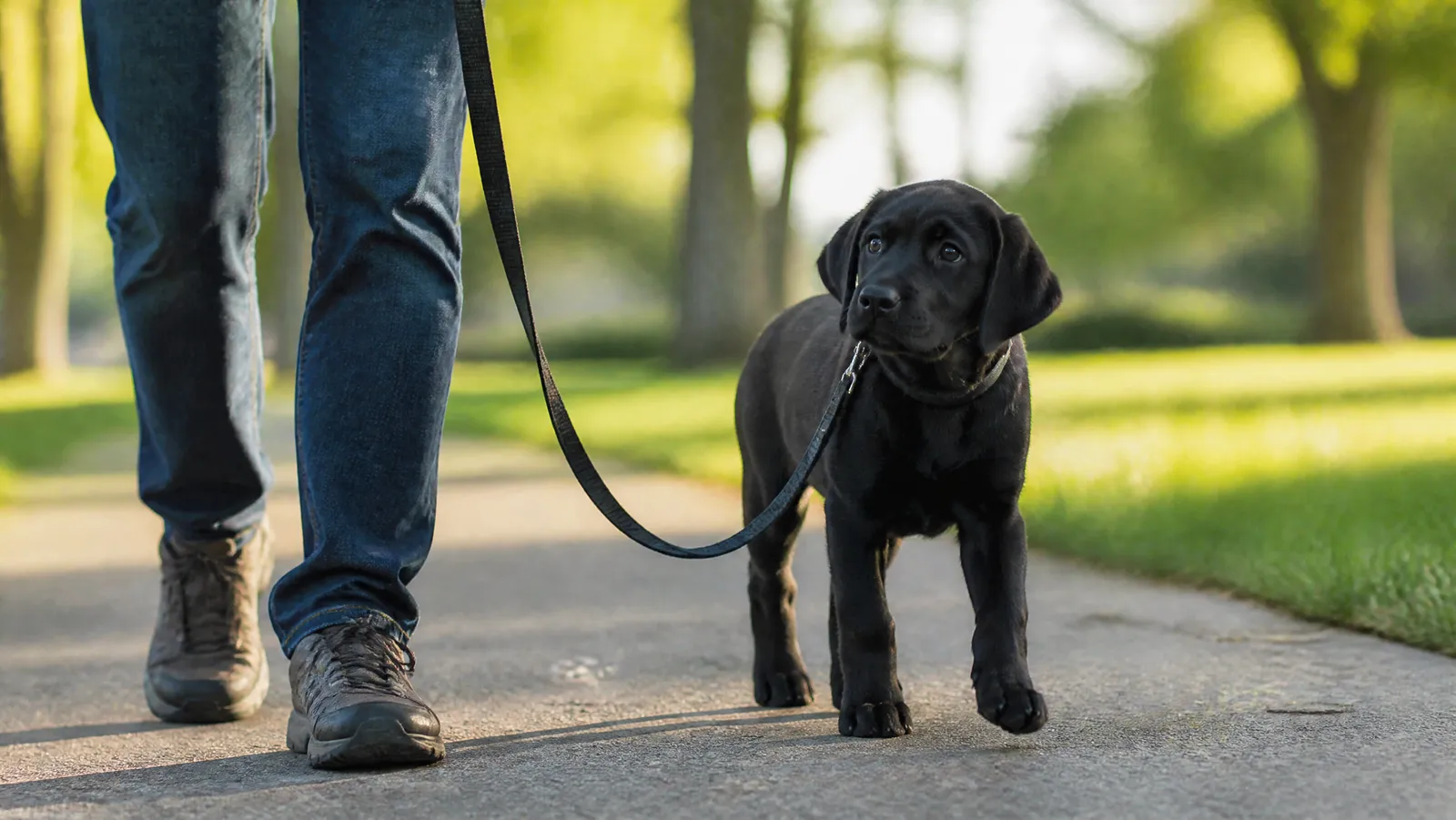
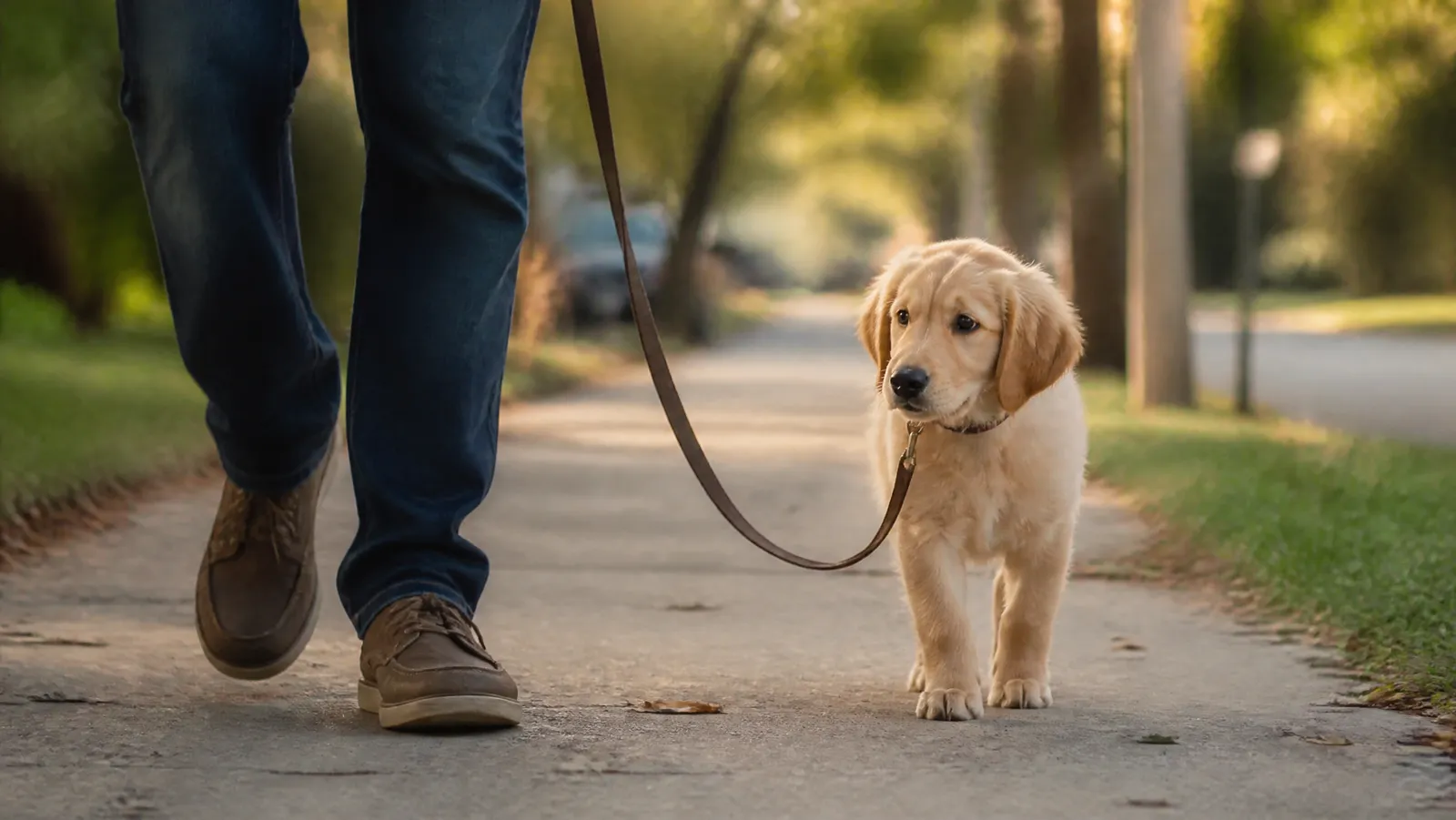
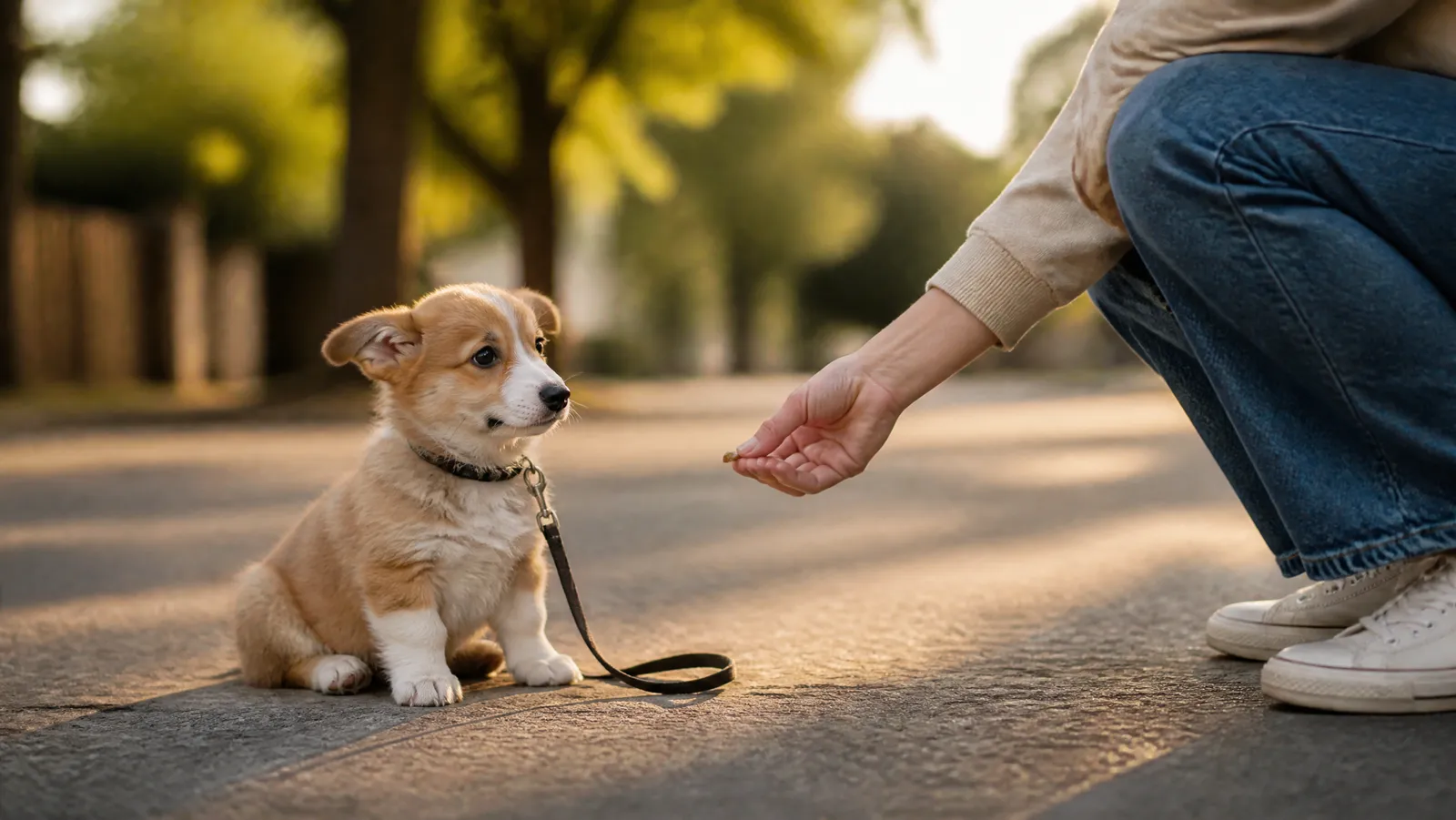
Long Line Training: Giving a Puppy Freedom Safely
A long line is the honest answer to when you can let your puppy off leash, and the answer is not yet. Here is the protocol we would run, why the line goes on a harness and never a collar, and why you start at 15 feet in a quiet field rather than 30 in a park.

Contains affiliate links · our policy
In this guide
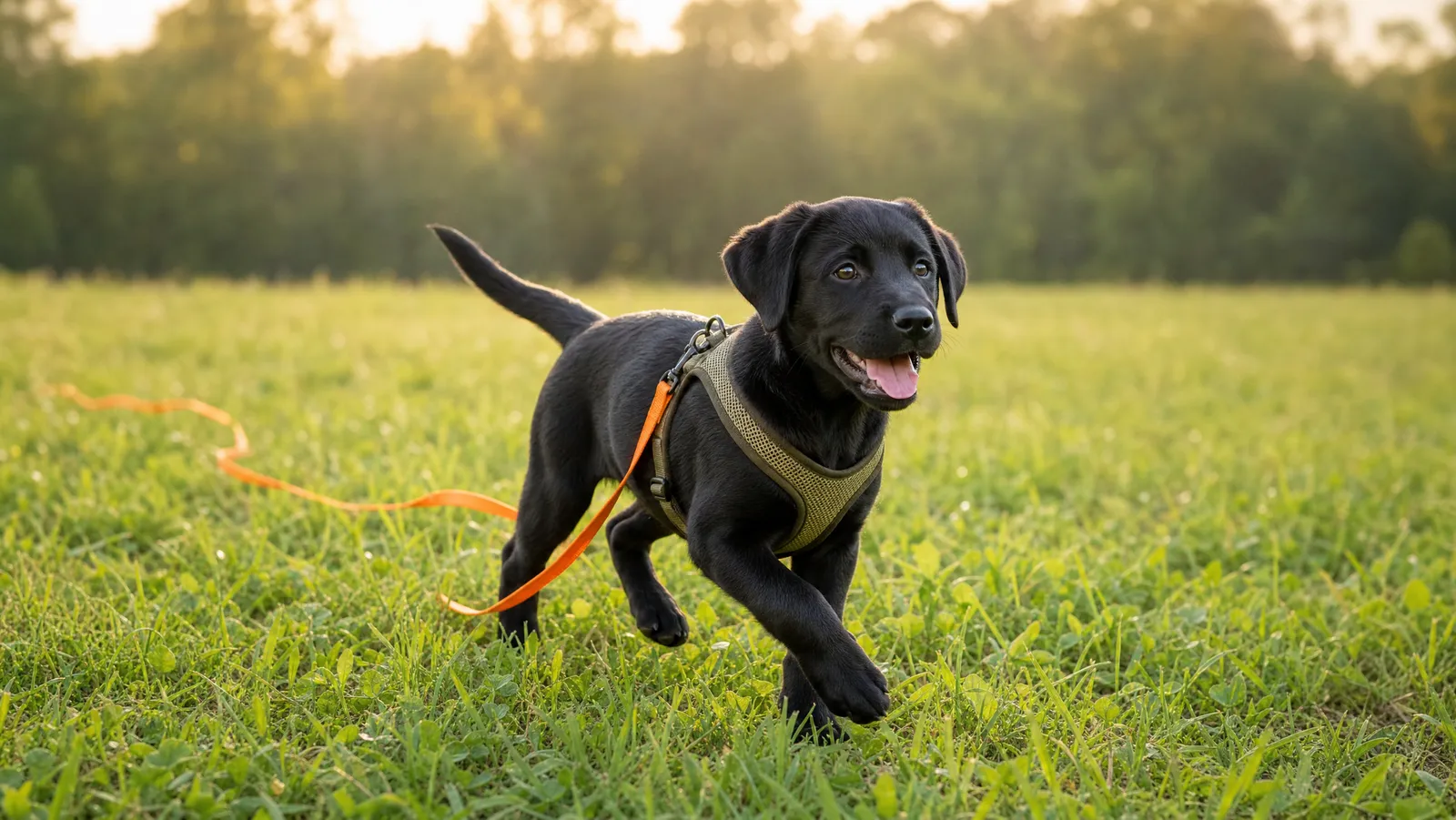
Long line training is the honest middle step between a six-foot leash and an off-leash puppy. A long line is a 15 to 30 foot leash, clipped to a harness, that lets a puppy range and sniff while you still hold the other end. It buys recall practice at real distance without ever gambling on whether the recall would have held.
We may earn a commission from links on this page, at no extra cost to you.
Long line training a puppy goes wrong in two ways before the line is even clipped on: people attach it to a flat collar instead of a harness, and they start at 30 feet in a park instead of 15 feet in a quiet field. Get those two right and the rest is patience. If the basics are not in place yet, start with how to leash train a puppy.
What a Long Line Is (and What It Is Not)
A long line is a fixed length of webbing or rope with a clip at one end and a handle at the other. The AKC's leash guide, by Harriet Meyers, draws the distinction that matters: a nylon long line gives your dog more room to move, but it does not extend based on the pull of the dog. You pay it out by hand and gather it in by hand. The guide calls it useful for teaching recall and for giving a puppy a chance to explore.
That hand-fed slack is the point, because the puppy never learns that leaning forward produces more rope. A retractable teaches exactly that. The AKC's retractable-leash article, by Stephanie Gibeault, MSc, CPDT, says a retractable rewards pulling.
It is not a walking leash either, and loose leash walking is a precision skill about one position, taught on a short lead where you can mark slack in half a second. A long line gives the opposite instruction: the puppy chooses where to go. Thirty feet of line on a pavement is how people end up tangled around a lamp post.
So the long line replaces nothing. The puppy still needs the plain four to six foot lead that the AKC guide says trainers recommend starting leash training with, and the options are in the best leashes for puppies. This is the second leash, for open ground only.
Clip It to a Harness, Never a Collar
Simple physics: 20 feet of line gives a puppy more room to build speed before they hit the end than six feet does.
The best evidence we have is a model study. Carter and colleagues, in the Veterinary Record in 2020 out of Nottingham Trent University, tested seven collars and a slip lead against a plastic cylinder standing in for a dog's neck, applying pulls of 40 N and 70 N and a jerk averaging 141 N. The collars exerted pressures of between 83 and 832 kPa on the model, and the authors concluded that no single collar tested provided a pressure low enough to mitigate the risk of injury when pulling on the lead. One author said in the university's announcement that collars should be used to display identification tags, with dogs walked on a harness or a loose lead that avoids neck pressure.
Two caveats. It measured pressure on a model, not injuries in live dogs. And a harness is no magic fix: Shih and colleagues, in Frontiers in Veterinary Science in 2021, found shelter dogs pulled more strongly and steadily in a back-connection harness than in a neck collar when the reward was food. A harness changes where the force lands, not how much of it there is.
For long line work the AKC's off-leash article is direct: attach the line to a well-fitted back-clip harness, to stop your dog pulling and straining their neck. Puppy collar vs harness argues the choice out, and the best puppy harnesses covers fit and growth headroom. We would not run a long line off a head halter either, though that is our judgement rather than a cited rule.
If your puppy hits the end of a line hard and then coughs, gags, paws at their neck, flinches when you touch the collar area or seems sore afterwards, we would call the vet that day rather than wait and watch. The collar study measured pressure, not injury, which is a reason to be cautious rather than reassured.
What Length to Start With
Buy 30 feet. Use 15.
The AKC's recall guide sets the progression: start on a six-foot leash, then move to a 20-foot or 30-foot long line and slowly give your dog more and more of that distance while you train. The AKC's STAR Puppy class materials put the first repetitions at about five feet, lengthening as the puppy improves.
- You can still reach your puppy. When the recall does not happen, the AKC's instruction is to walk toward your dog, gather the slack and try again. At 15 feet that is four strides.
- Thirty feet is a trip hazard. Loose line loops around your ankles, the puppy's legs and trees. The AKC's retractable article says 26 feet is likely too long for most dogs, and that at that distance you are unable to supervise your dog's behaviour.
- Short line, open ground. Keep it off pavements entirely.
Wear a glove, because flat nylon webbing can burn a bare hand as it slides through. And never wrap the line around your hand or wrist, for the same reason the AKC says never to grab a retractable leash while your dog is moving: you could be injured.
The Hi Kiss recall line is about $10 as of November 2026 in the 30 foot version, and Hi Kiss sells 15 and 20 foot lengths too.
How to Introduce It
Six short sessions, not one long afternoon. Everything below is paid in food, and nothing involves pulling the puppy anywhere.
- 1
Let it drag in a safe enclosed space
Clip the line to the harness in a garden or fenced field, drop the handle, and let the puppy wander with the line trailing. You are teaching one thing: the weight on the harness is neither a threat nor a cue.
- 2
Pick up the end and do nothing with it
Hold the handle, keep the line slack, follow the puppy rather than steering them. The AKC's advice on puppies who refuse to walk is to use the leash for safety rather than control, because pulling the puppy around teaches them to dislike the leash.
- 3
Pay every voluntary check-in
The moment the puppy glances back, mark it and feed. VCA Hospitals describes the mechanic: wait for the smallest moment you want, mark it with a word such as yes, and deliver a treat near your foot. Do not call the puppy yet.
- 4
Call from six feet, on the old rules
Add the cue at a distance where you cannot fail. The AKC's STAR Puppy material has a helper hold the puppy while the owner calls from about five feet. Pay generously: the recall guide says to praise like crazy while offering a favourite reward.
- 5
Add distance a few feet at a time
Let the puppy drift to eight feet, then twelve, then fifteen, calling only when their head is already coming up. If the recall fails, the AKC says not to reel them in but to walk toward the dog, gather the slack and try again. Never punish a slow return.
- 6
Add distraction, or distance, but not both
One variable moves per session. The recall guide builds from small distractions to larger ones, and its warning about tone is the useful one: if you sound angry, harsh or even just boring, why would your dog be interested.
Three to five minutes, two or three times a day, ending while the puppy still wants more. The AKC frames the long-term goal as reinforcement strong enough that obeying you is more valuable to your dog than the environment.
When Your Puppy Freezes on the Line
Some puppies get 10 feet out, feel the line, and stop dead. This is common, and it is not stubbornness.
The AKC, writing about puppies who refuse to go on walks, notes that a leash is a form of restraint and that clipping one on is enough to shut some puppies down, and says a young puppy will most likely drag their heels and pull backwards at first. Its fix is to lure the puppy toward you with treats rather than pulling them.
What we would do: drop the handle, walk away a few steps in an upbeat voice, and pay any movement at all. VCA Hospitals suggests that if the dog is too distracted, you move further away and try again. If freezing is the normal state rather than a one-off, the cause sits upstream of the line, in harness fit, pain or fear, and a puppy who will not walk covers how to rule those out. A long line may also help here, since there is no standing tension to brace against, though that is our reasoning rather than a cited finding.
When a Puppy Is Ready for Open Space at All
The length of line is the easy question. Whether a 12-week-old should be in a field at all is a veterinary one.
The AVSAB's puppy socialization position statement names the first three months of life as the most important socialization window, says puppies can generally begin socialization classes as early as seven to eight weeks of age, and argues that behavioural problems rather than infectious disease are a leading cause of death in dogs under three years old. Against that sits the real disease risk where you live, which only your own vet can weigh. We walk through that conversation in the first walk after vaccinations.
The AKC's off-leash article adds two constraints: use a long line only in open areas with plenty of room, and check local ordinances, since some locations do not permit leashes longer than six feet. Rules vary by locality, so read the sign at the gate.
The Lines We Would Buy
We did not run a testing panel. These four are judged on published specification and the makers' own claims, limitations included.
Hi Kiss Recall Training Long Line, 30 ft
The Hi Kiss line, about $10 as of November 2026, is our pick because it is the least interesting one: flat 3/4 inch nylon webbing, reinforced stitching, a nickel-plated swivel bolt snap that resists twisting. Hi Kiss positions it for recall at distance plus hiking, camping and backyard use, and says the nylon outlasts cotton. The limitations are honest: untreated nylon drinks up water and mud, and webbing sliding through a bare hand can burn.
Lynxking Check Cord Long Training Line, 3/8 in
The Lynxking check cord, about $13 as of November 2026, is for people who hate bulky line. Lynxking calls 3/8 inch, or 9.5 mm, the balance point between strength and portability, and says the 360 degree rotating clasp will not tangle in use or when rolled up. The material is non-absorbent and, the maker says, floats when submerged. Two caveats: one listing spans four lengths and the maker's text describes the 15 foot version, so pick deliberately, and a thin round rope bites into skin if a dog hits the end at a run.
ZALER Waterproof Long Line, 1/2 in x 30 ft
The ZALER waterproof line is about $22 as of November 2026, the expensive option here, and the reason is a PVC-coated material over a reinforced nylon core that ZALER says can be dragged through water and sand without getting wet. The maker says it is quick-drying, odour-resistant and wipes clean with a damp cloth, with a screw-lock aviation aluminium carabiner rather than a spring gate. ZALER states plainly on its own listing that this is not a chew-proof leash, which matters with a teething puppy.
NTR 30 ft Recall Training Line with Reflective Threads
The NTR reflective line, about $16 as of November 2026, earns its place on one feature: reflective thread stitched along the whole length, so you can see where the line is at dusk. It is a 48-strand static climbing rope that NTR says tensile-tests to 6-10 kN, with a soft rubber handle meant to protect against rope burn and a lockable hook the maker says stops the clasp opening unexpectedly. The flip side: that is more line than a puppy needs and heavier to drag, and the second hook invites tying the line to a tree or your waist.
What We Would Skip
- Retractable leashes, used as long lines. The AKC lists the failure modes: the cord rewards pulling, a thin cord pulled across skin can burn or cut, and a dog hitting the end of the leash can suffer injuries like a damaged trachea or spine.
- Clipping any long line to a flat collar. See the Carter study above.
- Tying the line to yourself, a tree or a fence post. A puppy who hits the end of an anchored line has nowhere for that force to go. If a line comes with a second hook, treat it as spare hardware.
- Fifty or 100 feet as a first line. Those lengths are for trained dogs in big empty spaces. On a puppy they are a tangle with a handle.
- Electronic collars for recall. The AVSAB's humane dog training position statement concludes that reward-based learning offers the most advantages and least harm to the learner's welfare, reports no evidence that aversive methods are more effective in any context, and notes that aversive training has been shown to impair a dog's ability to learn new tasks.
The Bottom Line
A long line is less a halfway house to off-leash freedom than a permanent piece of kit that happens to make freedom possible. The AKC's standard for a genuinely off-leash dog is one who ideally comes when called no matter the distraction, and nothing about a 16-week-old puppy meets it.
Three rules carry the value. The line goes on a well-fitted harness and never a collar. It starts at 15 feet in a quiet enclosed space, with the rest released over weeks. And when the recall does not happen, you walk toward your puppy and gather the slack rather than reeling them in.
For everything that comes before this, including the indoor work that makes a recall cue mean anything at all, see our leash training guide.
Our top picks

Thirty feet of 3/4 inch flat nylon webbing, which is the plainest possible version of this tool and the one we would buy first. Hi Kiss positions it for teaching recall at distance plus hiking, camping and backyard use, and says the nylon will outlast cotton lines. The reinforced stitching and nickel-plated swivel bolt snap are aimed at the usual failure point, a clip that twists the line into a corkscrew.
What we love
- 3/4 inch wide by 30 ft long nylon training lead, which is wide enough to hold without cutting into your fingers
- Hi Kiss positions it for teaching recall at distance, plus hiking, camping and backyard use
- Reinforced stitching and a nickel-plated swivel bolt snap that resists twisting
- Hi Kiss says the nylon will outlast cotton lines
- Also sold in 15, 20, 50 and 100 ft lengths, so you can buy the 15 ft version as a genuine first line
Keep in mind
- 3/4 inch nylon webbing can give you rope burn if it slides through a bare hand, so wear a glove
- Untreated nylon soaks up water and mud and stays heavy until it dries
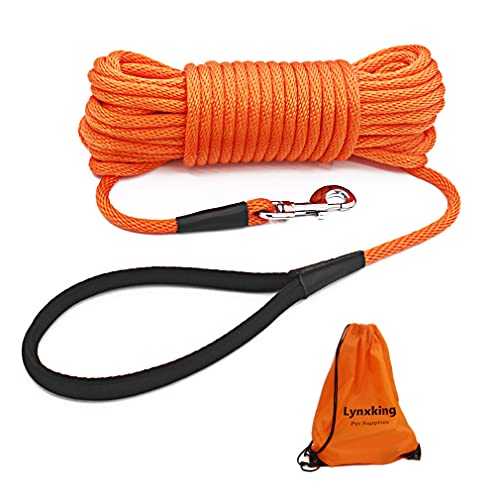
A round climbing-rope check cord for handlers who want less bulk in the hand and less line on the ground. Lynxking describes 3/8 inch, or 9.5 mm, as the balance point between strength and portability for a long line, and says the 360 degree rotating clasp will not tangle in use or when rolled up. The material is non-absorbent, which Lynxking says lets it float when submerged and stay highly visible.
What we love
- Lynxking describes 3/8 inch (9.5 mm) as the balance point between strength and portability for a long line
- Round rope with a 360 degree rotating clasp that Lynxking says will not tangle in use or when rolled up
- Non-absorbent material that Lynxking says floats when submerged and stays highly visible
- Double-layer woven handle, machine sewn at the rope joint
- Sold in 10, 15, 30 and 50 ft lengths
Keep in mind
- One listing spans four lengths and the maker's feature text describes the 15 ft version, so choose the length explicitly at checkout
- A 3/8 inch round rope is thin enough to bite into skin if a dog hits the end at a run

The line for mud, rivers and a wet autumn, which is where the cheap nylon ones stop being pleasant to hold. ZALER builds it from a PVC-coated material over a reinforced nylon core that the maker says can be dragged through water and sand without getting wet, and says it is quick-drying, odour-resistant and wipes clean with a damp cloth. The closure is a screw-lock carabiner in aviation aluminium rather than a spring clip.
What we love
- PVC-coated material over a reinforced nylon core that ZALER says can be dragged through water and sand without getting wet
- Screw-lock carabiner made from aviation aluminium, which cannot be nudged open the way a spring gate can
- ZALER says it is quick-drying and odour-resistant and wipes clean with a damp cloth
- 1/2 inch (13 mm) width, sold in 6, 10, 15, 20, 30 and 50 ft lengths
Keep in mind
- ZALER states plainly on its own listing that this is not a chew-proof leash, which matters with a teething puppy who will find the line with their mouth
- The PVC coating makes it the most expensive line in this group, at about $22 as of November 2026

A static climbing rope with reflective thread stitched along its length, which is the one feature the other three do not have and the reason to pick it for winter mornings. NTR says the 48-strand wear-resistant polyester tensile-tests to 6-10 kN, and fits a lockable bone-shaped hook with a latch the maker says prevents the clasp opening unexpectedly. The soft rubber handle is there to protect against rope burn.
What we love
- Reflective thread stitched along the length of the line for low-light visibility
- Two swivel hooks, one a lockable bone-shaped hook with a latch NTR says prevents the clasp opening unexpectedly
- 48-strand static climbing rope in wear-resistant polyester that NTR says tensile-tests to 6-10 kN
- Soft rubber handle intended to protect against rope burn
- Sold in 15, 20, 30 and 100 ft lengths
Keep in mind
- A 6-10 kN rated climbing rope is far more line than a puppy needs, and heavier for a small puppy to drag
- The second hook invites tying the line to a tree or your waist, which is not safe with a puppy who can hit the end at a run
Frequently asked questions
How long should a puppy long line be?
Shorter than the one most people buy first. The AKC's recall guide, by Stephanie Gibeault, MSc, CPDT, has you progress from a six-foot leash to a 20-foot or 30-foot long line and then slowly give your dog more and more of that distance while you train. A separate AKC article on off-leash readiness, by Sassafras Patterdale, CPDT-KA, describes long lines running from 10 to 50 feet. Our rule is to buy 30 feet and hold most of it: start by letting the puppy use about 15, in a quiet enclosed space, and pay out the rest over weeks rather than in one session.
Can I clip a long line to my puppy's collar?
We would not. Carter and colleagues, publishing in the Veterinary Record in 2020 through Nottingham Trent University, tested seven collars and a slip lead against a simulated dog neck fitted with a pressure sensor, applying a firm pull, a strong pull and a jerk. The collars exerted pressures of between 83 and 832 kPa on the model, and the authors concluded that no single collar tested produced a pressure low enough to mitigate the risk of injury when pulling on the lead. One of the study's authors said collars should be used to display identification tags, with dogs walked on a harness or a loose lead that avoids pressure on the neck.
Is a retractable leash the same as a long line?
No, and the difference is mechanical. The AKC's guide to dog leashes, by Harriet Meyers, notes that a nylon long line gives your dog more room to move but does not extend based on the pull of the dog, while a retractable extends as the dog pulls. The AKC's own retractable-leash article, by Stephanie Gibeault, MSc, CPDT, says a retractable rewards pulling and advises holding off until your dog understands how to walk politely on a standard six-foot leash. It also warns that when a dog hits the end of the leash, the dog can suffer injuries like a damaged trachea or spine.
Will a long line give my puppy a reliable recall?
It gives you the safe conditions to build one, which is not the same thing. The AKC's off-leash article sets the standard for genuine freedom as a dog who ideally comes when called no matter the distraction, and its advice is to build that gradually, keep reinforcement high so that obeying you is more valuable to your dog than the environment, and never punish a slow return. Many trainers describe this as months of work rather than weeks, and it is not linear. We would treat the line as permanent equipment, not a stage you graduate from on a schedule.
Should I use an e-collar to get a recall at distance?
No, and this is a settled position on this site rather than a preference. The AVSAB's humane dog training position statement concludes that reward-based learning offers the most advantages and the least harm to the learner's welfare, reports no evidence that aversive methods are more effective than reward-based methods in any context, and names electronic shock collars, prong collars, shake cans, shouting, alpha rolls and leash jerks among the aversive methods it advises against. The statement also notes that aversive training has been shown to impair a dog's ability to learn new tasks, which is the opposite of what recall work needs.
About the author
James Martin
I'm an animal lover through and through. I grew up with dogs, my family always had at least one pet, and today I share my home with a rescue who is the love of my life. I started Healthy Puppy Review to help owners cut through the marketing noise and make confident, well-researched choices about their dog's health and happiness.