When to Stop Feeding Puppy Food (and How to Know They're Ready)
Most dogs are ready to leave puppy food behind somewhere between 7 and 24 months — and breed size is what decides where your dog lands in that range. Here's how to read the timing, the signs your puppy has actually finished growing, and why lingering on puppy food too long quietly adds up.

Contains affiliate links · our policy
In this guide
When to stop feeding puppy food comes down to one thing: adult size, not adult attitude. Most small breeds are ready somewhere around 7 to 12 months, medium breeds around 12 months, and large and giant breeds anywhere from 12 to 24 months — because the switch happens when growth ends, and growth ends at very different times depending on how big the dog will be.
That's the short answer. The rest of this article is the useful part: what the ranges actually are (and where the major sources disagree), what "puppy food" even means on a label, why staying on it too long quietly works against most dogs, and the three concrete signs that your puppy has genuinely finished growing. It's the last chapter of the story that starts with our full puppy feeding schedule by age — the timeline that begins with the four-meals-a-day routine in our 8-week-old puppy feeding schedule and ends here, at the adult bowl.
What Age Should You Stop Feeding Puppy Food?
Here's the honest version of the timing table: the reputable sources agree on the shape and disagree on the edges. We'd rather show you both than pretend there's one clean number.
The American Kennel Club gives two sets of figures. Its puppy feeding fundamentals guide says small breeds can make the switch at 7 to 9 months, with larger breeds at 12, 13, even 14 months. Its breed-size transition guidance stretches things further: toy and small breeds at 8–12 months, medium breeds at about 12 months, large breeds around 15 months, and giant breeds at 18 months or beyond.
VCA Animal Hospitals frames it by maturity rather than a switch date: large dogs reach mature size between 12 and 18 months, giant breeds possibly not until 24 months — and VCA notes a veterinary team might suggest keeping a large or giant breed on puppy food until 18 or even 24 months. At the other end, veterinary sources commonly put small breeds at mature body size by roughly 6 to 8 months and medium dogs around 9 to 12 months, which is why their switch dates come so much sooner.
So a Yorkie might be done with puppy food before its first birthday while a Great Dane is still legitimately a "puppy," nutritionally speaking, at two. When the sources disagree — small breeds at 7 months versus 12, large breeds at 14 versus 18 — the AKC's tiebreaker is the one we'd use: it's better to be on puppy food a little too long than not long enough. Growth food fed slightly past the finish line is a portion problem you can manage; adult food fed during a growth spurt shortchanges a body that's still under construction.
One more wrinkle worth naming: these ranges assume you know the expected adult size. With a mixed-breed puppy of uncertain parentage, you're guessing at the single variable that drives the whole timeline — which is exactly the kind of guess your vet is better at than the internet.
What "Puppy Food" Actually Means on the Label
Before deciding when to leave puppy food, it helps to know what you're leaving. "Puppy food" isn't a flavor or a kibble size — it's a regulatory category.
AAFCO (the Association of American Feed Control Officials) publishes exactly two dog food nutrient profiles: one for growth and reproduction, and one for adult maintenance. Every complete-and-balanced food in the US declares which one it meets, in a small block of text called the nutritional adequacy statement. Purina's explainer on the AAFCO system adds the detail that resolves most confusion in this aisle: a food labeled for "all life stages" must meet the stricter growth and reproduction profile — which means it can carry more of certain nutrients than an adult dog strictly needs.
Two practical consequences fall out of that:
- Some dogs never technically "switch." If your food's statement says it's formulated for all life stages, it already met the growth standard your puppy needed — the "switch" for those households is really a portion recalculation, not a new bag. (Whether that's the right call for a large breed is a different question; see the next section.)
- The label is the referee. The words "puppy," "adult," or a photo of a gray muzzle on the front mean nothing on their own. The adequacy statement on the back — growth, adult maintenance, or all life stages — is the fact. Our guide to how to read a dog food label walks through exactly where that statement lives and how to parse it in about thirty seconds.
For large-breed puppies there's a sub-category that matters: VCA notes that big puppies should eat a food whose AAFCO statement covers growth of large-size dogs specifically, because of their elevated risk of bone and joint problems during growth.
Is Puppy Food Bad for Adult Dogs?
Short answer: it's not toxic, and this isn't a panic situation. It's an excess situation — and excess adds up quietly.
The calorie problem applies to every breed. Puppy food is deliberately denser in calories and fat than adult food, because growing bodies burn more per pound. Feed that same density to a dog that has stopped growing and the math turns against you. PetMD puts it plainly: dogs taken off puppy food too late may be more predisposed to obesity and the health problems that ride along with it, precisely because puppy formulas carry more fat and calories per cup. VCA adds a detail that surprises most owners: by six months a puppy is already about 75% of adult size and its energy requirement has already dropped significantly — the calorie taper starts well before the switch date.
The mineral problem is specific to large and giant breeds. During growth, big puppies are unusually sensitive to dietary calcium. A dvm360 veterinary review of developmental orthopedic disease identifies overnutrition, rapid growth, excess calcium, and genetics as the primary risk factors. And a large-breed puppy nutrition review in Today's Veterinary Nurse notes that until about six months of age a puppy's small intestine passively absorbs around 70% of the dietary calcium — the body can't simply refuse the excess — and puts the recommended dietary calcium for large-breed puppies at 0.8% to 1.2% on a dry matter basis, which is exactly the window large-breed growth formulas are built around. This is why the "all life stages" shortcut deserves caution in big dogs: a food formulated to growth standards isn't automatically formulated to large-breed growth standards.
We want to keep this in proportion. None of it means a Lab that ate puppy food for an extra month is headed for trouble. It means the direction of risk after growth ends is excess — of calories for everyone, and of calcium for the big dogs — which is a good reason to make the switch on time rather than "whenever the bag runs out."
How to Know Your Puppy Is Ready for Adult Food
The calendar gets you close. The dog gets you the rest of the way. A commonly cited benchmark in pet nutrition guides — and one consistent with VCA's maturity ranges — is that a puppy is ready around 80% of expected adult size. Here's how we'd confirm it at home:
- 1
Look for the growth plateau
Weigh your puppy every two to three weeks as you approach the breed-size window above. Growth ending looks like the number flattening: two or three weigh-ins a few weeks apart with essentially no gain. A bathroom scale (you, then you holding the puppy) works for big dogs; for small and medium puppies, a pet scale that reads to 0.1 lb makes a genuine plateau distinguishable from a slow crawl.
- 2
Check body condition, not just weight
Weight says how much dog; body condition says what kind. On the 9-point body condition scale used by VCA and adopted by WSAVA, 4 to 5 is ideal: ribs easily felt under a thin fat cover, a visible waist from above, a tuck from the side. A plateaued weight plus an ideal score is a dog that finished growing at the right size. A "plateau" on a dog drifting toward 6 or 7 may just be growth being outpaced by overfeeding.
- 3
Cross-check the breed-size window
A plateau at 5 months in a Golden Retriever isn't maturity — it's a reason to call the vet. The weigh-ins only mean "done growing" when they land inside the window the AKC and VCA ranges predict for your dog's expected adult size.
- 4
Get the vet's read at the 12-month-ish visit
For most dogs the one-year checkup lands right in the decision zone. Bring your weigh-in log. Your vet can score body condition with practiced hands, project remaining growth, and either green-light the switch or tell you a large breed needs a few more months on a large-breed growth formula.
When this decision belongs to your vet, not a chart
Bring your vet in early if you can't confidently project adult size (mixed breeds and rescues especially), if your large or giant breed's timing feels ambiguous, if your puppy's weight or body condition is trending high or low, or if there's any medical condition in the picture. Switch timing is a nutrition decision with a medical component, and the breed-size ranges in this article are population averages — your vet is looking at the one dog that actually matters.
Making the Switch (Without the Upset Stomach)
Once you've confirmed readiness, the switch itself is deliberately boring: gradual, over one to two weeks. VCA recommends transitioning over 7 to 14 days — starting around 90% puppy food and 10% adult food, then shifting the ratio every day or two — so the gut flora adjusts without protest. We've written up the full day-by-day plan, including what to do if stools go soft mid-transition, in our guide to how to transition a puppy to adult food; rather than duplicate it here, we'll flag the two logistics that catch people off guard.
Adult bags are bigger. Adult foods are typically sold in larger bags than puppy formulas, and a bag that takes two months to finish needs real storage — an airtight container keeps week eight of that bag as fresh as day one, and matters more now that a single bag lasts so much longer.
Adult portions are usually smaller than you expect. The new food has a different calorie density and your dog now has a maintenance-level requirement, so yesterday's scoop is the wrong scoop. Read the adult food's own feeding chart for your dog's actual weight, measure with real measuring cups rather than a repurposed mug, and keep doing the rib-check every couple of weeks for the first few months. Our puppy feeding chart explains why the bag's own chart always beats a generic one — that logic doesn't expire when the puppy grows up.
The Bottom Line
Stop feeding puppy food when growth stops — around 7 to 12 months for small breeds, about 12 for medium, and 12 to 24 months for large and giant breeds, per the AKC's and VCA's overlapping ranges. Confirm it with a weight plateau, an ideal body condition score, and your vet's opinion at the one-year visit, then make the change gradually over a week or two. If you're ever torn between two dates, take the later one; the AKC's better-too-long-than-too-short rule has the veterinary logic on its side.
And if you're reading this months ahead of the decision, the best preparation is a feeding routine that's already dialed in — our complete puppy feeding guide covers the whole arc, from the first four-meal days to the morning you pour the first adult bowl.
Our top picks
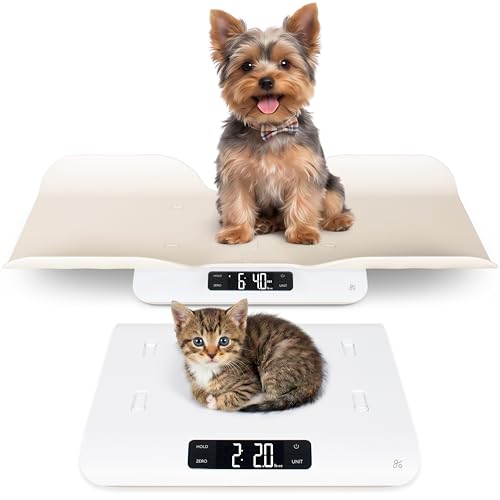


The tool for answering the one question this whole article turns on: has growth actually stopped? It reads to 0.1 lb, stabilizes the number while a wiggly puppy moves (a paw icon confirms the weight is locked), and the tare function zeroes out a blanket or bowl first.
What we love
- 0.1 lb precision makes a two-week growth plateau visible at home
- Wiggle-proof reading with a lock-in indicator for squirmy puppies
- Tare function, removable tray, and lb / lb:oz / kg modes
Keep in mind
- 44 lb capacity — large-breed puppies outgrow it long before adult size
- A real spend for something used mostly during puppyhood
The first adult bag is usually the biggest bag you've ever bought, and this food-grade HDPE vault with an airtight Gamma Seal lid keeps it fresh and pest-free to the bottom. It holds up to 30 lbs of kibble depending on kibble shape and density, and ships with a scoop.
What we love
- Airtight Gamma Seal lid locks out pests and staleness
- BPA-free, food-grade plastic made in the USA
- Scoop included
Keep in mind
- Capacity varies with kibble size — Gamma2 itself suggests sizing up one to two sizes for larger kibble
- A 40+ lb bag won't fit; you'd need the bigger model
Adult portions are usually smaller than the puppy portions you've been scooping, and this stainless set — 1 cup, 1/2 cup, 1/3 cup, and 1/4 cup — makes the new, smaller number a measurement instead of a guess. Smooth burr-free edges, wood handles with a hanging hole, and dishwasher safe.
What we love
- Four exact sizes from 1/4 cup to 1 cup replace the free-pour
- Stainless steel, dishwasher safe, under ten dollars as of July 2026
Keep in mind
- Largest scoop is 1 cup, so big-dog portions take several passes
- Measures volume only — gram-level precision still needs a kitchen scale
Frequently asked questions
What age should you stop feeding puppy food?
It depends almost entirely on breed size. The AKC's feeding guidance puts small breeds at roughly 7 to 9 months, while its breed-size transition advice runs toy and small breeds to 8–12 months, medium breeds to about 12 months, large breeds to around 15 months, and giant breeds to 18 months or more. VCA Animal Hospitals notes large dogs reach mature size between 12 and 18 months and giant breeds may not finish until 24 months, so a vet team may keep them on puppy food that long. When sources disagree like this, the practical move is to use the range, watch your dog's growth, and confirm with your vet.
Is it OK for an adult dog to keep eating puppy food?
It usually won't cause an emergency, but it works against most adult dogs over time. Puppy food carries more calories and fat per cup than adult food, and PetMD notes that dogs switched off puppy food too late may be more predisposed to obesity and its associated health problems. The exception worth knowing: a food labeled for 'all life stages' meets AAFCO's growth standards by design, so an adult dog eating one isn't eating an inappropriate food — but the portion still has to match an adult's lower calorie needs. If your adult dog is on any growth-formulated food and gaining weight, that's a portion-and-formula conversation for your vet.
Can I switch my puppy to adult food at 6 months?
For most puppies, 6 months is early. VCA Animal Hospitals notes puppies are around 75% of adult size by six months, and the common benchmark for switching is roughly 80% of expected adult size — so even small breeds are usually just arriving at readiness then, while medium, large, and giant breeds still have months of growth left. The AKC's take is that it's better to be on puppy food a little too long than not long enough. If your small-breed puppy has clearly plateaued at 6–8 months, ask your vet before switching rather than rounding down on your own.
What happens if I switch to adult food too early?
Adult maintenance food is formulated for dogs that have finished growing, so the risk of switching early is shortchanging a body that's still building bone and muscle. AAFCO publishes separate nutrient profiles for growth and for adult maintenance precisely because the requirements differ. That's why the AKC advises erring on the side of staying on puppy food a little longer rather than leaving it too soon. One early switch in an otherwise healthy puppy isn't cause for panic — move back to a growth or all-life-stages food and mention it at your next vet visit, especially for a large or giant breed still months from mature size.
About the author
James Martin
I'm an animal lover through and through. I grew up with dogs, my family always had at least one pet, and today I share my home with a rescue who is the love of my life. I started Healthy Puppy Review to help owners cut through the marketing noise and make confident, well-researched choices about their dog's health and happiness.