The Benefits of Adding Omega-3 Fish Oil to Your Dog's Diet
Omega-3 fish oil can support a softer coat, calmer skin, and healthier joints in dogs — but the EPA and DHA on the label matter far more than the words 'fish oil.' Here's what actually helps, plus the five supplements we recommend.

Contains affiliate links · our policy

In this guide
A good omega-3 supplement is one of the simplest upgrades you can make to your dog's daily routine. Done right, it can mean a softer coat, less flaky or itchy skin, and steadier support for aging joints. But the supplement aisle is confusing on purpose — bottles shout "fish oil!" while burying the numbers that actually matter. Here's what omega-3s really do for dogs, how to dose them, and how to tell a genuinely useful product from a pretty label.
What Omega-3s Actually Do for Dogs
When people say "fish oil," what they really mean are two long-chain omega-3 fatty acids: EPA (eicosapentaenoic acid) and DHA (docosahexaenoic acid). These are the components doing the work, and the benefits with the best support behind them fall into a few buckets:
- Skin and coat. This is the most popular reason owners reach for fish oil, and it's well placed. Omega-3s help reinforce the skin barrier, which can mean less flaking, less dryness, and a softer, glossier coat over time. Many dogs with itchy, irritated skin see real relief.
- Joints and inflammation. EPA in particular has anti-inflammatory effects, which is why omega-3s are commonly recommended as part of a management plan for arthritis and stiff, sore joints. They're frequently used alongside other joint support rather than as a standalone fix.
- Heart, kidney, and brain. Omega-3s are also studied for cardiovascular and kidney support in dogs, and DHA plays an important role in brain and eye development — which is why it shows up in puppy and senior formulas.
Just don't expect a miracle pill. Omega-3s are a supportive supplement, not a cure, and they work best as one part of good overall nutrition and care.
How Much to Give (and Why EPA + DHA Beats "Fish Oil" Volume)
This is the part most labels make hard, so it's worth getting right. Dosing is based on body weight and on the combined milligrams of EPA and DHA — not on how many capsules or chews you hand over. A 1,000 mg "fish oil" softgel might contain only 300 mg of actual EPA + DHA, while a concentrated one packs far more into the same capsule. Two products with identical capsule counts can deliver completely different doses.
A commonly cited range for generally healthy dogs is roughly 20–55 mg of combined EPA + DHA per pound of body weight per day, with veterinary sources citing somewhat higher ranges for specific conditions. So the only number that matters is the EPA + DHA total per serving printed on the label — find it, then do the math for your dog's weight.
A sensible approach is to start low and build up. Begin at around a quarter of your target dose and increase gradually over a week or two while watching your dog's stool, since too much too fast is the usual cause of digestive upset.
Get a dose — and a green light — from your vet
The ranges above are general guidance, not a prescription. Your veterinarian can set a target dose for your dog's weight and goals, and flag any reasons to hold off. That matters because very high doses of omega-3s may affect blood clotting, and fish oil can interact with other medications. Be especially careful before surgery, or if your dog has pancreatitis, a clotting disorder, fat intolerance, or takes other prescriptions. Watch for loose stool, vomiting, or excess gas, and dial the dose back if they appear.
Softgels vs. Chews vs. Liquid
There's no single "best" format — the right one is whichever you'll actually give every day.
- Softgels are usually the most concentrated and the easiest to dose precisely. You can hide them in food or snip one open and squeeze the oil over a meal. The catch: some dogs refuse to swallow a capsule.
- Chews are the most convenient by far — your dog thinks they're a treat, and there's no mess or measuring. The trade-off is that chews tend to deliver less EPA + DHA per piece and may include added flavorings, so read the label closely.
- Liquid oil is easy to pour over food and simple to scale up or down, which is handy for large dogs. The downsides are mess, a shorter shelf life once opened, and faster oxidation.
If your dog is on a multivitamin or other daily supplements already, consistency is the real win — pick the format that fits your routine. (For more on rounding out a dog's nutrition, see our look at a daily vitamin that works well for dogs.)
Quality and Freshness Matter More Than You'd Think
Fish oil is a fat, and fats go rancid. Oxidized (rancid) oil isn't just unpleasant — it loses potency and can contribute to the digestive upset people blame on fish oil generally. A few habits keep your supplement working:
- Buy a size you'll finish in a reasonable time rather than a giant tub that sits half-used for a year.
- Store it cool and out of direct light; many liquid oils belong in the fridge after opening.
- Trust your nose — fresh fish oil smells mildly fishy, while a sharp, sour, or "off" smell means toss it.
Look for products with sensible packaging and clear labeling of EPA + DHA content. A supplement that lists its actual fatty-acid amounts is usually one that has nothing to hide.
How We Picked
We focused on supplements that clearly support skin, coat, and joint health, then weighed how easy each is to dose, how well it suits different dogs (capsule-takers vs. chew-only picky eaters), and overall value per serving. We also confirmed every product link below is live and points to an available listing. Our top choice, the Nutramax Welactin softgels, stood out for concentrated EPA + DHA and a strong quality reputation — but each pick below earns its place for a specific dog and routine.
A shiny coat starts on the inside, but it rarely works alone. Pairing omega-3s with a vet-guided joint routine makes sense for older or stiff dogs, and if itchy skin is tied to a sensitive gut, a daily probiotic can support things from another angle.
Our top picks

A concentrated, vet-trusted softgel from a brand known for quality control. Each soft capsule delivers a strong dose of EPA and DHA, and you can twist or snip it open to squeeze the oil over food for fussy dogs.
What we love
- High, concentrated EPA + DHA per softgel
- Well-regarded brand with strong quality control
- Can be given whole or squeezed onto food
Keep in mind
- Some dogs won't swallow a softgel
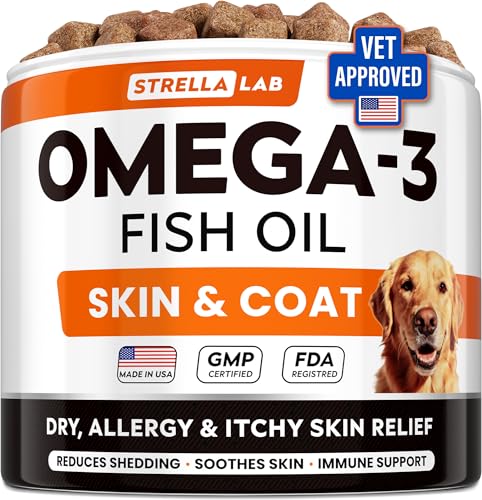
A soft chew aimed at skin, coat, and itch support that most dogs happily eat like a treat. A practical pick if capsules and liquid oil are a daily battle in your house.
What we love
- Treat-like format dogs accept easily
- Generous 180-count tub
- No mess or measuring
Keep in mind
- Lower EPA + DHA per chew than a softgel
- Check the label for added flavorings

A bacon-flavored omega-3 chew built for picky eaters who turn their nose up at fishy supplements. The flavor does the convincing so you can stay consistent day to day.
What we love
- Bacon flavor wins over picky dogs
- Easy, no-measure daily dosing
Keep in mind
- Flavoring won't suit every dog
- Verify EPA + DHA content per chew

Pairs krill oil with fish oil in a single soft chew, giving you two omega-3 sources in one daily treat. A nice option if you want to broaden the fatty-acid profile beyond fish oil alone.
What we love
- Combines krill and fish oil sources
- Convenient soft-chew format
Keep in mind
- Krill blends often cost more per mg of omega-3

A premium salmon-oil chew focused squarely on skin and coat, from a brand with a clean-ingredient reputation. The salmon source and soft format make it an easy daily habit for a glossier coat.
What we love
- Salmon-based, skin-and-coat focused
- Clean-label, premium positioning
Keep in mind
- Priciest pick on this list
Frequently asked questions
How much fish oil should I give my dog?
Dosing is based on body weight and on the actual milligrams of combined EPA and DHA — not on the number of capsules or chews. A commonly cited range for healthy dogs is roughly 20–55 mg of combined EPA + DHA per pound of body weight per day. Start at the low end, increase slowly while watching for loose stool, and ask your vet for a target dose specific to your dog, especially if a health condition is involved.
What's the difference between EPA and DHA?
EPA (eicosapentaenoic acid) and DHA (docosahexaenoic acid) are the two active omega-3 fatty acids in fish oil. EPA is most associated with calming inflammation, which is why it's emphasized for skin and joint support, while DHA plays a bigger role in brain, eye, and nervous-system development. A good supplement lists both amounts so you can dose by their combined total.
Is fish oil or salmon oil better for dogs?
Both deliver EPA and DHA — the meaningful difference is concentration, not the fish. Salmon oil and many liquid oils are less concentrated, so you pour more to hit the same EPA + DHA target, while concentrated softgels pack more into a smaller dose. Krill oil is another source. Compare products by the EPA + DHA milligrams per serving rather than by the name on the bottle.
Can fish oil have side effects in dogs?
The most common issues are mild and dose-related: loose stool, vomiting, gas, or fishy breath, usually when the dose is too high or introduced too quickly. Very high doses may affect blood clotting, so check with your veterinarian before surgery or if your dog takes other medications or has a condition like pancreatitis or a clotting disorder.
How long does it take to see a shinier coat?
Set realistic expectations. Skin and coat changes are gradual because the body has to incorporate the new fatty acids over several weeks. Many owners notice less flaking and a softer, glossier coat after about four to eight weeks of consistent daily dosing.
About the author
James Martin
I'm an animal lover through and through. I grew up with dogs, my family always had at least one pet, and today I share my home with a rescue who is the love of my life. I started Healthy Puppy Review to help owners cut through the marketing noise and make confident, well-researched choices about their dog's health and happiness.