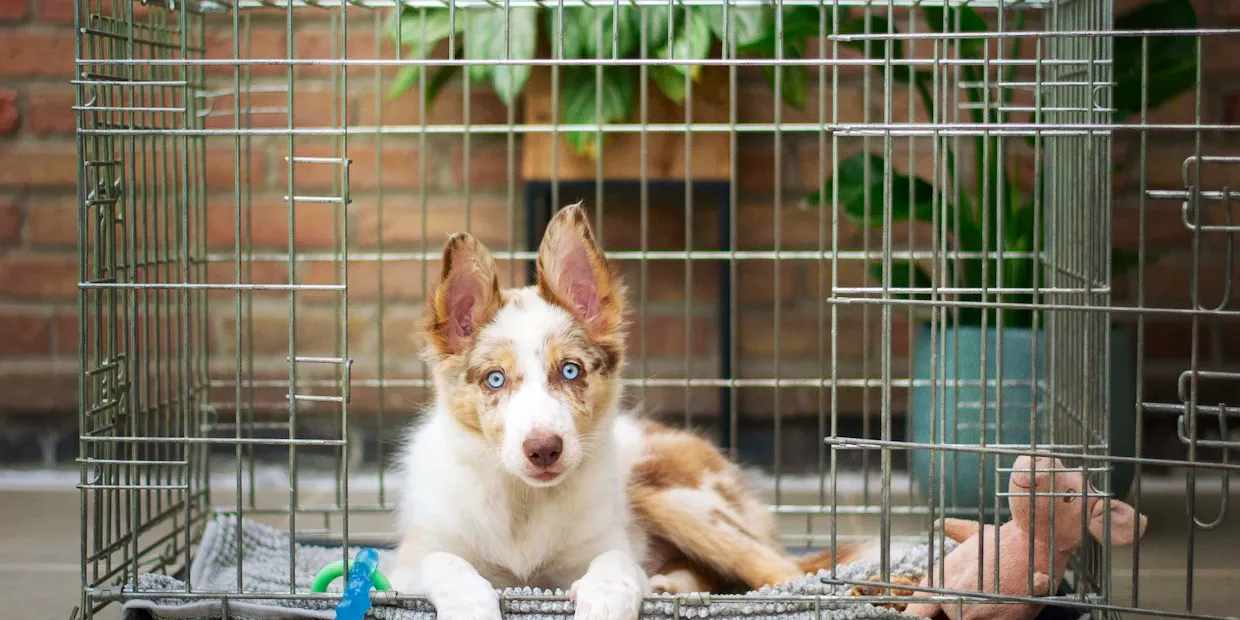
8-Week-Old Puppy Feeding Schedule: The First Weeks Home
An 8-week-old puppy does best on four small meals a day, served at the same times every day. Here's the exact schedule we'd run for the first weeks home — sample times, portion logic, water, treats, and what changes by 10 and 12 weeks.

Contains affiliate links · our policy
In this guide
- The 8-Week-Old Puppy Feeding Schedule at a Glance
- Feeding Schedule for an 8-Week-Old Puppy: How Much Goes in the Bowl
- Keep the Breeder's Food — At Least for the First Week
- Toy and Small Breeds: Skipped Meals Are a Real Risk
- Water, Mess, and What Normal Looks Like
- Treats Count Toward the Day's Food
- Meal Times Are Potty Times
- What Changes at 9, 10, and 12 Weeks
- The First Weeks, In Short
- Our Top Picks
- FAQ
Feed an 8-week-old puppy four small meals a day, at the same times every day. The American Kennel Club's feeding timeline calls four feedings a day usually adequate across roughly the 6-to-12-week window, and VCA Animal Hospitals notes that three to four meals a day breaks the day's food into smaller volumes for a puppy's small belly. Weaning typically wraps up at about eight to ten weeks — right when most of us bring one home.
That's the whole answer in one line. The rest of this guide is the part that actually gets you through the first weeks: what times to feed, how much goes in the bowl, why you shouldn't change the food yet, and what shifts at 9, 10, and 12 weeks. This is the day-one chapter of our complete puppy feeding schedule — the pillar covers the full first year; this covers the weeks when everything is new.
The 8-Week-Old Puppy Feeding Schedule at a Glance
Why four meals? VCA notes that feeding three to four meals a day breaks the day's food into smaller volumes for a puppy's small belly — at this age, the day's calories simply don't fit comfortably in one or two big meals. At 8 weeks, four is the number that squares that circle.
The exact times matter less than their consistency. Anchor the meals to your household's real day, keep them roughly evenly spaced across waking hours, and hold them steady. Here's the shape we'd run:
| Time | Meal | Notes | |------|------|-------| | 7:00 a.m. | Breakfast | Soon after waking; potty trip immediately after | | 11:30 a.m. | Lunch | Mid-day meal; another potty trip follows | | 3:30 p.m. | Third meal | The one that disappears first as your puppy grows | | 6:30 p.m. | Dinner | Early enough that the last potty trips land before bedtime |
Two working rules make this schedule function. First, serve the meal and pick up whatever's left after about 15 minutes — a commonly cited practice that discourages picky grazing and, more usefully at this age, tells you immediately when a meal was skipped. Second, keep dinner on the early side. A common rule of thumb is to finish the last meal two to three hours before bed, so the evening potty trips happen before lights-out instead of at 2 a.m.
If your puppy inhales food like it's a race, a maze-bottomed slow feeder is the cheap fix — the small Outward Hound bowl holds 3/4 cup, which fits an 8-week-old's portions. But don't buy problems you don't have yet; a plain bowl and a steady schedule are enough for most puppies.
Feeding Schedule for an 8-Week-Old Puppy: How Much Goes in the Bowl
Start with the chart printed on the food bag. It's calibrated to that recipe's calorie density, which generic internet numbers are not. Find your puppy's age and expected adult weight, take the daily amount, and divide it by four. Write the per-meal scoop on a sticky note near the food bin so everyone in the house serves the same portion.
Then verify with the scale, not the bowl. Weigh your puppy weekly — the bathroom-scale trick works fine at this size: weigh yourself holding the puppy, weigh yourself alone, subtract. Steady weekly gain is the goal. Purina's long-running life span study links keeping dogs lean from a young age to longer, healthier lives, so resist the urge to round every scoop up. A soft potbelly after meals is normal right now — the AKC's feeding timeline notes a puppy should be losing that potbelly and pudginess by about 12 weeks.
For converting the bag's numbers into actual portions for your puppy's weight — and sanity-checking a chart that seems off — our puppy feeding chart does the math by age and weight.
Keep the Breeder's Food — At Least for the First Week
Whatever the breeder, shelter, or rescue was feeding, keep feeding it. Homecoming week already asks a lot of a small digestive system — new house, new water, new stress — and the food is the one variable you can hold constant.
The AKC's guidance on switching foods is blunt about why: an abrupt change can cause vomiting, diarrhea, and a decreased appetite. If you do want to move to a different puppy food, wait until your puppy has settled in, then transition gradually over about a week — the AKC's example runs 25 percent new food on day one, 50 percent by day three, 75 percent by day five, and 100 percent at day seven, stretching longer for sensitive stomachs.
One texture note for this age: many 8-week-olds handle dry kibble better with a splash of warm water to soften it, and that's normal, not fussy. The AKC's timeline has large-breed puppies eating unmoistened dry food by 9 or 10 weeks and small dogs by 12 or 13 weeks, so a softened bowl at 8 weeks is right on schedule.
Toy and Small Breeds: Skipped Meals Are a Real Risk
For most puppies, a missed meal is information. For a two-pound toy breed, it can be a genuine problem — and this is the one part of the schedule we'd treat as non-negotiable.
Very small puppies are prone to hypoglycemia — low blood sugar. Purina Pro Club explains that toy-breed puppies haven't fully developed the ability to regulate blood glucose and can deplete their reserves between meals, especially when they're active, cold, or stressed — which describes homecoming week exactly. The AKC lists the signs: drowsiness or lethargy, weakness, trembling, loss of balance, and in serious cases seizures or collapse.
This is why small, frequent meals aren't optional for the little breeds — and why the response to those signs is a veterinarian, not a home remedy. Notice it, call, go. It is not a condition to manage off a blog post, including this one.
When the schedule becomes a vet call
Call your veterinarian promptly if your 8-week-old refuses two meals in a row, is unusually lethargic, or shows weakness, wobbliness, or trembling — especially if you have a toy or small breed, where low blood sugar can develop between meals. New-home nerves can soften an appetite for a meal or two; a puppy who is both not eating and acting "off" is a different situation, and at this age the safe move is a phone call the same day, not watchful waiting.
Water, Mess, and What Normal Looks Like
Keep fresh water available throughout the day. Scheduled meals, yes — scheduled water, no. If you're deep in house-training, many trainers suggest picking the water bowl up a couple of hours before bed, but that's a bedtime tactic, not a daytime policy, and it's worth running past your vet if your puppy seems to drink unusually large amounts.
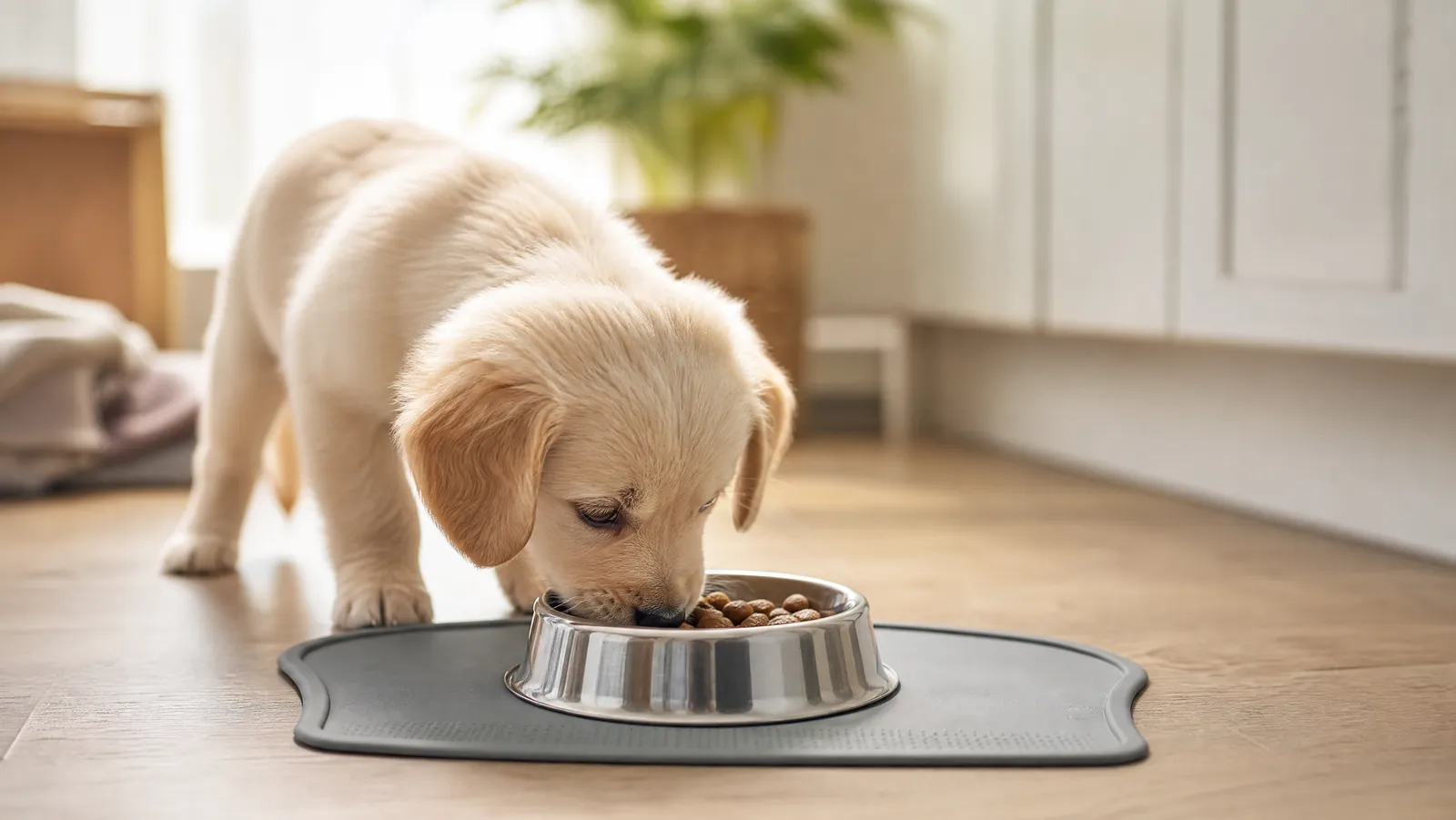
And accept now that an 8-week-old at a bowl is a mess. Paws in the water dish, kibble carried three feet away and eaten off the floor, a wet chin dragged across the kitchen — all standard. It fades as coordination arrives; it isn't a training problem to fix at this age. If it bothers you, solve it with hardware, not scolding: a non-slip bowl that stays put (the PEGGY11 pair runs $11.99 as of July 2026) and a silicone mat with a raised edge under the whole station catch most of it. That's the entire feeding-gear list we'd actually buy for week one — two bowls, maybe a mat, and nothing else until a real problem shows up.
Treats Count Toward the Day's Food
You'll be treating constantly right now — name response, potty rewards, crate games — and every one of those calories is part of the day's total. VCA Animal Hospitals' guidance is that treats should not exceed 10 percent of daily calories — which leaves the other 90 percent of the day's intake to come from complete and balanced food; the AKC cites the same 10 percent rule and adds the practical corollary — if treats creep up, trim the meals slightly to compensate.
The easy way to stay inside the line at this age: use part of the day's kibble ration as training treats, and save the special stuff for the wins that matter. An 8-week-old is not a demanding audience — their own dinner, delivered one piece at a time from your hand, is a jackpot.
Meal Times Are Potty Times
Here's the quiet payoff of a fixed schedule: it does half your house-training for you. What goes in on a schedule comes out on a schedule — young puppies typically need to go within minutes of finishing a meal, so four fixed meals hand you four predictable potty windows. Be at the door right after each meal and you're rewarding successes instead of cleaning up misses.
This is also where feeding and crate training reinforce each other: eat, out, play, rest, repeat. The rhythm only works if the meals hold still, which is one more reason we'd resist free-feeding — food available all day means potty needs smeared across all day, and your best predictor gone.
What Changes at 9, 10, and 12 Weeks
The honest answer: less than the internet implies. A week-by-week puppy feeding schedule mostly means the same four meals with slowly growing portions.
- 9 weeks: identical schedule. Portions creep up — recheck the bag chart against your puppy's new weight after each weekly weigh-in. Larger breeds may be ready for unmoistened kibble around now, per the AKC's 9-to-10-week note.
- 10 weeks: still four meals for most puppies. If a big-breed pup starts leaving the mid-afternoon meal, ask your vet whether consolidating to three is reasonable — but there's no prize for dropping a meal early.
- 12 weeks: the transition window opens. The AKC's timeline has puppies dropping from four feedings to three sometime in the 3-to-6-month stretch, and says the potbelly should be disappearing by now. Small breeds are typically ready for dry, unmoistened food by 12 or 13 weeks.
When a meal does get dropped, consolidate — same daily total, redistributed across three servings, not a cut. For the full staircase from four meals down to two, and where your puppy's breed size bends the rules, see our guide to how often to feed a puppy.
The First Weeks, In Short
Four meals a day at fixed times. The breeder's food, unchanged, for at least the first week — then a gradual seven-day transition if you're switching. Portions from the bag chart divided by four, verified by a weekly weigh-in. Water down all day, treats inside 10 percent of calories, a potty trip after every meal. And a low bar for calling the vet: two refused meals, lethargy, or wobbliness gets a phone call the same day.
Hold that steady for a month and you'll arrive at the 12-week mark with a puppy who eats calmly, potties predictably, and trusts the routine — which is most of what "well-started" means. For everything that comes after, from dropping to three meals through the switch to adult food, Healthy Puppy Review's feeding guide walks the whole first year.
Our top picks


Two 2-cup stainless steel bowls — one for food, one for water — with an anti-slip silicone bottom that stops an enthusiastic 8-week-old from hockey-pucking the bowl across the kitchen. Stainless and silicone construction, BPA-free, and the whole thing goes in the dishwasher.
What we love
- Anti-slip silicone base keeps the bowl in place and cuts mealtime noise
- Covers both bowls a new puppy needs in one purchase
- Stainless steel, BPA-free, dishwasher safe
Keep in mind
- Sized for pets under 20 pounds — a medium or large breed will outgrow the 2-cup capacity
A maze-bottomed bowl the manufacturer says slows eating up to 10X, in a 3/4-cup size made for extra-small and small breeds, puppies, and cats. It comes in three slow levels, sits on a non-slip base, and is top-rack dishwasher safe with no BPA, PVC, lead, or phthalates.
What we love
- Maze design rated by the maker to slow gulpers up to 10X
- 3/4-cup capacity matches small-puppy meal sizes
- Non-slip base; top-rack dishwasher safe
Keep in mind
- A growing large-breed puppy outgrows the 3/4-cup size quickly
- Some puppies need a few meals to make peace with the maze
A waterproof, food-grade silicone mat measuring 18.5 by 11.5 inches, with 1/8-inch raised edges that catch the water an 8-week-old reliably flings out of the bowl. Raised dots on the surface keep bowls from sliding, and the whole mat rinses or wipes clean.
What we love
- 1/8-inch raised edges contain drips and splashes
- Textured, slip-resistant top keeps bowls put
- Waterproof BPA-free silicone that rinses clean
Keep in mind
- The low edge contains everyday mess, not a full bowl tip-over
Frequently asked questions
How much food should an 8-week-old puppy eat per day?
It depends on the food and on your puppy's expected adult size, which is why the feeding chart printed on the bag is the right starting point — it's calibrated to that specific recipe's calories. Find the row for your puppy's age and projected adult weight, take the daily total, and split it into four equal meals. Then treat it as a starting point, not a verdict: weigh your puppy weekly, and nudge portions up or down based on growth and body condition rather than appetite alone. Your vet can confirm the target at the first checkup, which should be within the first week home.
Can I free-feed an 8-week-old puppy instead of scheduled meals?
We'd skip free-feeding. Leaving food out all day makes it hard to notice the single most useful early-warning sign you have — a skipped meal — and it smears potty timing across the whole day, which makes house-training slower. Four scheduled meals give you four appetite checks and four predictable potty windows. There is one nuance: for tiny toy-breed puppies, some vets do recommend more frequent access to food to keep blood sugar steady. If you have a very small puppy, ask your vet what schedule they want, and follow that over any article, including this one.
When should a puppy go from four meals a day to three?
Not yet at 8 weeks. The American Kennel Club's feeding timeline keeps puppies at four feedings a day through roughly the 6-to-12-week window, then drops to three meals somewhere in the 3-to-6-month stretch. In practice the puppy usually tells you: when they start picking at or ignoring one of the four meals — commonly the mid-afternoon one — their stomach has grown enough to take the same daily food in three larger servings. Consolidate the portions rather than cutting them, keep the remaining times fixed, and check with your vet if you're unsure your puppy is ready.
My 8-week-old puppy isn't eating — should I worry?
A slightly dented appetite in the first day or two home can be nerves — new house, new people, no littermates. Keep the routine calm, offer the same food the breeder or shelter used, and give it a little time. But the threshold for calling a vet is low at this age: a puppy who refuses two meals in a row, seems unusually tired, or acts weak or wobbly needs a prompt call — especially a toy or small breed, where low blood sugar can develop quickly. Skipping one meal is worth watching closely; skipping two is worth a phone call, not a wait-and-see.
About the author
James Martin
I'm an animal lover through and through. I grew up with dogs, my family always had at least one pet, and today I share my home with a rescue who is the love of my life. I started Healthy Puppy Review to help owners cut through the marketing noise and make confident, well-researched choices about their dog's health and happiness.