The Best Slow Feeder Bowls for Puppies
The best slow feeder bowl for puppies is the cheapest one that holds an entire meal and uses the simplest maze. Here's how to size one correctly, why a slow feeder is not bloat insurance, and the five bowls we'd actually consider — plus the free version that works just as well.

Contains affiliate links · our policy
In this guide
- Do slow feeder dog bowls actually work?
- Size the bowl to the meal, not to the puppy
- Do anti-gulping dog bowls prevent bloat? An honest answer
- Safety checks before a puzzle bowl for fast eaters hits the floor
- How to introduce a slow feeder without a frustrated puppy
- The five slow feeders we'd actually consider
- Cleaning: the part everyone skips
- You can do this for $0
- What we'd actually buy
- Our Top Picks
- FAQ
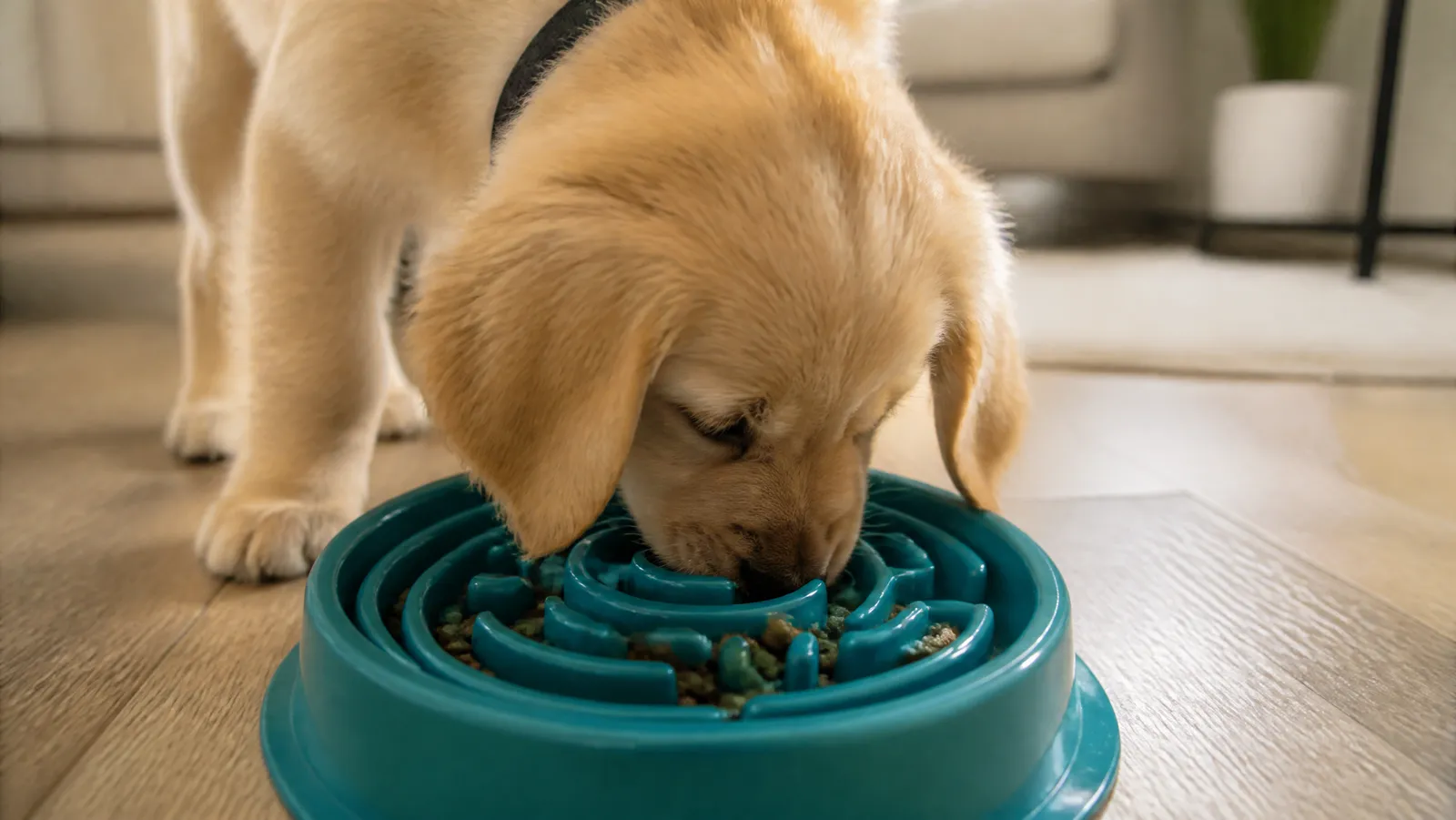
The best slow feeder bowl for puppies is almost always the cheapest one that holds an entire meal and uses the simplest maze pattern. We'd start with the small Outward Hound Fun Feeder Slo Bowl — $6.39 as of August 2026, 3/4-cup capacity, easiest difficulty level — and size up the moment your puppy's portion outgrows it. That is most of the decision.
The rest of this guide covers the two mistakes that actually cost you something: buying a bowl that can't hold one meal, and buying a maze so aggressive your puppy walks away from dinner. Neither is solved by spending more. Both are solved by knowing your puppy's real per-meal portion, which comes from your puppy feeding schedule and portions, not the bowl's packaging.
And the quiet part, early: this is a $7 to $20 category carrying a great deal of marketing weight. A slow feeder is cheap and genuinely useful. It is not a medical device, and no bowl prevents bloat.
Do slow feeder dog bowls actually work?
Yes — at the one narrow thing they claim, though the evidence base is small. A study by Louise Buckley and Josie Lees at Harper Adams University, published in Veterinary Evidence, tested 10 adult pet dogs and found that go-slow feeding bowls reduced how quickly dogs ate, and that while dogs got faster with practice, they still ate more slowly than they did from a standard bowl. That's the honest ceiling of the evidence: in a 10-dog study, these bowls slowed eating down.
Notice what that finding does not include. It does not show a slow feeder makes a dog healthier, happier, or safer. The same paper cautioned against selling these devices as fun, because the researchers found no evidence dogs wanted their rate of eating slowed. Marketing that pitches a maze bowl as a treat for your dog is running ahead of the data.
You'll also see one number everywhere in this category: Outward Hound's own copy says the Fun Feeder design "slows down eating up to 10X." That is the manufacturer's claim, not an independent test result. The useful information on those packages is the difficulty level — Slow, Slower, Slowest — not the multiplier.
So what's the real case for a puppy? According to the American Kennel Club, dogs who eat too fast gulp down an excessive amount of air along with the food, and the AKC lists choking, vomiting, and discomfort as the near-term risks. Those are the things you see at 7 a.m.: a bowl emptied in nine seconds, a puddle of returned kibble four minutes later, a gassy dog. Slowing the meal is a cheap, reasonable response — and four minutes of problem-solving instead of nine seconds of inhaling is worth $7 on its own.
Size the bowl to the meal, not to the puppy
This is the section that saves you a second purchase: capacity is the spec that matters, and almost nobody checks it before buying.
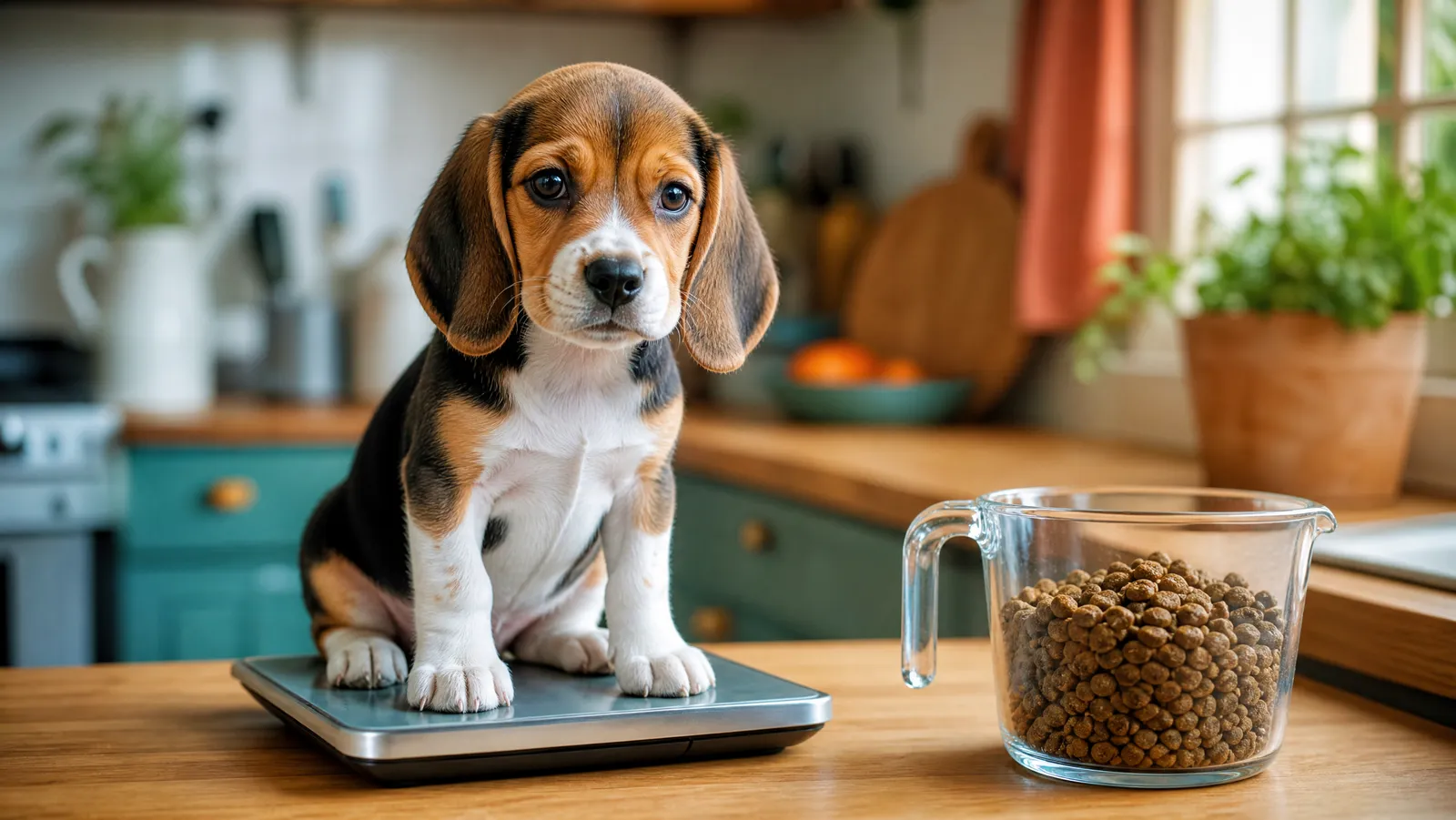
A slow feeder has to hold the entire meal with room left for the maze to do its job. Kibble sitting proud of the ridges defeats the design — your puppy eats the pile off the top, then works the channels. Start from the per-meal number on your food's feeding chart and buy a bowl rated above it. Our puppy feeding chart by age and weight gives you that figure; without it you're guessing at a spec you can't return.
Two things make this harder than it sounds:
- The portion is a moving target. A puppy's daily ration climbs steeply through growth while meals per day drop — so each meal gets bigger twice over. A 3/4-cup bowl that fits a 10-week-old Lab's dinner will not fit the same dog at five months.
- Bowl sizes are named, not measured. "Small" and "large" mean nothing across brands. The small Fun Feeder holds 3/4 cup; the large holds 4 cups — a five-fold difference behind two adjectives, with the STAOVA ceramic between them at a manufacturer-stated 1.5 cups.
Our rule: if you're between sizes and the puppy is still growing, buy up. The larger bowl costs three or four more dollars and will still be in service a year from now.
One last point that isn't about volume: a slow feeder only does its job on a measured, scheduled meal. It is not a way to make an all-day bowl safer — if food sits out continuously, a maze just spreads the same grazing across more crevices and hides how much your puppy ate. If that question is still open, read our comparison of free-feeding versus scheduled meals before you buy any bowl.
Do anti-gulping dog bowls prevent bloat? An honest answer
No. And the way this question gets used to sell bowls is the least honest thing about the category.
Gastric dilatation-volvulus is real and it is catastrophic. Cornell University's Riney Canine Health Center describes GDV as occurring suddenly and states that without medical and surgical intervention it is fatal. Cornell's risk factors include eating too quickly — so a fast eater does carry a cited risk factor, and slowing the meal addresses it.
But addressing a risk factor is not the same as preventing a disease, and the evidence that slow feeders reduce actual GDV incidence is limited. If a product page tells you a bowl prevents bloat, that's a claim it cannot support.
Two facts should reframe this for puppy owners:
GDV is largely an adult, large-breed, deep-chested problem. Cornell lists large, deep-chested dogs — Great Danes, Saint Bernards, Weimaraners — as most at risk, along with older age, and the landmark Purdue University cohort study of large and giant breeds published in the Journal of the American Veterinary Medical Association found risk rising with each year of age. Buying a $7 bowl for an 11-week-old puppy out of fear of an emergency that mostly strikes older large and giant breed dogs is the wrong reason. The right reasons are near-term: gulping, choking, regurgitated meals, gas, and building a calm mealtime habit now, while the dog is 15 pounds instead of 90.
Raised feeders are the counterintuitive part. That same Purdue work identified a raised feeding bowl as a risk factor for GDV in large and giant breeds — reversing the conventional wisdom of the time — and Cornell now lists raised food bowls among its risk factors. That's observational research, not a controlled trial, and it concerns large and giant breeds. Still, if you have a large-breed puppy and were planning to put a slow feeder on an elevated stand, raise it with your vet first.
Bloat is an emergency — go immediately, don't wait it out
Cornell lists the signs of GDV as non-productive retching or attempting to vomit with nothing produced, excessive drooling, a bloated abdomen, pale gums, restlessness, and weakness. If you see these, this is not a wait-and-see situation — Cornell states GDV requires immediate medical and surgical intervention and is fatal without it. Drive to an emergency veterinary hospital now, and call them from the road so they're ready for you.
Safety checks before a puzzle bowl for fast eaters hits the floor
Three groups of puppies need more thought than "add bowl, add food."
Flat-faced puppies. Pugs, French bulldogs, and Boston terriers have short muzzles that make deep, narrow channels awkward — they can't get into a tight groove the way a Labrador can. We haven't found a controlled study on maze geometry and brachycephalic dogs, so treat this as mechanical judgement, not a research finding: choose a shallow, wide pattern, and supervise early meals. The STAOVA ceramic's raised pattern, a manufacturer-stated 1.89 inches high, is the shape we'd try first; the large Fun Feeder's deep Notch maze is what we'd avoid.
Chewers. Some puppies decide the bowl is the toy. A puppy who gnaws the rim instead of eating from the maze is an ingestion risk, and swallowed plastic or silicone fragments are a real veterinary problem. Supervise early meals, put the bowl away between them, and retire any bowl with visible bite damage — plastic and silicone alike.
Frustrated puppies. The failure mode nobody warns you about is a puppy who gives up. If the maze makes dinner a chore, some puppies stop eating it, and an under-eating growing puppy is a much bigger problem than a fast-eating one. Start easy; escalate only if your puppy is clearly cruising through meals.
When the bowl isn't the answer
If your puppy regularly regurgitates meals, gags, coughs around food, seems painful after eating, or is losing condition, that needs a veterinary exam — not a different bowl. Fast eating is one explanation for those signs, but it isn't the only one, and several of the alternatives are treatable. The AKC's own guidance on fast eaters starts with a complete veterinary check-up to make sure there's no underlying medical condition behind the behaviour. A $7 bowl is not a diagnosis.
How to introduce a slow feeder without a frustrated puppy
- 1
Start with the easiest maze you can buy
Buy the lowest difficulty level in the size you need — for Outward Hound that's the SLOW level, not Slower or Slowest. You can always make a bowl harder later. You cannot easily un-teach a puppy who has decided the food bowl is a losing battle.
- 2
Serve the normal portion, not a smaller one
Don't reduce the meal because it's going to take longer. Measure exactly what you'd have measured into a plain dish. The goal is to change the pace of the meal, not the amount.
- 3
Supervise the first several meals
Watch the first three or four dinners. You're checking that your puppy can get food out of the channels, isn't chewing the bowl instead of eating, and finishes. If a meal is left half-eaten twice running, the maze is too hard — go back to a plain dish and try an easier pattern.
- 4
Work up in difficulty only if they're breezing through it
If your puppy is emptying the easy maze in under a minute after a couple of weeks, step up: a harder pattern, or a splash of warm water to make the kibble stickier. The Harper Adams work found dogs speed up with experience, so some escalation is expected — just make it your choice rather than a surprise.
The five slow feeders we'd actually consider
For most puppies, the small Outward Hound Fun Feeder Slo Bowl is where we'd start. It's $6.39 as of August 2026, holds 3/4 cup, and — critically — it's the brand's easiest SLOW level in a shallow bowl. Its limitation is the obvious one: a medium or large puppy outgrows 3/4 cup, sometimes within months.
Large-breed puppies should skip to the 4-cup Fun Feeder at $10.19 as of August 2026, with a caveat. It uses Outward Hound's Notch pattern, which the brand describes as its most challenging maze, in a deeper bowl — a lot of difficulty for a first slow feeder. Buy it for the capacity and make the first few meals easier with a splash of warm water.
The STAOVA ceramic bowl is the flat-faced pick and the anti-scrubbing pick. At $19.99 as of August 2026 it's the expensive option, and ceramic chips or breaks if a puppy flips it. But the raised pattern is shallower than a maze, the manufacturer states it's 8.15 inches wide and holds 1.5 cups, and a weighted base plus an anti-slip pad keeps it put.
The Bifeaw silicone bowl earns its place on versatility, not capacity. The manufacturer states it's freezer, microwave, and dishwasher safe and doubles as a lick mat — so wet food can be smeared in and frozen into a genuinely long meal. At a manufacturer-stated 7.5 by 1.2 inches it's shallow, better for wet food than a big dry dinner. Supervise it with chewers.
On budget, the YINEYA maze bowl at $6.98 as of August 2026 has one detail we like: the manufacturer states the maze is of moderate width, specifically to make cleaning easier. Anyone who has scraped dried food from a narrow channel knows why that matters. The frustration is that no capacity is published, so you can't check it against your puppy's portion before it arrives.
Cleaning: the part everyone skips
A maze bowl is a crevice machine. Food packs into the channels, and the corners where ridges meet the base are the last place a sponge reaches.
The FDA's pet food handling guidance recommends washing pet food bowls and scooping and measuring utensils with soap and hot water after each use, and using a clean scoop rather than the bowl itself to measure food. That's a daily job, not a weekly one. NSF International's study of household germ hot spots put pet food dishes fourth among the germiest items tested, behind kitchen sponges, sinks, and toothbrush holders — and a maze bowl is a plain dish with extra hiding places.
Per their manufacturers, both Outward Hound bowls are top-rack dishwasher safe, STAOVA's glazed ceramic is dishwasher and microwave safe, Bifeaw's silicone is dishwasher, microwave, and freezer safe, and the YINEYA maze cleans by hand or machine. Even so, run a brush through the channels first — dishwashers move water, not scrubbing.
You can do this for $0
If you don't want to buy anything, don't. The AKC's guidance on slowing dogs down includes several free methods that work on the same principle:
- Invert a smaller dish inside a larger one. The AKC describes exactly this: set a bowl one or two sizes bigger on the floor, then put your puppy's regular dish upside down inside it. Your puppy eats around the ring — same physics as a maze, for nothing.
- Use a muffin tin. Spread the meal across the cups. The AKC notes this breaks the meal into smaller portions and eliminates excessive gulping. Anything you set on top as an obstacle must be too large to swallow — Preventive Vet is explicit that rocks and sticks should not be used as blockers, because they are both a choking hazard and a risk of intestinal blockage or perforation.
- Scatter the meal. Spread kibble across a snuffle mat, a towel, or the lawn. It slows eating and adds foraging work.
- Hand-feed the meal as training rewards. Our favourite for an 8-to-12-week-old puppy: it slows the meal to a crawl and buys a hundred repetitions of sit and recall a day using food you were going to serve anyway.
None of this is a compromise. A puppy eating dinner one piece at a time out of your hand is eating slower than any bowl can manage.
What we'd actually buy
If your puppy inhales meals and you want a bowl, buy the small Outward Hound Fun Feeder if their per-meal portion fits under 3/4 cup, and the 4-cup version if it doesn't or soon won't — both under $11 as of August 2026. Choose the STAOVA ceramic instead for a flat-faced puppy, or if you hate scrubbing plastic. Then wash it daily, supervise the first week of meals, and re-check the capacity in two months when the portion has moved.
And keep it in proportion. A slow feeder changes the pace of a meal. It doesn't change what's in the meal, how much there should be, or when it arrives — and those three matter far more to a growing puppy than the shape of the bowl. If any of them are still open questions, start with Healthy Puppy Review's puppy feeding guide and come back to the bowl afterwards.
Our top picks


The shallow, simple maze in this small Fun Feeder is the right starting difficulty for a puppy, and at 3/4 cup it suits extra-small to small breeds, puppies, or cats per the manufacturer. Outward Hound's own copy says the design slows eating up to 10X, which is a marketing claim rather than an independent measurement — the useful part is that it's the SLOW level, the easiest of the brand's three.
What we love
- Easiest maze difficulty, which is exactly where a puppy should start
- Non-slip base and top-rack dishwasher safe
- Cheapest way to find out whether your puppy needs one at all
Keep in mind
- The 3/4-cup capacity will be outgrown by a medium or large puppy, often within months
- Dried wet food sets hard in the maze grooves and needs real scrubbing
Four cups of capacity is the reason to buy this one: a growing large-breed puppy's per-meal portion climbs past a small bowl quickly, and this size has room to spare. It uses the brand's Notch pattern, which Outward Hound describes as its most challenging maze, in a deeper bowl aimed at medium to large breeds.
What we love
- 4-cup capacity keeps up with a large-breed puppy's growing portions
- Same non-slip base and top-rack dishwasher-safe construction as the small
- Still under $11 as of August 2026
Keep in mind
- The deep, complex Notch maze is too much for a young puppy or a flat-faced breed to start with
- Oversized for a small-breed puppy, who will scatter kibble chasing it around the channels

A weighted ceramic bowl with a raised pattern instead of a deep maze, which makes it a sensible shape for a flat-faced puppy who struggles with narrow channels. The manufacturer states it measures 8.15 inches wide by 1.89 inches high, holds 1.5 cups, and is dishwasher and microwave safe, with an anti-slip pad under the weighted base.
What we love
- Wide and shallow — easier for short-muzzled puppies than a deep maze
- Weighted base plus a grip pad genuinely resists being shoved across the floor
- Glazed surface wipes clean without the crevice problem plastic mazes have
Keep in mind
- Ceramic can chip or break if a puppy flips it, and a chipped edge means the bowl is done
- Roughly three times the price of the cheapest plastic bowls here
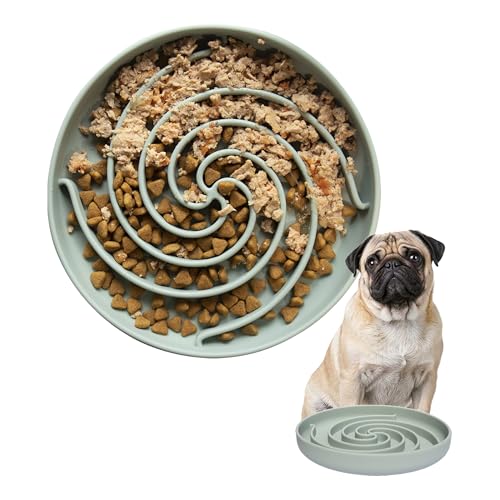
Flexible silicone that the manufacturer states is freezer, microwave, and dishwasher safe, which is the point — you can smear wet or fresh food into it, freeze it, and stretch a meal out considerably. The manufacturer states it measures 7.5 by 1.2 inches and holds roughly 1 to 2 cups, and suggests it doubles as a lick mat.
What we love
- Freezer-safe, so wet or raw-style food can be turned into a long, slow meal
- Doubles as a lick mat, per the manufacturer, which earns it more use than a bowl alone
- Soft and flat — no hard rim for an enthusiastic puppy to knock a tooth on
Keep in mind
- Silicone is chewable, so it needs supervision and retirement at the first bite mark
- Shallow profile makes it a poor fit for a big dry-kibble meal

A food-grade polypropylene maze bowl at $6.98 as of August 2026, with non-slip rubber pads on the base. The manufacturer describes smooth raised ridges intended not to scrape the mouth, nose, or tongue, and states the maze is of moderate width, which is the detail that makes it easier to clean by hand or in the dishwasher.
What we love
- Wider maze channels are meaningfully easier to scrub than narrow ones
- Non-slip rubber pads keep it from sliding on hard floors
- Costs about the same as a bag of training treats
Keep in mind
- The manufacturer does not publish a capacity, so you cannot size it against your puppy's portion before it arrives
- Plastic is chewable, and a puppy who bites chunks off it needs a different bowl
Frequently asked questions
Do slow feeder bowls actually work?
At the narrow thing they claim — slowing the rate of eating — the evidence points that way, but it is thin. A small study by Louise Buckley and Josie Lees at Harper Adams University, published in Veterinary Evidence, tested 10 adult pet dogs and found that go-slow feeding bowls reduced how fast dogs ate, and that although dogs got quicker with practice, they still ate more slowly than they did from a standard bowl. That is a modest finding from a small sample. It does not tell you a slow feeder improves your puppy's health, and the same paper cautioned against marketing these bowls as something dogs enjoy, since the researchers found no evidence dogs wanted their eating slowed down.
Are slow feeder bowls safe for puppies?
For most puppies, yes, with supervision for the first several meals. Three situations need extra care. Flat-faced puppies — pugs, French bulldogs, Boston terriers — have short muzzles that make deep, narrow maze channels genuinely hard to work, so choose a shallow, wide pattern. Puppies who chew the bowl instead of eating from it are an ingestion risk; retire any bowl with bite damage, plastic or silicone. And a puppy who gives up on dinner because the maze is too hard is a worse outcome than a puppy who eats fast. Start with the easiest pattern available.
What size slow feeder does my puppy need?
Size by the portion, not by the puppy. The bowl has to hold one full meal with room for your puppy's muzzle to move through the maze, so start from the per-meal amount on your food's feeding chart and buy a capacity above it. A 3/4-cup bowl cannot serve a 1.5-cup meal, and a puppy's portion climbs fast during growth — a large-breed puppy can outgrow a small bowl in a couple of months. If you are between sizes and your puppy is still growing, buy up. The larger bowl costs a few dollars more and will still be in service next year.
Do slow feeders prevent bloat?
No, and we would not buy one on that basis. Gastric dilatation-volvulus is a genuine, life-threatening emergency, and Cornell's Riney Canine Health Center lists eating too quickly among its risk factors, alongside large deep-chested conformation, older age, and using a raised food bowl. But addressing a risk factor is not the same as preventing a disease, and there is limited evidence that slow feeder bowls reduce GDV incidence. GDV is also overwhelmingly a large-breed, deep-chested, adult problem — the Purdue research found risk rising with each year of age. For a puppy, the honest reasons are gulping, choking, regurgitation, gas, and enrichment.
About the author
James Martin
I'm an animal lover through and through. I grew up with dogs, my family always had at least one pet, and today I share my home with a rescue who is the love of my life. I started Healthy Puppy Review to help owners cut through the marketing noise and make confident, well-researched choices about their dog's health and happiness.