Is Raw Dog Food Safe for Puppies? What the Recalls and the Vets Say
Every major veterinary and public-health body in the US discourages raw feeding, and the recall record explains why. Here's the honest case for and against raw for a puppy, what freeze-drying and HPP really do, and the handling routine to follow if you feed it anyway.

Contains affiliate links · our policy
In this guide
Short answer: no, raw dog food is not considered safe for puppies by the organizations that set veterinary standards in the US. The AVMA discourages feeding raw or undercooked animal-sourced protein to dogs and cats, the FDA says the single best thing you can do to prevent foodborne infection is not to feed a raw diet, and the CDC does not recommend raw pet food at all.
That is the verdict, and it deserves the rest of this article, because the reasons behind it are specific and the middle-ground options are real. If you are still building the basics of mealtimes, our puppy feeding guide covers schedule and portions; this piece is about one decision inside it.
What the AVMA, FDA, and CDC Actually Say
Start with the primary sources rather than the forums. The AVMA's raw feeding position states that it "discourages feeding any raw or undercooked animal-sourced proteins (e.g., meat, poultry, fish, egg, milk) to dogs and cats because of their risk to human and animal health." The policy names the pathogens it is worried about — Salmonella, Campylobacter, E. coli, Listeria monocytogenes, and highly pathogenic avian influenza among them — and adds that people handling contaminated raw pet foods are also at risk of becoming sick.
The FDA's consumer guidance is blunter. In its Get the Facts advisory on raw pet food, the agency states that because raw pet food is more likely than processed pet food to contain harmful bacteria, the single best thing you can do to prevent infection is to not feed your pet a raw diet. That advice came out of the agency's own testing: in a two-year study, FDA's Center for Veterinary Medicine analyzed 196 samples of commercially available raw dog and cat food and found 15 positive for Salmonella and 32 positive for Listeria monocytogenes.
The CDC's pet food safety guidance closes the loop on the human side: raw pet food can make dogs and cats sick, and the agency does not recommend feeding it. Infected pets can shed bacteria in their feces and saliva without ever looking ill, which is how a dog's dinner becomes a family's problem.
None of these organizations sells kibble. They are describing a contamination rate, not a brand preference.
Households where raw is the wrong experiment
If anyone in your home is pregnant, under five, over 65, or immunocompromised, the calculus changes. The FDA specifically flags that Listeria monocytogenes can cause serious illness and death in people who are pregnant, very young, very old, or have weakened immune systems, and the AVMA notes that apparently healthy dogs can carry these organisms subclinically and pose a risk to the people around them. A crawling toddler and a raw-fed puppy share the same floor.
Raw Dog Food Recalls Are Not a Hypothetical
The strongest argument against raw for a puppy is not a position statement — it is the recall log.
In December 2024, Portland-based Northwest Naturals voluntarily recalled a batch of its 2-pound Feline Turkey Recipe raw frozen pet food after a strictly indoor Oregon cat contracted H5N1 bird flu and died; the AVMA's reporting notes the product had been distributed across a dozen states and into British Columbia. Weeks later, on December 31, 2024, Los Angeles County warned about a separate raw brand after one cat in a household tested positive for H5N1 and four others in the same home were presumed infected.
Then it happened again. On March 1, 2025, Olympia, Washington-based Wild Coast Raw voluntarily recalled lots of its Frozen Boneless Free Range Chicken Formula raw cat food over possible H5N1 contamination, according to the FDA recall notice. State agriculture department sampling in Oregon and Washington had matched the strain found in affected cats to the product itself.
Those cases involved cats, which have been the animals falling ill in these particular incidents. But the contamination pathway — raw poultry ingredients carrying a live virus into a sealed retail package — has nothing to do with species. It is a reminder that a commercial label and a freezer case do not constitute a kill step.
Why Puppies Are the Highest-Stakes Case
Adults and puppies do not face the same odds, for two separate reasons.
The immune reason. The FDA notes that pets infected with Salmonella may show vomiting, diarrhea that can be bloody, fever, loss of appetite, and reduced activity — and that many shed the bacteria without showing signs at all. A young puppy has less reserve for that fight and dehydrates far faster than a grown dog. If a raw meal is followed by loose stool, you also lose your usual diagnostic shortcut, because you can no longer assume it is a simple diet change; our guide on what to do when puppy food causes diarrhea walks through when a soft stool is normal and when it is a phone call.
The growth-nutrition reason. This one gets less airtime and arguably matters more. A puppy needs a diet that is complete and balanced for growth, which means hitting calcium, phosphorus, and a long list of other nutrients within defined ranges — not merely being made of meat. Homemade raw diets fail this constantly. A 2024 case series published in the veterinary literature described four dogs with neurological deficits from suspected nutritional secondary hyperparathyroidism after being fed an exclusive diet of raw meat, and specifically flagged that large-breed puppies fed unsupplemented, boneless raw meat are especially susceptible because their calcium requirement is elevated. VCA likewise warns that raw diets likely contain more than enough protein but can be deficient in important vitamins and minerals, which can lead to clinical disease.
So whatever you feed, check the nutritional adequacy statement for the word "growth" or "all life stages" — and for a large-breed puppy, the extra clause about growth of large size dogs. Many raw and freeze-dried products are labeled for intermittent or supplemental feeding only, which means they are toppers, not diets. Our guide to how to read a dog food label shows exactly where that sentence hides and how to decode it.
Why Owners Choose Raw Anyway
A fair article has to explain the appeal, because the people feeding raw are not careless.
A 2019 survey of 218 raw-feeding dog owners published in BMC Veterinary Research found the motivations split fairly evenly across three themes: 26 percent fed raw to respect the dog's carnivorous nature, 24 percent to improve the pet's health, and another 21 percent because commercial food had caused problems in the past. And 78 percent named the scarce information about commercial food ingredients — origin, quality — as the most undesirable feature of commercial pet food. Owners commonly report better coat condition, smaller and firmer stools, and enthusiastic eating from picky dogs — and those observations are real observations, even when the mechanism is unclear.
What is missing is the evidence layer. Tufts' Cummings School of Veterinary Medicine puts it plainly in its clinical nutrition guidance: there is currently no evidence that raw diets offer any benefits over cooked diets, while there is substantial evidence that they may be associated with dental fractures, bacterial and parasitic infections, and other health concerns. Tufts Petfoodology's October 2025 research update summarizes a Cornell University study of 85 commercial raw cat foods and 27 cooked ones: viable bacteria were cultured from 42 percent of the raw foods and none of the cooked foods, and only the raw foods contained parasite DNA and elevated antibiotic-resistance genes.
We would put it this way. The upside is plausible and mostly anecdotal. The downside is measured and published. That asymmetry is the whole argument.
Freeze-Dried vs Raw Dog Food Safety: What Processing Really Does
Two processes get sold as the answer, and both are partial.
Freeze-drying removes water. It does not cook anything, and it is commonly described as leaving bacteria dormant rather than dead — which is why the FDA's handling advice applies to a freeze-dried bag as much as a frozen tube. Tufts' research update explicitly includes freeze-dried and frozen products among the raw pet foods raising animal and public health concerns, and the Cornell work it summarizes found that every freeze-dried cat food tested was confirmed raw, while only a small minority of those products said so clearly on the label.
High-pressure processing (HPP) is the stronger tool. It uses extreme water pressure to inactivate pathogens without heat, and peer-reviewed work in the Journal of Food Protection has quantified inactivation of Salmonella, Shiga toxin-producing E. coli, and Listeria monocytogenes in raw diet pet foods using HPP. Meaningful reduction, though, is not the same as sterilization, and reduction depends on the exact pressure, time, and formulation used.
So the honest framing for the products in this article: a complete-and-balanced-for-growth commercial freeze-dried meal like Instinct's Puppy FreshDried Bites reduces two of the risks — the nutritional gamble of a homemade recipe, and some of the pathogen load — compared with grinding your own chicken backs in the kitchen. It does not make raw feeding safe, and we are not going to pretend otherwise. If you want to test the concept before rearranging your freezer, a small topper is the cheapest experiment, and the base food stays responsible for complete nutrition.
How to Safely Handle Raw Dog Food
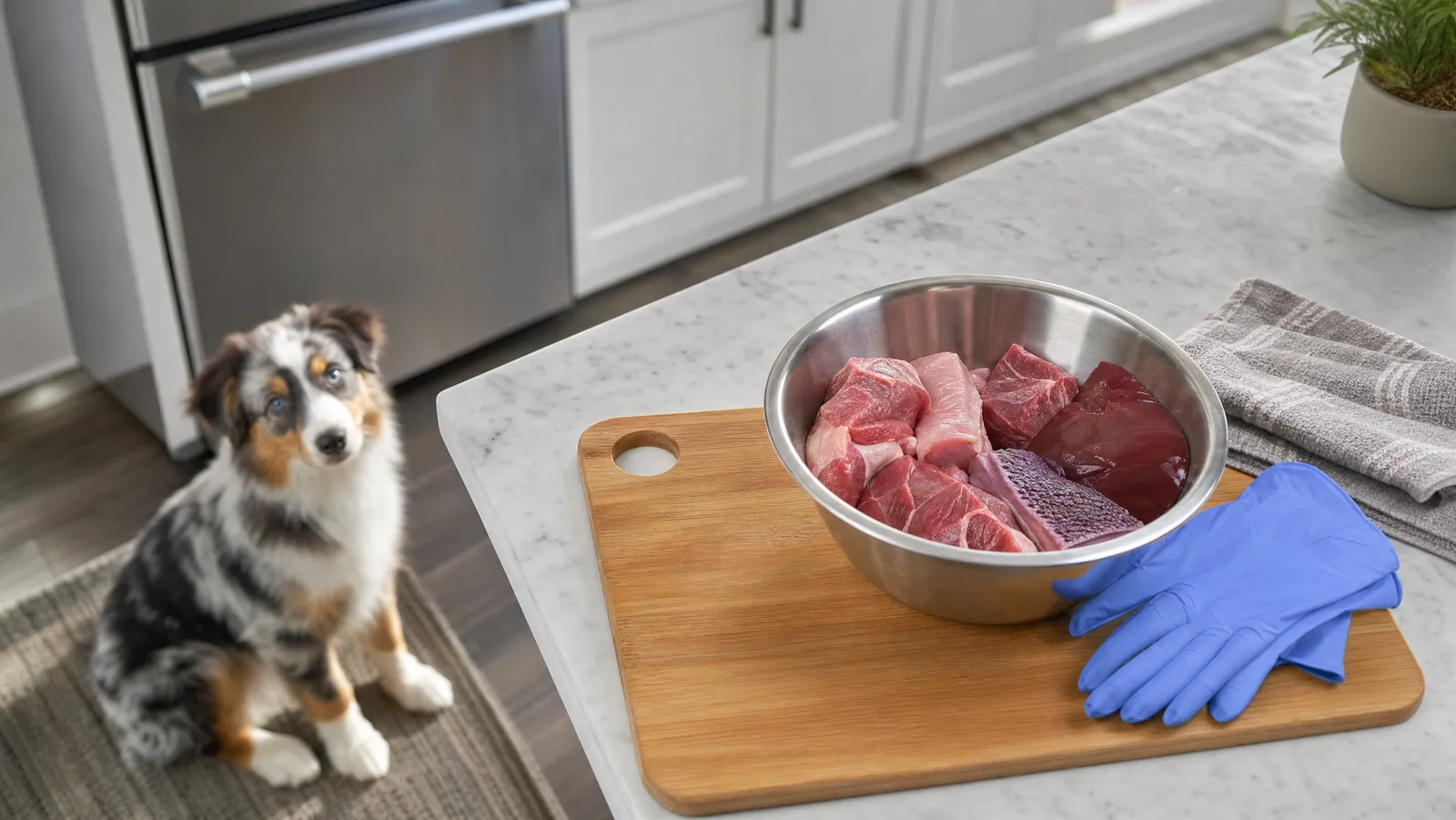
If a household is feeding raw-style anyway, the handling routine is where risk actually gets managed. This follows FDA and CDC guidance.
- 1
Keep it frozen, and thaw it in the refrigerator
Never thaw raw pet food on the counter or in the sink. Thaw in the fridge, in a sealed container on the bottom shelf, so nothing drips onto human food.
- 2
Give raw prep its own surface and tools
Use a dedicated cutting board, scissors, and scoop that never touch human food. The FDA advises washing and sanitizing anything that contacted the raw food, including counters and utensils.
- 3
Wash your hands for 20 seconds, before and after
The CDC recommends washing with soap and water for at least 20 seconds after handling raw pet food and after touching anything it contacted — and making sure children wash their hands too.
- 4
Run bowls through a sanitizing dishwasher cycle
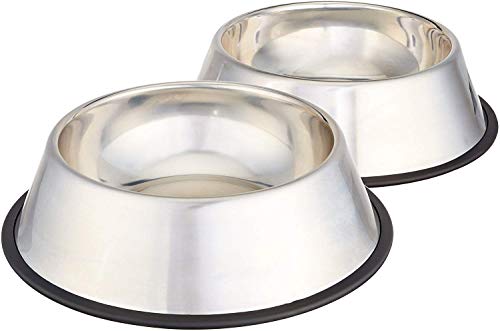
Wash the bowl after every meal, not at the end of the day. Stainless steel bowls like these Amazon Basics stainless bowls tolerate hot sanitizing cycles and don't develop the scratches where bacteria settle in aging plastic.
- 5
Feed in one place, and clean up right away
Pick a spot that isn't the kitchen floor or a rug, refrigerate or discard leftovers promptly rather than leaving the bowl down, and wipe the area afterward.
- 6
No face-licking after meals — especially with young kids
Dogs can spread bacteria through saliva after eating. Keep post-meal face contact away from toddlers and anyone immunocompromised until the dog's muzzle has been cleaned.
Talk to your vet before any raw diet for a puppy
Bring this up at your next puppy visit rather than after a problem starts. Your veterinarian can tell you whether your puppy's breed, size, and health history change the risk math, and can refer you to a board-certified veterinary nutritionist if you want a raw-style diet formulated properly for growth. Call the clinic the same day if a raw-fed puppy develops bloody diarrhea, repeated vomiting, fever, lethargy, or refuses to drink — and mention the raw diet on the phone, because it changes what your vet looks for first.
Our Verdict
For most puppies, we would not feed raw. The organizations that regulate and study this — the AVMA, the FDA, and the CDC — all advise against it; the recall record from 2024 and 2025 shows commercial packaging is not a guarantee; and the growth-nutrition stakes make DIY raw a genuinely risky place to learn. For a large-breed puppy, we would be firmer still.
If your household is going to feed raw-style regardless, the version we would choose is narrow: a commercially prepared product that is complete and balanced for growth, handled like raw chicken at every meal, with your veterinarian informed. That reduces risk. It does not remove it, and anyone who tells you otherwise is selling something.
The good news is that the rest of the job — meal timing, portion sizes, when to drop from three meals to two — is unaffected by this decision. Our puppy feeding schedule guide covers all of it, whatever ends up in the bowl.
Our top picks


Stella & Chewy's Freeze-Dried Raw Meal Mixers, Perfectly Puppy Beef & Salmon (3.5 oz)
If a household is going to feed raw-style to a puppy anyway, this is the shape it should take: a complete and balanced freeze-dried meal built for growth rather than a topper you have to balance yourself. It is 85 percent meat and organs with 15 percent non-GMO fruits and vegetables, and it carries natural DHA plus calcium and phosphorus for bones and teeth.
What we love
- Complete and balanced for growing puppies — not a mixer you have to build a diet around
- Natural DHA for brain and eye development; calcium and phosphorus included rather than guessed at
- No grain, corn, wheat, soy, legumes, artificial colors, or preservatives
Keep in mind
- Freeze-drying reduces but does not eliminate pathogens — handle every bite like raw meat
- At $54.86 as of July 2026, feeding it as the whole diet gets expensive fast for a big puppy
A freeze-dried raw topper formulated for puppies, with DHA, vitamin E, and L-carnitine, designed to scoop over a complete kibble rather than replace it. The 3.5 oz bag is the cheapest honest way to find out whether your puppy tolerates a raw element before anyone commits to a freezer full of it.
What we love
- Puppy-specific formulation with DHA, vitamin E, and L-carnitine
- Built as a topper, so the complete-and-balanced job stays with the base food
- Small bag keeps the experiment cheap — $9.99 as of July 2026
Keep in mind
- Freeze-drying reduces but does not eliminate pathogens — handle it like raw meat
- A mixer is not a diet; it cannot balance a bowl on its own
Stainless steel resists the scratches and odors that let bacteria linger in worn plastic bowls, and it survives a sanitizing dishwasher cycle, which is the part of the raw-handling routine people skip. Each bowl holds up to 38 oz at maximum fill (28 oz recommended) and sits on a no-slip rubber base.
What we love
- Dishwasher safe, so the post-meal sanitizing cycle is genuinely easy to do daily
- Stainless steel doesn't scratch and harbor bacteria the way aging plastic does
- Two bowls at $14.69 as of July 2026 means one can be washing while the other is in use
Keep in mind
- A clean bowl reduces contamination risk; it does nothing about pathogens in the food itself
Frequently asked questions
Can puppies eat raw meat at all?
They can eat it, but the major veterinary bodies advise against it. The AVMA discourages feeding any raw or undercooked animal-sourced protein to dogs and cats because of the risk to human and animal health, and the CDC states plainly that it does not recommend feeding raw pet food or treats. Puppies are where those warnings land hardest: they dehydrate quickly with GI illness, and they live at floor level in close contact with the humans who might also get sick. If you still want a raw-style diet, use a commercially prepared product that is complete and balanced for growth, and tell your veterinarian before you start.
Is freeze-dried raw safer than frozen raw for a puppy?
Freeze-drying lowers the risk but does not remove it. Removing water makes bacteria dormant rather than dead, which is why the FDA's safe-handling advice applies to freeze-dried raw the same way it applies to frozen raw. Tufts Petfoodology's 2025 research update explicitly includes freeze-dried and frozen products in its list of raw pet foods that raise animal and public health concerns, and researchers at Cornell found that every freeze-dried cat food they tested was in fact a raw product. Treat a freeze-dried bag like raw meat: wash hands, wash the bowl, keep it away from kids' hands and human food surfaces.
What should I do if my puppy gets diarrhea after a raw meal?
Call your veterinary clinic rather than waiting it out. Diarrhea after any diet change is common, but with raw food you cannot rule out a pathogen, and the FDA notes that Salmonella signs in pets include vomiting, diarrhea that may be bloody, fever, loss of appetite, and low energy. Puppies dehydrate much faster than adult dogs, so blood in the stool, repeated vomiting, refusal to drink, or a puppy who has gone flat all warrant a same-day call. Bag or photograph the food and its lot code, too, so your vet and the FDA have something to work with.
Is raw feeding riskier for large-breed puppies?
Yes, on top of the pathogen question there is a skeletal one. Large and giant-breed puppies need calcium held within a fairly narrow window during growth, and homemade raw diets are where that math most often goes wrong. A 2024 case series in the veterinary literature described four dogs with neurological deficits from suspected nutritional secondary hyperparathyroidism after being fed an exclusive raw meat diet, and noted that large-breed puppies fed unsupplemented boneless raw meat are especially susceptible because of their elevated calcium requirement. If your puppy will be big, the growth statement on the label matters more than the ingredient panel.
About the author
James Martin
I'm an animal lover through and through. I grew up with dogs, my family always had at least one pet, and today I share my home with a rescue who is the love of my life. I started Healthy Puppy Review to help owners cut through the marketing noise and make confident, well-researched choices about their dog's health and happiness.