The Best Puppy Teething Chews and Edible Treats
A teething chew is food, not hardware — so it has to be digestible, too big to swallow whole, and cheap enough in calories to fit a puppy's daily treat budget. Here is how we judge an edible chew, the six we would buy, and the chews to leave on the shelf while the baby teeth are in.

Contains affiliate links · our policy
In this guide
The best puppy chews for teething are fully edible, soft enough to give against baby teeth, sized so your puppy cannot swallow the whole thing, and fed inside a daily calorie budget. That last rule is the one a toy never asks of you. Here is how we judge a chew, then six we would buy.
We may earn a commission from links on this page, at no extra cost to you.
This is the edible half of a two-part buying decision. We covered the durable goods in the best puppy teething toys, and a chew is a genuinely different purchase, because a chew gets eaten. That raises three questions a rubber ring never does: is it digestible, is it sized right, and what does it cost in calories? We answer all three before the picks. For the wider picture of what is happening in that sore little mouth, start with our guide to puppy teething and biting.
How We Chose These Puppy Teething Chews
We should be straight about method, because a lot of roundups are not.
We did not run a testing panel, and we are not going to tell you we chewed through fourteen bags over six weeks. What we did was narrow the field: we looked only at chews that are currently available and labelled for puppies, we read each maker's stated age and weight limits, and we ruled out the categories veterinary sources warn about for a mouth full of baby teeth.
What is left is six products that are fully edible or single-ingredient, pliable rather than rigid, and sold in a puppy size. Where a label carries an age limit, a weight limit or a supervision warning, we repeat it below — that sentence is usually the most useful thing on the package. If you are not yet sure your puppy has entered this phase, the signs are in puppy teething symptoms.
What to Look For in a Puppy Chew for Teething
Four things, roughly in order of how much they matter.
Fully digestible, and not rawhide. A chew is food, so the question is what happens after it is swallowed. The ASPCA's position statement on dog chews and treats notes that most dogs find rawhide chews highly palatable and often consume an entire chew during a single session, and asks pet parents to limit the amount of rawhide consumed at any given time and to discourage consumption of significant pieces that could cause choking or gastrointestinal obstruction. Chews that are formulated to be eaten and digested are meant to narrow that specific worry — but the ASPCA's point about swallowing significant pieces applies to any chew, edible ones included.
A texture that gives. VCA Hospitals advises avoiding anything extremely hard for a teething puppy, such as nylon, bones or antlers, and its wider chew-toy guidance groups bones, cow hooves, pig ears, hard rawhides and large ice cubes together as toys too hard for teeth — items that it says can chip and even fracture a dog's teeth as they chew. The practical version we use in a store aisle is the fingernail test: if your nail leaves no mark, it is not a teething chew.
A size your puppy cannot swallow. VCA's rule for toys is that a toy should never be so small as to easily fit entirely in the dog's mouth, and the same logic applies to the last inch of a chew. The ASPCA warns that overly aggressive chewers may consume large chunks, leading to intestinal obstruction requiring surgical intervention, and that obstruction may be more likely to occur in smaller dogs — which is most teething puppies. When you are between sizes, size up.
Supervision you can actually provide. VCA Hospitals says to make sure your puppy is supervised while chewing, and notes that any item a puppy chews can become dangerous if they bite off parts and swallow them, because swallowed pieces could block their intestines or get caught in their throat. A chew is a thing you do with your puppy, in the room, not a thing you leave behind.
What a Chew Costs in Calories
This is the question a toy never raises, and it is the one most buying guides skip entirely.
VCA Hospitals' guidance is that roughly 90 percent of a dog's calories should come from a complete and balanced food, with treats limited to the remaining 10 percent of daily calorie intake. Chews count against that 10 percent. So do dental chews, training rewards, and the handful of kibble you pay out during a sit-stay.
For a growing puppy the daily calorie target depends on weight, breed and growth stage, which makes it a number to get from your vet rather than from an article. Once you have it the arithmetic is simple: 10 percent of it is the treat allowance, and the calories per chew are printed on the bag. If one long-lasting chew uses most of the allowance, it is a weekend event rather than a daily habit. It also helps to know where the chew lands relative to meals, which is easier when meals happen at the same times every day — ours is laid out in a predictable puppy feeding schedule.
The 6 Best Puppy Chews for Teething
Each pick below says who it is for, what the maker claims, and at least one honest limitation. Prices are approximate and current as of October 2026.
N-Bone Puppy Teething Rings — Our Pick
Who it's for: puppies three months and up who would rather eat a chew than work a toy.
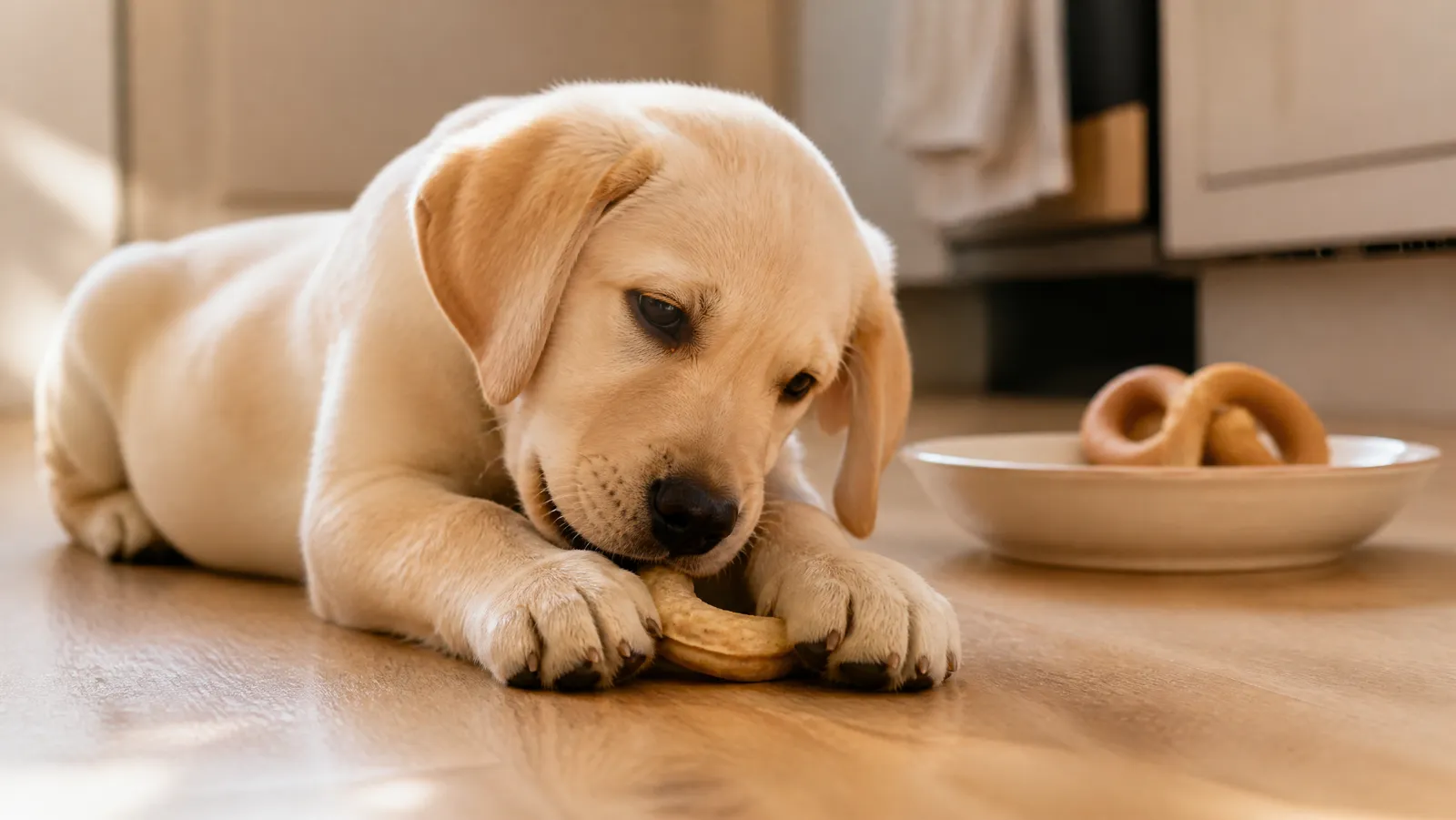
These are fully edible and digestible, with no plastic and no rawhide in them, and N-Bone enriches them with calcium and DHA omega-3 that it says supports strong teeth and bones along with healthy brain development. The ring shape is the quiet advantage: a small puppy can pin a ring down with one paw in a way that is awkward with a bone shape, and N-Bone says the chewing action helps soothe sore gums. The company also notes the ring leaves no messy residue on carpet or furniture, which matters more at 6am than it should.
A six-pack of N-Bone Puppy Teething Rings runs about $9 as of October 2026. The limitation is the label: N-Bone designs these for puppies three months and older, with the more durable adult rings sold separately, so an eight-week-old is too young for this one.
N-Bone Puppy Teething Sticks, Chicken Flavor — Best Budget
Who it's for: anyone who wants to find out cheaply whether their puppy is interested in edible chews at all.
This is the smallest sensible experiment on the page. The sticks are completely edible and digestible, all natural with no artificial colors or preservatives, SQF certified, and made with rice flour for easier digestion. N-Bone describes the texture as pliable and safe for a puppy's new teeth, and as helpful for sore gums — which is exactly the "gives under pressure" quality the fingernail test is looking for.
A 3.7-ounce bag of N-Bone Puppy Teething Sticks is about $4 as of October 2026. Two honest caveats: it comes in one flavor, so a fussy puppy can leave you with a full bag, and N-Bone lists it for puppies of all sizes rather than giving a specific age cutoff like the variety pack does. The sizing judgement sits entirely with you.
N-Bone Puppy Teething Sticks Variety Pack — Best Variety Pack
Who it's for: owners of a picky puppy, and anyone who would rather test three flavors than guess at one.
You get chicken, pumpkin and peanut butter across three bags, 11.22 ounces in total. N-Bone describes the texture as soft yet durable and intended to massage sore gums, says the sticks are fortified with DHA and calcium, and makes them in the USA. They are fully edible with no rawhide and formulated for gentle digestion, which puts them in the same category as our top pick rather than in the natural-chew category further down.
The three-bag N-Bone Puppy Teething Sticks Variety Pack is about $9 as of October 2026. N-Bone lists this pack for puppies over 12 weeks of age, so check your puppy's age before you order. The practical downside is that three opened bags go stale faster than one — seal them properly, or you will be throwing the third flavor away.
Nylabone Healthy Edibles Puppy Variety Pack — Best Long-Lasting Edible
Who it's for: small puppies under 15 pounds, when you want a chew that lasts longer than a soft stick.
Nylabone positions these as long-lasting edible chews that double as training rewards, and the three-count pack covers roast beef, turkey and apple, and bacon. The turkey and apple flavor is formulated with DHA, which Nylabone says supports brain and eye development. They are made in the USA with no artificial preservatives, colors or flavors.
The three-count Nylabone Healthy Edibles Puppy variety pack is about $4 as of October 2026. Two things to know. Nylabone intends these for x-small puppies up to 15 pounds, so a growing medium or large breed will pass out of the size range quickly. And three chews is a sampler, not a supply — if they work, you are ordering again within the week.
Nylabone Healthy Edibles Turkey & Sweet Potato (16 Count) — Best for Stocking Up
Who it's for: the puppy who has already proved they like Healthy Edibles.
Same idea as the variety pack, scaled up: 16 edible puppy bones in one box, in a single turkey and sweet potato flavor. Nylabone describes them as all-natural and highly digestible, formulated with DHA, and free of artificial preservatives, colors and flavors.
A 16-count box of Nylabone Healthy Edibles Turkey and Sweet Potato is about $17 as of October 2026, the highest price here. Nylabone intends it for x-small puppies up to 15 pounds, same as the sampler. Committing to one flavor 16 times is the risk you take for the lower price per chew, which is why we would buy the three-pack first.
Nature Gnaws Extra Thin Beef Bully Sticks — Best Single-Ingredient Chew
Who it's for: small puppies whose owners want one recognisable ingredient and nothing else.
Bully sticks are a natural chew rather than a formulated treat: this one is single-ingredient natural beef pizzle, rawhide-free, low-odor, grain-free and gluten-free, from a family-run brand that describes its ingredients as responsibly sourced. The extra-thin 5-to-6-inch profile is made for small dogs, and Nature Gnaws markets these for teething puppies, small dogs and senior chewers. Nature Gnaws also says the chewing action helps reduce plaque and tartar — the maker's claim about its own product, not a finding we can point you to a study for.
A 10-count bag of Nature Gnaws Extra Thin Beef Bully Sticks is about $12 as of October 2026. This is the pick that most needs the safety framing repeated. It is supervised-only, and because the sticks are extra thin they wear down to a short stub quickly — the moment the ASPCA's warning about swallowing significant pieces becomes live. Take the stub away. The listing also carries no stated age or weight limit, so unlike the N-Bone and Nylabone picks there is no label to defer to.
Chews We'd Skip While the Baby Teeth Are In
These are categories rather than brands, and the reasoning is the same every time: a developing tooth loses against an object that will not yield.
- Rawhide. The ASPCA asks owners to limit how much rawhide is consumed at once and to discourage consumption of significant pieces that could cause choking or gastrointestinal obstruction, noting that obstruction may be more likely in smaller dogs — and it observes that most dogs find rawhide highly palatable and often eat an entire chew in one session. VCA Hospitals separately groups hard rawhides among the chews too hard for teeth. Fully edible chews are formulated around both problems, but they still need the same sizing and supervision.
- Cooked bones, including kitchen leftovers. According to the AKC, cooked bones splinter into shards, so a dog that eats one may choke on the small pieces, and those pieces can cause serious damage to the mouth, throat or intestines; the AKC advises giving your veterinarian a call for advice if your dog does ingest cooked bones. VCA Hospitals also lists bones among the extremely hard items to avoid for a teething puppy.
- Antlers and dried cow hooves. VCA Hospitals names antlers alongside nylon and bones as extremely hard materials to avoid during teething, and lists cow hooves among the toys that are too hard and can chip or fracture teeth. There is nothing a baby tooth gains from either.
- Very hard nylon. Same VCA guidance, and worth separating from the puppy-formula nylon some brands sell, which the makers describe as a softer, more flexible material than their adult chews. A firm adult nylon bone does not belong in a four-month-old's mouth.
- Anything you cannot dent. The fingernail test covers whatever novelty chew appears on the shelf next.
How to Serve a Chew to a Teething Puppy
The chew does maybe half the work. The habits around it do the rest.
Keep sessions short and supervised. Hand the chew over, sit down near your puppy, and stay there. VCA Hospitals' instruction to supervise chewing and the ASPCA's instruction to actively observe your dog while chewing both describe the same thing: a chew is an activity you attend, not a babysitter.
Take the chew back and store it. When the session ends, the chew goes into a sealed container rather than staying on the floor. A chew lying around all afternoon is a chew being eaten without supervision, and a chew whose calories you have stopped counting.
Have a plan for the last inch. Every chew eventually becomes a short piece that fits in a puppy's mouth. The ASPCA's warning about swallowing significant pieces, and VCA's rule that nothing should be small enough to fit entirely in the mouth, point to the same handling rule: when the chew gets short, it is done. Trade it for something else rather than letting your puppy finish it.
Think twice before freezing an edible chew. VCA Hospitals does note that you can freeze toys and treats to help alleviate inflammation and discomfort, in the same spirit as chilling a teething ring for a human baby, and cold genuinely helps. Our own preference is to get the cold from items built to be frozen: a soft edible chew is not designed as a freezer item, and in our experience freezing one mostly makes it harder, which is the opposite of what you want against baby teeth. For the cold options we would actually use, see how to soothe a teething puppy.
Never leave a chew in the crate. A crate is where your puppy is alone, which rules out anything edible by definition. Settle a crated puppy with routine and timing rather than with a consumable; our approach is in crate training your puppy.
One more thing worth separating out: if your puppy goes off dinner during this stretch — the problem usually filed as teething puppy not eating — the cheap first move is to change the food's texture, not to add chews. We walk through that in how to soften puppy food.
Chews vs. Toys vs. Frozen Things
They are not interchangeable, and a good teething kit has all three. The short version:
- Edible chews get consumed, so they cost calories, need to be sized and supervised, and run out. They are the best answer when your puppy wants to eat something rather than work something.
- Chew toys are durable goods. They do not touch the calorie budget and they are what you rotate to keep novelty up — though VCA Hospitals still advises supervising a puppy while chewing, and any toy that is breaking apart should come away. They do not satisfy a puppy who is specifically hungry.
- Frozen items are about relief rather than occupation. VCA Hospitals' point about freezing toys and treats to ease inflammation and discomfort makes this the category to reach for in the evening.
Practically: one or two edible chews for supervised sessions, three or four toys in rotation, and something cold ready for the bad hour.
The Bottom Line
Buy the label, not the marketing. For a puppy still on baby teeth, that means fully edible or single-ingredient chews with a texture your fingernail can mark, in a size your puppy cannot swallow, fed inside the 10 percent of daily calories VCA Hospitals allots to treats. If you want one bag, make it the N-Bone Puppy Teething Rings once your puppy is past three months — or start with the chicken teething sticks at about $4 as of October 2026 if you are not yet sure your puppy will take to a chew at all.
Then do the unglamorous part: stay in the room, put the chew away afterwards, retire it early, and never let it into the crate. And if you want the stage-by-stage context — which weeks are the rough ones and why — read the teething timeline these chews are sized for.
Our top picks


A fully edible, digestible ring with no plastic and no rawhide in it, made in the USA and enriched with calcium and DHA omega-3 that N-Bone says supports strong teeth and bones and healthy brain development. The textured ring shape is easier for a small puppy to pin down than a bone shape, and N-Bone says the chewing helps soothe sore gums.
What we love
- Fully edible and digestible — no plastic, no rawhide
- Textured ring is easy for a small puppy to hold down
- Enriched with calcium and DHA omega-3, per N-Bone
- Ring design leaves no messy residue on carpet or furniture
- Made in the USA with natural ingredients
Keep in mind
- N-Bone lists it for puppies 3 months and older, so it is not for a brand-new 8-week-old
- Six rings per bag does not go far if you are chewing every day

The cheapest way to find out whether your puppy wants an edible chew at all. It is completely edible and digestible, made with rice flour for easier digestion, with a pliable texture N-Bone describes as safe for a puppy's new teeth and helpful for sore gums.
What we love
- Lowest price of our six picks
- Pliable texture the maker calls safe for a puppy's new teeth
- Completely edible and digestible
- All natural, with no artificial colors or preservatives
- SQF certified and made with rice flour for easy digestion
Keep in mind
- Listed for puppies of all sizes rather than carrying a stated age limit, so sizing the piece is on you
- One flavor only, so a picky puppy can leave you with a full bag
Three flavors — chicken, pumpkin and peanut butter — in one order, which is the inexpensive way to learn what your puppy actually wants. N-Bone describes the texture as soft yet durable and intended to massage sore gums, and says the sticks are fortified with DHA and calcium.
What we love
- Three flavors in one pack: chicken, pumpkin and peanut butter
- Soft yet durable texture intended to massage sore gums
- Fully edible with no rawhide, formulated for gentle digestion
- Fortified with DHA and calcium, per N-Bone
- Made in the USA
Keep in mind
- N-Bone lists this pack for puppies over 12 weeks of age
- Three bags open at once means more to store properly and more to go stale

Three edible chews in three flavors — roast beef, turkey and apple, and bacon — that Nylabone positions as long-lasting and usable as training rewards. The turkey and apple flavor is formulated with DHA, which Nylabone says supports brain and eye development.
What we love
- Three flavors included: roast beef, turkey and apple, and bacon
- Long-lasting edible chews the maker also positions as training rewards
- Turkey and apple is formulated with DHA, per Nylabone
- Made in the USA with no artificial preservatives, colors or flavors
Keep in mind
- Intended for x-small puppies up to 15 pounds, so a larger puppy outgrows the size
- Only three chews in the pack, which makes it a sampler rather than a supply

The same Healthy Edibles idea in a 16-count box, which is the version to buy once you already know your puppy will eat them. Nylabone describes these edible puppy bones as all-natural, highly digestible and formulated with DHA.
What we love
- 16 edible puppy bones per box
- All-natural and highly digestible, formulated with DHA per Nylabone
- No artificial preservatives, colors or flavors
- One consistent flavor, which keeps things simple once turkey and sweet potato is a hit
Keep in mind
- Intended for x-small puppies up to 15 pounds
- Highest price of our six picks, and a single flavor — a bad guess leaves you with 16 of them

One ingredient — natural beef pizzle — in an extra-thin 5-to-6-inch profile built for small dogs, and rawhide-free. Nature Gnaws markets these for teething puppies, small dogs and senior chewers, and says the chewing action helps reduce plaque and tartar.
What we love
- Single-ingredient natural beef pizzle
- Extra-thin profile sized for small dogs
- Rawhide-free, low-odor, grain-free and gluten-free
- The maker says the chewing action helps reduce plaque and tartar
- Family-run brand with responsibly sourced ingredients
Keep in mind
- Supervised-only: an extra-thin stick wears down to a swallowable stub quickly and has to be taken away at that point
- The listing gives no stated age or weight limit, so judging the fit is on you
Frequently asked questions
Are puppy teething sticks safe?
Soft, fully edible teething sticks are among the gentler things you can hand a puppy, but no chew is hands-off. The ASPCA asks owners to actively observe their dog while chewing and to discourage the consumption of significant pieces that could cause choking or gastrointestinal obstruction, noting that obstruction may be more likely in smaller dogs. So check the maker's age limit, stay in the room, and take the last stub away rather than letting it be swallowed.
How many chews a day can a teething puppy have?
Count calories rather than chews. VCA Hospitals advises that about 90 percent of a dog's calories come from a complete and balanced food, with treats limited to the remaining 10 percent of daily calorie intake — and that ceiling covers chews, dental treats and training rewards together, not just biscuits. A growing puppy's daily calorie target depends on weight and growth stage, so ask your vet for the number and work backwards from the count printed on the bag.
What age can a puppy start having chews?
Follow the label rather than a rule of thumb, because the limits differ by product. N-Bone lists its teething rings for puppies three months and older and its teething sticks variety pack for puppies over 12 weeks, while Nylabone's Healthy Edibles puppy chews are intended for x-small puppies up to 15 pounds. According to the AKC, baby teeth start to shed around 12 to 16 weeks as the adult teeth emerge, and the AKC advises offering safe chew toys at that point.
Do chews help with puppy biting?
They help, but they are a substitute rather than a solution. The AKC's advice for a nipping puppy is to keep a chew toy handy so you can offer it in place of your hand, fingers or furniture, and to end the play session if the nipping continues after the swap. A chew is the thing you trade in; the training is the part that lasts. Remember too that an edible chew cannot be left with an unsupervised puppy, which limits when you can reach for one.
Can puppies have rawhide?
We would skip it while the baby teeth are in. The ASPCA notes that most dogs find rawhide chews highly palatable and often consume an entire chew during a single session, and it asks owners to limit how much rawhide is eaten at once and to discourage swallowing significant pieces that could choke or obstruct — adding that obstruction may be more likely in smaller dogs. VCA Hospitals also groups hard rawhides with chews too hard for a dog's teeth. Fully edible puppy chews sidestep the question.
About the author
James Martin
I'm an animal lover through and through. I grew up with dogs, my family always had at least one pet, and today I share my home with a rescue who is the love of my life. I started Healthy Puppy Review to help owners cut through the marketing noise and make confident, well-researched choices about their dog's health and happiness.