How to Potty Train a Puppy: The Schedule, the Method, and What to Do When It Goes Wrong
Potty training is four habits repeated until they stick: take them out on a clock, always to the same spot, reward within two seconds, and confine them when you can't watch. Here's the age-by-age schedule, how long it really takes, and what to do when a puppy who had it figured out starts having accidents again.

Contains affiliate links · our policy
In this guide
- The Method in One Screen
- The Potty Schedule, Age by Age
- How Long This Actually Takes
- When a Trained Puppy Starts Having Accidents Again
- Overnight: Sleeping Through Without Accidents
- Pee Pads: Helpful Tool or Extra Step?
- Moving From Pads to the Backyard
- Teaching Your Puppy to Ask to Go Out
- House-Training Around a Full-Time Job
- Apartments, High-Rises, and No Backyard
- Cleaning Up So It Doesn't Happen There Again
- When Nothing Seems to Be Working
- The Gear That Actually Earns Its Place
- What to Do Tomorrow Morning
- Explore the full series
- Our Top Picks
- FAQ
Potty training a puppy is four habits repeated until they stick: take the puppy out on a clock rather than on request, always to the same spot, reward within two seconds of the last drop, and confine them whenever you can't watch. Per the AKC, a puppy whose training started early can usually be depended on most of the time by around six months. Everything else in this guide is detail on those four things.
Healthy Puppy Review is reader-supported: if you buy through a link on this page we may earn a small commission, at no extra cost to you.
That's the whole method. The reason people search for how to potty train a puppy at 6 a.m. anyway is that the method is simple and the execution is relentless, and nobody warns you that week two is usually worse than week one. So below is the honest version: the schedule by age, what the timeline really looks like, and what to do when it stops working.
The Method in One Screen
There are only five moving parts, and they run in a loop all day.
- Take them out on a timer, not on a signal. An eight-week-old puppy cannot tell you they need to go. Set a phone alarm for every hour or two and beat the accident rather than reacting to it.
- Use one door and one spot. The same six feet of grass, reached the same way. Scent does most of the teaching here; the puppy's own previous deposits are the cue.
- Go out on leash, even in a fenced yard. A loose puppy in a yard is a puppy on a scent tour. On leash, in one spot, boring on purpose, the bladder is the only thing left to do.
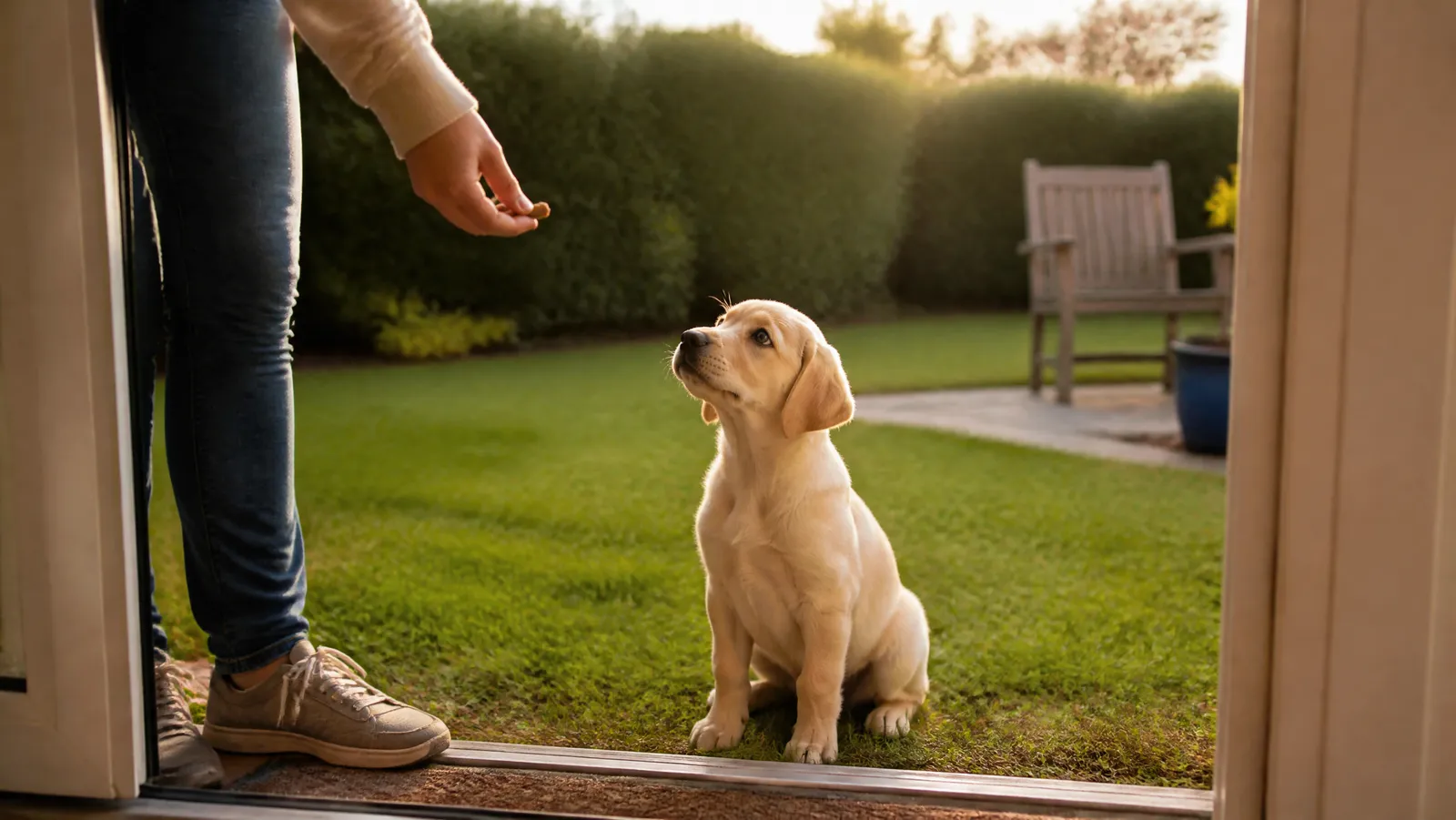
- Pay immediately. The AKC's guidance is to pick a simple phrase like "go potty," say it calmly as the puppy starts, and reward with praise and a treat the moment they finish. Two seconds late and you've paid for sniffing the fence.
- Confine or tether when you're not watching. Not as punishment — as a way to stop the puppy from rehearsing accidents you never see.
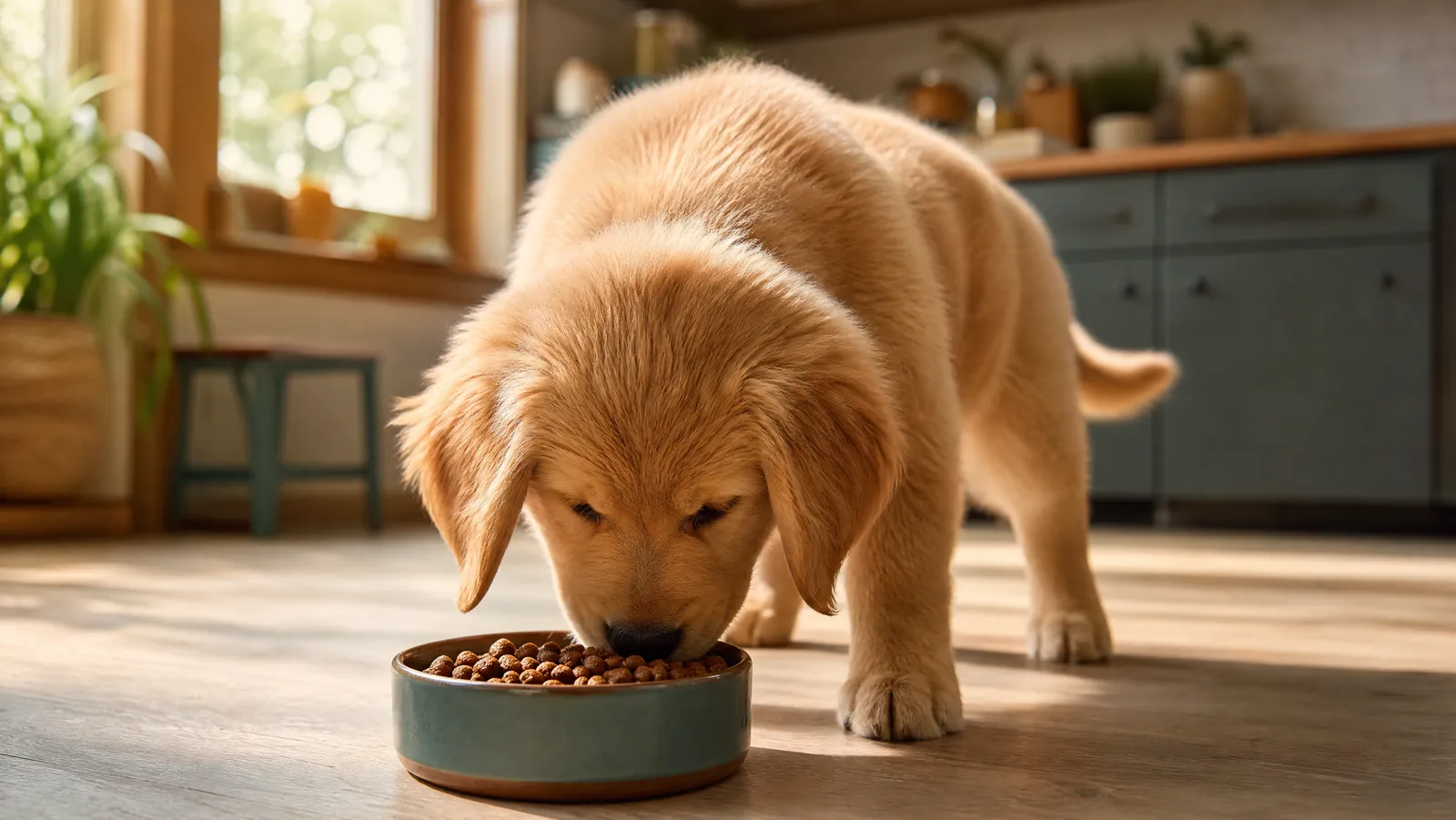
Then let the day's schedule do the rest. Puppies eliminate on a fairly predictable delay after eating, so meals are the anchor points of the whole system: the AKC advises taking a puppy out within five to thirty minutes of a meal, sooner for the youngest ones. If your meals move around, your potty trips move around too, which is why we'd get the puppy feeding schedule locked in first and build the potty routine on top of it.
One more thing before the schedule, because it saves people a lot of grief: your job in month one is to prevent accidents, not to correct them. Every accident that happens where you can't see it is a small deposit into the wrong habit. Management is not cheating — it is the training.
The Potty Schedule, Age by Age
Here is the working version. The AKC's rule of thumb appears in a couple of forms across its guidance — one version says a puppy can hold it for roughly the same number of hours as their age in months, another says age in months plus one — and we've used the conservative reading, because the cost of being early is a boring trip outside and the cost of being late is a rug.
| Age | Realistic hold while awake | Trips outside per day | |---|---|---| | 8–10 weeks | About 2 hours | 10–14, including after every meal, nap, and play session | | 10–12 weeks | About 3 hours | 8–10 | | 3–4 months | 3–4 hours | 6–8 | | 4–6 months | 4–6 hours | 5–6 | | 6+ months | 6–8 hours | 4–5 |
The AKC notes this rule scales up until roughly nine months to a year, at which point you're dealing with an adult bladder, not a growing one. Even then, we wouldn't routinely ask any dog to hold it more than six to eight hours.
Two adjustments the table can't make for you. Size shifts the numbers: a toy-breed puppy has a physically smaller bladder and tends to hit the wall sooner than the table suggests, while a large-breed puppy often has a little more room. And frequency of meals drives frequency of trips — a puppy on four meals a day has four post-meal appointments, and dropping to three meals removes one of them, which is one of the quiet reasons house-training gets easier around three or four months. If you're still working out that side of it, our guide to how often to feed a puppy lays out the meal frequency by age.
We'll go deeper on this later in the series with a full puppy potty training schedule by age, including printable versions for a puppy who's home all day and one who isn't.
How Long This Actually Takes
Weeks to months, and the range is genuinely that wide. The AKC's own framing is that some puppies develop reliable habits within days while others may require several months, with age, prior experience, consistency, and method all pushing the timeline around. The more useful benchmark comes from Dr. Jerry Klein, the AKC's chief veterinarian: if training begins early, a six-month-old puppy is usually able to be depended on most of the time to eliminate outside.
Read that phrasing carefully. Most of the time. Not "done."
Here's the shape most owners actually experience:
- Weeks 1–2: frequent accidents, several a day. Normal. You're building a route, not a skill.
- Weeks 3–6: accidents drop sharply if your supervision is tight. This is where confinement pays off.
- Months 3–4: long dry stretches, then a bad day that feels like a step backward. Also normal.
- Months 5–6: mostly reliable in familiar rooms, still unreliable in new houses, new floors, and after long car rides.
- Months 6–12: the last accidents are almost always situational — a schedule change, a visitor, a new carpet.
A puppy who came from a setup where they eliminated on paper or in a pen often takes longer, because they've already learned that indoors is an option. That's not a defect, it's just extra unlearning. We'll break down how long potty training a puppy takes by breed size and starting age in its own article, because the averages hide a lot.
When a Trained Puppy Starts Having Accidents Again
Rule out the vet before you rule in the training. VCA Animal Hospitals is explicit that if a house-trained dog suddenly starts eliminating indoors, the first step should be asking your veterinarian to check for a physical illness — VCA's list of conditions that can derail house-training includes cystitis (bladder inflammation, often from a urinary tract infection), urinary stones, diabetes, kidney or liver disease, and Cushing's disease. A puppy who is straining, dribbling, asking out constantly, or producing bloody urine is a vet appointment, not a training problem, and there is no home remedy worth trying first.
Once medical causes are off the table, the usual culprits are unglamorous:
- Freedom arrived too early. The most common pattern we see: a puppy strings together ten clean days, gets the run of the house, and immediately regresses. Access should expand one room at a time.
- The schedule moved. Someone went back to the office. Dinner shifted an hour. The routine that was doing the remembering stopped.
- Adolescence. Somewhere between five and ten months, a lot of puppies get selectively forgetful about rules they clearly know.
- A new surface or a new house. House-training is more location-specific than most people expect.
VCA's advice when a physically healthy dog keeps eliminating indoors is to restart training as though the dog were a young puppy — back to the timer, back to confinement, for a week or two. It works faster the second time. There's more to say about puppy potty training regression, including why it clusters around specific ages, and we'll cover it separately.
Overnight: Sleeping Through Without Accidents
Nights are easier than days, which surprises people. The AKC notes puppies can generally hold it longer while asleep and inactive than while awake, and the practical corollary from AKC guidance is that most puppies can manage the night without a potty break by around four months old.
Until then, plan on one or two alarms. Our approach:
- Last meal well before bed. The AKC suggests avoiding feeding within two hours of bedtime, and picking a puppy food that digests well.
- Water stays available but the bowl comes up an hour or so before lights out for very young puppies, unless your vet has told you otherwise.
- Final trip out is the last thing that happens. Not before the last play session — after it.
- Set an alarm rather than waiting to be woken. A 2 a.m. alarm at nine weeks is a dry crate. A 3 a.m. whine is often already too late.
- Keep the night trip boring. No lights, no talking, no play. Out, pee, back to the crate.
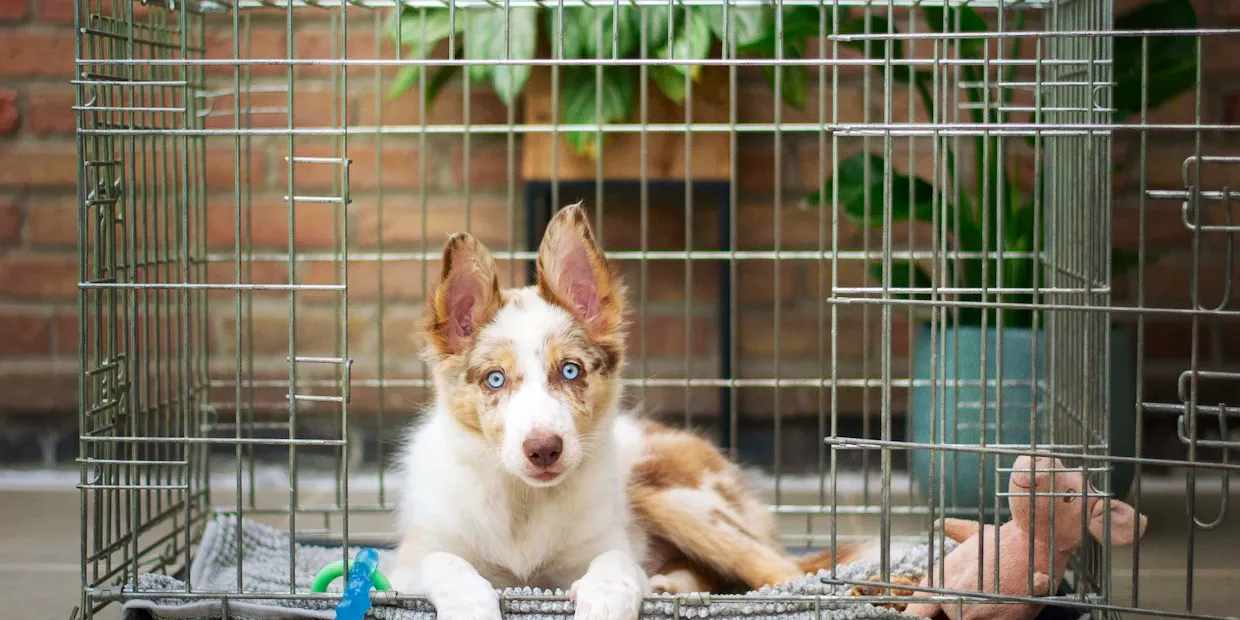
The crate is doing real work here. Most puppies won't soil the space they sleep in if it's sized correctly — large enough to stand, turn around, and lie down comfortably, per the AKC, but not so large they can use one corner and sleep in another. That instinct is what builds holding capacity in the first place, which is one of several reasons we think crate training makes the first year easier. A crate that's too big, on the other hand, teaches the opposite lesson quickly. We'll cover potty training a puppy at night in an article of its own later, including what to do when the crate isn't working.
Pee Pads: Helpful Tool or Extra Step?
Honest answer: pads solve a logistics problem and create a training problem. The AKC's caution is worth quoting plainly — pads can be tricky because you're reinforcing two different options for the puppy. You're teaching "not on the rug, but yes on this other absorbent thing on the floor," and then later asking the puppy to drop half of that rule.
Use pads when the logistics genuinely demand it:
- You're away from home longer than the puppy's hold time and nobody can cover the gap.
- You live several floors up and can't get down in ninety seconds.
- Your vet has advised limiting outdoor exposure until vaccinations are further along.
- Weather or mobility makes frequent trips outside unrealistic.
Skip them if you can get the puppy outdoors every one to two hours. One habit is faster to teach than two.
If you do use them, use them deliberately: one pad, one location, never scattered around the house, and moved toward the exit door over time rather than left in the middle of the living room. We use the Amazon Basics leak-proof training pads — about $18.99 for 100 as of August 2026 — mostly for the plastic lining and the 1.65-inch border on all four sides, because the failure mode of a cheap pad isn't absorbency, it's the edge. A hundred-count box is also the right quantity; you don't want to be rationing pads during the two weeks you need them most. We'll dig into whether puppy pee pads actually work, and what the research and trainers say about the tradeoff, in a dedicated piece.
Moving From Pads to the Backyard
The transition is a slow drag, not a switch. If you pull the pads overnight, most puppies will simply go where the pad used to be.
What we'd do, over two to four weeks:
- Consolidate to one pad in one location. Whatever you've been doing, this is step zero.
- Move the pad a few feet per day toward the door you use. If accidents start, you moved too fast — go back a step and slow down.
- Park the pad at the door for several days, so "I need to go" and "I go to the door" become the same thought.
- Move the pad outside, to the exact spot you want the puppy using. Weight it down.
- Shrink it. Fold the pad in half, then in quarters, over successive days.
- Remove it, and take a lightly used pad out to the spot once so the scent cue survives the handoff.
Two things speed this up: taking the puppy outside first at every high-probability moment — after waking, after meals, after play — so outdoors gets the easy wins, and paying much better outside than you ever paid inside. A pad success gets calm praise. A grass success gets the good treat.
The step people skip is the scent handoff, and it's the one that matters most. Full details on how to transition a puppy from pee pads to outside are coming in its own article, including what to do when a puppy will only go on a pad.
Teaching Your Puppy to Ask to Go Out
Bells solve a real problem: a puppy who needs out has no way to say so, and scratching the door or whining are the alternatives they invent on their own. The AKC's method is about as simple as training gets.
- Hang a strap of bells on the handle of the door you always use, at the puppy's nose height.
- Every single time you take the puppy out, ring the bells yourself — or touch the puppy's nose to them — right before you open the door.
- Say your cue ("outside"), go out, and reward the elimination as usual.
- After several days, pause with your hand on the door and wait. Most puppies will nudge the bells.
- The instant the bells ring, open the door. Every time, without exception, for the first couple of weeks.
Smearing a little peanut butter or cream cheese on the bells to get the first nose-touch is a common trainer shortcut, and running the sequence several times a day may speed things up — though the AKC's own version of the method is simply to ring the bell yourself every single time you head out, and let repetition do the work.
The predictable failure: within a week, some puppies discover the bells are a door-opening button and start ringing them to go sniff the lawn. The fix is to keep bell-triggered trips strictly boring — leash on, one spot, sixty seconds, back inside if nothing happens. We'll cover the puppy potty training bell method in full, including button alternatives and how to fix a bell-abusing dog, later in the series.
House-Training Around a Full-Time Job
Start with the arithmetic, because it's unforgiving. An eight-week-old puppy holds it for about two hours. A commute plus a workday is nine or ten. Nothing about the training method closes that gap — only coverage does.
Realistic ways to cover it:
- Take time off at the start. The first two weeks are the highest-leverage days of the whole process. If you can front-load a week of leave or remote work, do it here rather than saving it for later.
- Hire a midday visit. A walker or sitter at the midpoint cuts a ten-hour stretch into two five-hour ones. For a puppy over four months, that's often enough on its own.
- Split shifts with the household. Two people staggering lunch breaks beats one person doing everything.
- Use a pen, not a crate, for long absences. A crate is for stretches the puppy can actually hold. For a longer window, an exercise pen with the bed at one end and a pad at the other lets the puppy make the right choice within a wrong situation.
- Expect the timeline to stretch. A puppy who eliminates indoors five days a week will take longer. That's a tradeoff, not a failure.
The thing we'd push back on is the guilt. Plenty of well-house-trained dogs came from working households; they just took a few extra weeks. There's a lot more to say about potty training a puppy while working full time, and it gets its own article with sample workday schedules.
Apartments, High-Rises, and No Backyard
The AKC's take is that house-training in a high-rise isn't fundamentally different from anywhere else — it just has a transit problem in the middle. Here's what changes in practice.
Carry the puppy to the elevator. A puppy who is walked down a hallway with a full bladder often doesn't make it, and once they've gone in the hallway, the hallway becomes a spot. Carry until they're reliable, then walk.
Time the trip, not the urge. In a twelfth-floor apartment, ninety seconds of that "we need to go now" window is spent waiting for an elevator. So you leave earlier than you would in a house — before the puppy circles, not after.
Pick one exterior spot and use it exclusively. City puppies get an overwhelming amount of scent information at street level. One patch, reached the same way, keeps the cue clear.
Consider a balcony or patio station if you have the space. The AKC notes real sod patches and commercial indoor dog bathrooms as options for high-rise dwellers, with a waste container to keep odor manageable. A real-grass patch has one advantage over a pad: the surface matches what you'll eventually ask for outdoors.
Mind the vaccination window. Shared elevators, lobbies, and sidewalks carry more exposure than a private yard. Ask your vet what's appropriate for your puppy's vaccination stage before deciding how much street-level time to allow.
The full version — our apartment potty training playbook, floor by floor — is coming later in this series.
Cleaning Up So It Doesn't Happen There Again
A cleaned-looking spot and a cleaned spot are different things, and a puppy's nose knows which is which. Dog urine leaves uric acid behind, which has very low water solubility and crystallizes into porous surfaces as it dries — that's why the smell reappears on a humid day weeks after you mopped, and why the puppy keeps choosing that exact square foot.
Enzymatic cleaners are the category that addresses this: they use enzymes to break down the uric acid and proteins rather than masking the odor. Ordinary detergents and air fresheners leave the residue in place.
What not to use matters just as much:
- Ammonia-based cleaners. The ASPCA's guidance is not to clean up accidents with an ammonia-based cleanser, because urine itself contains ammonia — the leftover smell can draw the animal straight back to the same spot.
- Bleach as your odor solution. Bleach doesn't break down the uric acid, so it hides the problem rather than solving it. The ASPCA notes that diluted bleach can be used on things like kennels and toys, but only if it's diluted, thoroughly rinsed, and the bleach odor has dissipated before the pet is allowed back around them.
- Heat, early. The AKC's advice on urine stains is to avoid steam cleaners, since heat can set the stain and odor permanently — so keep them away from a fresh spot until the enzyme treatment has done its work.
The method itself is boring and it works. Blot up as much liquid as you can with paper towels or an old towel, pressing rather than rubbing. Then saturate the area — enough product to reach as deep as the urine went, which on carpet means the pad underneath, not the fibers. Let it dwell as long as the label says, usually well past the point where you'd want to stop. Blot again, air dry, and repeat once if you can still smell it when the spot is dry. The Rocco & Roxie enzyme stain and odor eliminator is our default here, at about $23.92 for 32 ounces as of August 2026; it carries the Carpet and Rug Institute's Seal of Approval, and the manufacturer states it's chlorine free, color safe, and safe around pets and children when used as directed. Buy more than you think you need — proper saturation uses a startling amount. Our full guide to how to clean puppy accidents, including hardwood, grout, and crate bedding, is coming separately.
When Nothing Seems to Be Working
Work this list in order.
1. See the vet. Any medical condition that increases frequency, urgency, or volume can cause house soiling, per VCA — its examples include cystitis, urinary stones, diabetes, kidney or liver disease, and Cushing's disease. On the stool side, intestinal parasites are extremely common in puppies: the Companion Animal Parasite Council's schedule has puppies dewormed at 2, 4, 6, and 8 weeks of age and then treated monthly until six months, and giardia and coccidia can cause watery or bloody diarrhea that no amount of training will fix. A puppy who can't hold it, strains, dribbles, or has blood in the urine or stool needs an appointment, not another week of the schedule.
2. Stop punishing, completely. This is where good owners lose the most ground. Humane society guidance is unambiguous: rubbing a puppy's nose in it, dragging them to the spot, or scolding after the fact only teaches them to be afraid of you or afraid to eliminate in front of you — which makes house-training dramatically harder, because now the puppy sneaks off to the guest room. The American Veterinary Society of Animal Behavior's 2021 position statement on humane dog training recommends reward-based methods for all aspects of training, noting aversive methods risk increasing fear, anxiety, and aggression. If you find a mess after the fact, the correct response is to clean it and say nothing. If you catch the puppy mid-stream, make a mild interrupting sound — startling, not frightening — scoop them up, get them to the right spot, and reward if they finish there.
3. Audit your own consistency for three days. Write down every trip and every accident with times. Nearly every stalled case we've seen shows up in that log: a four-hour gap in the afternoon, a yard trip where nobody actually watched, a reward given at the back door instead of at the spot.
4. Shrink the world back down. More confinement, more supervision, more trips, for a week. Then expand one room at a time.
5. Get eyes on it. If a puppy over six months is still having regular accidents with a clean bill of health and a tight routine, a certified trainer or a veterinary behaviorist will spot in one session what a checklist can't. We go through why your puppy isn't potty training in much more depth, case by case.
The Gear That Actually Earns Its Place
It's a short list, most of it inexpensive, and one item does more than all the others combined.
- An enzymatic cleaner, in quantity. The single highest-value purchase in house-training, because it's the only thing that stops a spot from becoming a habit. Buy a bigger bottle than feels sensible.
- A correctly sized crate. Stand, turn, lie down — no more. A divider panel lets one crate grow with the puppy instead of buying two.
- An exercise pen, if you're gone longer than the puppy can hold it.
- A six-foot leash used indoors. Tethering the puppy to your belt for the first few weeks eliminates most unsupervised accidents at zero cost.
- A treat pouch by the door. Rewards that live in the kitchen arrive four seconds late, which is three and a half seconds too late.
- Door bells, once the basic routine is holding.
- Pads or a grass patch, only if the logistics above apply to you.
What we'd skip: attractant sprays, indoor "training" litter systems for dogs who have yard access, and anything marketed as a punishment device. Our full roundup of the best puppy potty training supplies comes with the ones we'd actually buy again.
What to Do Tomorrow Morning
Pick the door. Pick the spot. Set alarms for every two hours starting when the puppy wakes up. Put treats by that door tonight so you're not walking to the kitchen in the morning. Then run the loop — out on the clock, leash on, one spot, pay immediately, confine when you can't watch — and accept that the first two weeks look like failure while the habit is being laid down underneath.
The dogs who get this fastest aren't the smartest ones. They're the ones whose owners were boringly consistent for a month.
Explore the full series
- Puppy Potty Training Schedule by Age (8 Weeks to 6 Months) — Hour-by-hour potty schedules from 8 weeks to 6 months, and how the intervals stretch.
- How Long Does It Take to Potty Train a Puppy? — The realistic timeline to reliability, and what makes it shorter or longer.
- Puppy Potty Training Regression: Why It Happens and How to Fix It — Why a house-trained puppy starts having accidents again, and the two-week reset that fixes it.
- Potty Training a Puppy at Night: When They Can Finally Sleep Through — Night schedules by age, the evening routine that decides how the night goes, and when they can sleep through.
- Do Puppy Training Pads Work? An Honest Look at Pee Pads — An honest verdict on pee pads: what they solve, what they cost you, and who should skip them.
- How to Transition a Puppy From Pee Pads to Going Outside — The step-by-step protocol for weaning a puppy off pads, including the scent handoff most people skip.
- Puppy Potty Training Bells: Teaching Your Puppy to Ask to Go Outside — How to teach a puppy to ring a bell to go out — and what to do when they start ringing it every ten minutes.
- Potty Training a Puppy While You Work Full Time — The coverage math and the pen setup that keep house-training honest across a nine-hour workday.
- Apartment Potty Training: House-Training a Puppy Without a Backyard — House-training without a backyard: closing the elevator gap, and when an indoor station is the right call.
- How to Clean Puppy Accidents So They Don't Go Back to the Same Spot — Why an ordinary cleaner leaves a spot that still reads as a toilet, and the enzymatic routine that does not.
- Why Isn't My Puppy Potty Training? Troubleshooting a Difficult Case — The five causes behind a puppy who still is not getting it, and the three-day log that tells you which one you have.
- The Best Puppy Potty Training Supplies — The short gear list that actually earns its place, tiered by what to buy now, what to buy if, and what to skip.
Our top picks

Amazon Basics Leak-Proof Dog and Puppy Potty Training Pee Pads, Regular 22 x 22 in (100 Count)

Rocco & Roxie Enzyme Stain & Odor Eliminator (32 fl oz)
A 100-count box of 22 x 22 inch pads with five-layer construction, a quick-dry top sheet, and a core that gels liquid on contact instead of letting it pool. The plastic lining and the 1.65-inch border on all four sides are the part that matters at 3 a.m. — they are what keeps an overshoot off the floor rather than on it.
What we love
- 100 pads per box, so you are not re-ordering mid-training
- Plastic lining plus a 1.65-inch border on all four sides to prevent overflow
- FSC-certified pads (FSC N004130)
Keep in mind
- Regular size and standard absorbency — a large-breed puppy will outgrow the 19 x 19 inch center pad
- The built-in attractant is a manufacturer claim, and some puppies ignore it entirely
An enzymatic formula aimed at urine, feces, and vomit, which is the category vets and shelters point to for pet accidents because enzymes break down the residue rather than covering it. It carries a Seal of Approval from the Carpet and Rug Institute, and the manufacturer says it is chlorine free, color safe, and safe around pets and children when used as directed.
What we love
- Enzymatic, so it targets the residue that keeps a puppy returning to the same spot
- Carpet and Rug Institute Seal of Approval
- Works on carpet, hard floors, furniture, clothing, kennels, and crates
Keep in mind
- 32 oz goes fast if you are soaking accidents properly rather than misting them
- Enzymes need dwell time — this is not a wipe-and-walk-away product
Frequently asked questions
When should I start potty training a puppy?
The day the puppy comes home. The American Kennel Club is direct about this: potty training should begin the day your puppy comes home, because puppies start learning household routines immediately. For most people that means an eight-week-old, which is also roughly when bladder control is at its weakest. You are not expecting success at eight weeks — you are building the loop. Same door, same patch of grass, same praise, every single time. The habit gets laid down long before the bladder can hold up its end of the deal.
How long does it take to potty train a puppy?
Longer than the internet suggests, and it varies a lot. The AKC says some puppies develop reliable habits within days while others take several months, and AKC chief veterinarian Dr. Jerry Klein notes that if training starts early, a six-month-old puppy can usually be depended on most of the time to eliminate outside. So plan on four to six months of active work with accidents scattered through it, not a weekend. Small breeds and puppies who spent their first weeks eliminating on paper often take longer, because they have more to unlearn.
How often should I take my puppy out?
More often than feels reasonable. The common rule of thumb, which the AKC states in a few forms, is that a puppy can hold it for roughly one hour per month of age — some AKC guidance uses age in months plus one. Either way an eight-week-old is on a two-hour clock at best. On top of the clock, take them out after every wake-up, meal, drink, chew session, and play session. The AKC notes this can add up to a dozen trips or more each day for a very young puppy.
Should I use pee pads to potty train a puppy?
Only if your schedule or your building genuinely requires it. The AKC's caution is that pads can be tricky because you end up reinforcing two different options for the puppy — inside is fine here, but not there. If you work away from home, live twelve floors up, or have a puppy who isn't fully vaccinated yet, that tradeoff can still be worth it. If you can get the puppy outdoors every one to two hours, skipping pads usually means a shorter total training arc with one habit to teach instead of two.
Why does my puppy pee in the house right after coming in from outside?
Usually because outside was playtime and the puppy never actually emptied. Puppies get distracted by leaves, wind, and neighbors, then relax indoors and remember they needed to go. The fix is boring on purpose: leash them, stand in one small spot, say nothing for five minutes, and if nothing happens, go inside and crate or tether them for ten to fifteen minutes before trying again. If a puppy is straining, dribbling constantly, or producing bloody urine, stop troubleshooting the routine and call your vet — VCA Animal Hospitals lists cystitis, urinary stones, and other physical illnesses among the medical causes of house soiling, and advises having a vet check for them.
About the author
James Martin
I'm an animal lover through and through. I grew up with dogs, my family always had at least one pet, and today I share my home with a rescue who is the love of my life. I started Healthy Puppy Review to help owners cut through the marketing noise and make confident, well-researched choices about their dog's health and happiness.