Do Puppy Training Pads Work? An Honest Look at Pee Pads
Pee pads work — at containing a mess in one spot indoors, which is not the same job as house-training. Here is the real trade you are making, who should take it, who should skip it, and how to use pads so the transition outside later is survivable.

Contains affiliate links · our policy
In this guide
- What Puppy Training Pads Are Genuinely Good At
- The Real Cost: You Are Teaching Two Right Answers
- Do Pad-Trained Puppies Take Longer to House-Train?
- Should You Use Puppy Training Pads? Five Cases Where the Answer Is Yes
- Who Should Skip Pee Pads
- If You Do Use Pads, Use Them Deliberately
- Disposable vs Washable Pee Pads: The Actual Comparison
- Pee Pads vs Going Outside: What We Would Actually Do
- What We Would Do
- Our Top Picks
- FAQ
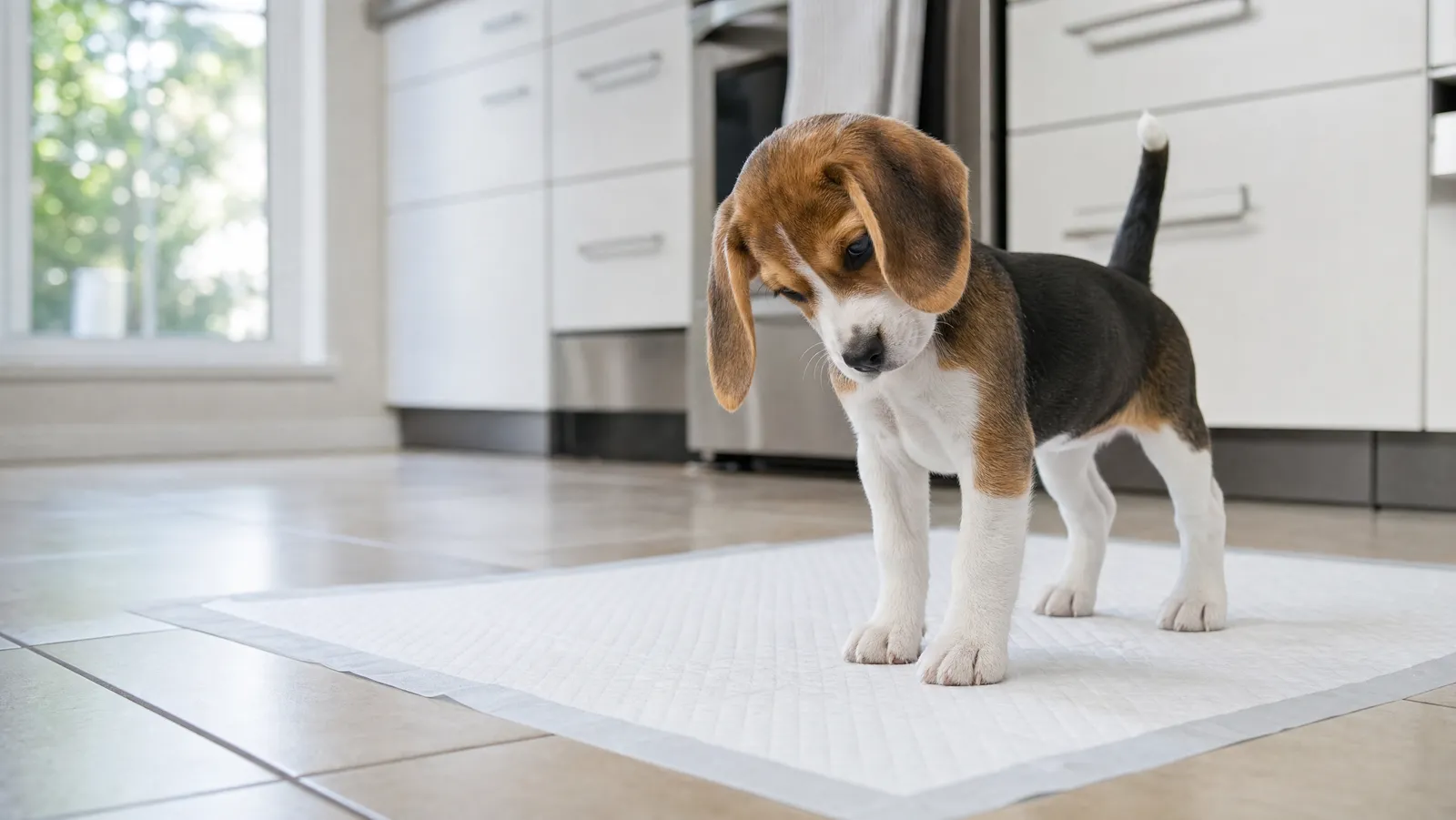
Yes — puppy training pads work, but not at the job most owners buy them for. They reliably contain a mess in one spot indoors, which is a genuinely useful thing. They do not house-train a puppy. Those are two different problems, and pads solve the first while quietly adding to the second.
Healthy Puppy Review is reader-supported: if you buy through a link on this page we may earn a small commission, at no extra cost to you.
A pad is a logistics tool. House-training is a habit you build by making outdoors the only place elimination ever happens. Use pads and you teach your puppy that two surfaces are acceptable, and at some point you will have to un-teach one of them. That trade is worth making in some homes and a bad deal in others, and this page is about working out which one you are in. If your situation makes pads genuinely optional, how to potty train a puppy without pads is the shorter road, and we would take it.
What Puppy Training Pads Are Genuinely Good At
A nine-week-old cannot hold it long. The American Kennel Club's rule of thumb is age in months plus one, in hours — about three hours at the ceiling, and much less while awake and playing. If you are not standing there at the right minute, that urine lands somewhere. A pad decides where.
- They protect the floor. Urine that soaks into a hardwood seam or carpet padding for six hours becomes a smell you can only fix with tools.
- They give the accident an address. Bond Vet calls convenience the primary advantage of pads and notes they can be a useful aid at the stage when a puppy needs to go frequently. Wiping one square beats hunting three surprises.
- They keep a confined puppy off their own bedding. A puppy in a pen who needs to go and has nowhere acceptable will use the blanket, and soiling the sleeping area can be a hard habit to reverse.
- They cover what nobody plans for. An ice storm, a stomach bug, a broken elevator, a whelping box, a dog on post-surgery rest.
Reliability is not the problem with pee pads. Used as intended, they work. The problem is what else they teach.
The Real Cost: You Are Teaching Two Right Answers
The American Kennel Club quotes its expert Mary Burch, PhD, on why pads and paper training get tricky: you are reinforcing two different options for the puppy. In the clean version of house-training there is exactly one rule — hold it indoors, go outdoors. Pads replace that with a rule plus an exception, and puppies do not process exceptions the way you would like.
They do not learn the absorbent rectangle in the laundry room, and only that. They learn something closer to soft absorbent things on the floor are acceptable. Preventive Vet's Cathy Madson, a certified professional dog trainer, says it plainly: anything could be a pee pad, and teaching a puppy to go on a thin paper pad may also teach them it is fine to go on similar items.
In practice the collateral is predictable. The bath mat. The entry rug. A towel on the bathroom floor. The folded laundry on the couch. And the one that genuinely upsets people: the dog bed.
Bond Vet supplies the other half — once a dog has designated an area as its preferred place to go, it may be difficult to shake the practice. You are not renting the pad habit for a few weeks. You are buying it, and getting back out is a separate project with its own timeline, which is why how to transition a puppy from pee pads to outside is an article of its own.
Do Pad-Trained Puppies Take Longer to House-Train?
Probably. But be suspicious of anyone who answers that with a number, including us.
We looked for a study measuring days-to-house-trained for pad-raised versus outdoor-only puppies and could not find one. What exists is professional consensus, stated carefully. The AKC's potty pad training guide says that if you confuse your puppy, they will likely have more accidents and take longer to train, and its main house-training article adds that it may take additional training to move a pad-trained puppy to the outdoors as the primary place to go.
So: the delay is real in trainer experience, unquantified in published research, and it arrives after the pad phase rather than during it. Weeks one through eight can look wonderful. The bill comes later. For the baseline you are measuring against, how long potty training a puppy takes is four to six months for most puppies with no pad detour built in.
Should You Use Puppy Training Pads? Five Cases Where the Answer Is Yes
Pads earn their place when getting outside in time is not physically possible. That is a constraint, not a character flaw, and it describes a lot of homes.
1. You live several floors up. The AKC notes that the frequent trips outside very young puppies need may be too challenging for elderly owners or apartment dwellers. Ninety seconds to the elevator plus a lobby plus a sidewalk is longer than a nine-week-old's warning. We will cover apartment potty training in its own article, but the short version is that a pad in the pen beats a puddle by the door.
2. You are away longer than your puppy can hold it. By that same AKC rule, a three-month-old tops out around four hours. If your workday is eight, no amount of consistency closes the gap, and your options are a midday visitor, a pad in the confinement area, or an accident. Run the arithmetic for your puppy's exact age against our puppy potty training schedule by age before deciding you need pads at all — plenty of owners buy them for a gap that has already closed.
3. Your vet has asked you to limit exposure to public ground. This is the case people get wrong in both directions, so it is worth being precise. The 2022 AAHA canine vaccination guidelines call for revaccination at two- to four-week intervals until a puppy is older than 16 weeks, adding that 18 to 20 weeks may be preferred in areas of high distemper risk — so the series often is not finished until the fourth month. The AKC's pad guide reflects the practical consequence: if you have no backyard and your dog's toilet area is a public place, you might want to limit your puppy's exposure until they are fully vaccinated.
The counterweight matters just as much. The American Veterinary Society of Animal Behavior states that the primary and most important time for puppy socialization is the first three months of life, and that it should be the standard of care for puppies to receive that socialization before they are fully vaccinated — noting that behavioral issues, not infectious diseases, are the number one cause of death for dogs under three years of age. AVSAB says puppies can generally start classes as early as 7 to 8 weeks with a minimum of one set of vaccines at least 7 days beforehand and a first deworming. Read together: avoid unknown ground where sick dogs may have been, not the world. Parvovirus risk is local, so ask your own vet where the line sits in your neighborhood.
4. Weather or mobility makes the trip unsafe. Bond Vet lists severe weather, apartments without easy outdoor access, and senior or disabled dogs among the situations pads suit. If you use a cane on icy steps at 2 a.m., the pad is not the risky choice.
5. Whelping, recovery, and very small dogs in winter. A washable pad under a whelping box or a recovering dog is doing plain absorbency work with no training implications at all. Toy breeds have small bladders and strong opinions about sleet.
Who Should Skip Pee Pads
If you recognize yourself here, pads will cost you time later for a convenience you did not need.
- You have a door to a yard. If outside is fifteen seconds away, use it. Every trip repeats the habit you actually want.
- Someone is home most of the day. The interval problem solves itself, and the pad is only teaching the exception.
- Your puppy is already going outside reliably. Do not add a second option to a working system. It is a common self-inflicted setback.
- Your puppy is a committed chewer. Preventive Vet warns that pads on the floor can be an open invitation for shredding and swallowing. VCA Animal Hospitals notes that pets who have swallowed a foreign body typically develop a poor appetite and vomiting fairly quickly, that time is critical because an obstruction can compromise blood supply to the gut, and that exploratory surgery is generally recommended when obstruction is suspected. If your puppy has eaten pad material and is vomiting repeatedly, refusing food, straining without producing stool, lethargic, or painful in the belly, call your vet or an emergency clinic now — do not wait it out and do not try to make them vomit at home.
- You are moving house soon. Adding a training variable during a disruption is how you end up with two half-finished systems.
If You Do Use Pads, Use Them Deliberately
Most pad problems come from pads used the way the box implies — several of them, scattered around, left down as furniture. A few rules keep the damage contained.
- One pad, in one place, always the same place. Scattering pads teaches the whole floor. Pick the spot you would eventually want to be nearest the exit and commit.
- Keep the pad inside a confinement area, not loose in the house. A pen or a gated room, pad at the far end from the bed and water. Never inside the crate — Preventive Vet is explicit that pads belong in long-term confinement areas only, and a pad there cancels the instinct crate training relies on.
- Still go outside on every supervised trip. The pad covers the hours you are absent. If it replaces the outdoor routine while you are home, the outdoor habit never gets built.
- Move the pad toward the exit, slowly. The AKC's method is to move the pad only a small distance each day — first toward the door, then just outside that door, then gradually to the final outdoor spot, then shrink the pad by trimming it until the puppy is using the ground instead. This is a multi-week job, not a weekend.
- Clean off-pad accidents with an enzymatic cleaner. The AKC advises keeping enzymatic pet stain cleaners on hand and following the instructions carefully, because leftover odor marks the spot as a toilet.
- Do not leave a soiled pad down so they know where to go. It does establish the location. It also builds tolerance for a smell you will spend months teaching them to ignore.
If you already started with pads and want out, that is a solved problem — transitioning from pee pads to outside walks through the pad-moving sequence week by week, plus the mistakes that cause most relapses.
Disposable vs Washable Pee Pads: The Actual Comparison
Two real products, two very different weeks. The maths is checkable. The Amazon Basics 100-count pack runs about $18.99 as of September 2026, which is about 19 cents a pad, while the Eterish two-pack of washables is about $14.99 as of September 2026, or about $7.50 per pad — so each washable pad has to survive roughly 40 uses to break even, before you count detergent, water and your own time.
| | Disposable (Amazon Basics) | Washable (Eterish) | | --- | --- | --- | | Up-front cost (as of September 2026) | About $18.99 for 100 | About $14.99 for 2 | | Cost per use | About $0.19 | About $7.50 first use, then laundry | | Size | 22 x 22 in, 19 x 19 in absorbent center | 36 x 41 in | | Absorbency (maker's claim) | Gel core, 5-layer construction | Holds up to 8 cups | | Ongoing work | Bag it, bin it | Rinse, wash, dry, rotate | | Smell | Leaves with the trash | Depends entirely on your laundry routine | | Waste | One or more pads a day to landfill | Two pads, many months |
Two honest notes on that table. It is not apples to apples on size — the Eterish pad covers roughly three times the area of a regular disposable, which is an advantage in a pen and a nuisance in a small washing machine. And the smell row decides it for most households: a disposable's odor leaves when the bag does, while a washable's odor depends entirely on whether one ends up sitting in a hamper for two days.
One thing we would not pay extra for is the attractant. The Amazon Basics listing advertises a built-in attractant that helps aid in potty training — that is the manufacturer's claim. We could not find published veterinary or behavioral research showing pad attractants improve training outcomes, and the pad-specific write-ups we found were commercial rather than peer-reviewed. It may help your puppy. Treat it as a bonus, not a feature.
Pee Pads vs Going Outside: What We Would Actually Do
If outdoors is available, outdoors wins, and it is not close. Every trip outside repeats the final behavior. Every trip to the pad repeats something you will later ask the puppy to stop doing.
If pads are genuinely necessary, run the hybrid deliberately. Pad in the pen for the hours you are gone. Outside for every trip you are home for — after waking, after meals, after play, and on the interval your puppy's age allows. Same door, same patch of grass, same cue word, reward delivered outside immediately after they finish. The pad is then a backstop for the hours you cannot cover, not a parallel system competing with the one you want.
And revisit the decision monthly. Pads are needed at nine weeks because of bladder capacity, and that changes fast — a puppy who could not last your commute in October often can by December. Pull the pad the week the arithmetic says you can, not the week it becomes annoying. The longer the habit runs, the longer the walk back.
What We Would Do
Buy one 100-count pack rather than a subscription. Put one pad in one place inside a pen. Take the puppy outside every other time. Recheck the hold-time maths monthly, and pull the pad the week your schedule and their bladder finally overlap.
And be honest about which problem you are solving. If it is that you cannot get down four flights in ninety seconds, pads are the right tool and you should use them without guilt. If it is that getting up at 2 a.m. is miserable, the pad only postpones the job — the puppy potty training work still happens, on the same timeline, a few weeks later. For that one we would set the crate up properly instead — the AKC notes dogs generally prefer not to soil their sleeping area, and that instinct does more overnight than any pad can.
Our top picks

Amazon Basics Leak-Proof Dog and Puppy Potty Training Pee Pads, Regular 22 x 22 in (100 Count)

The default disposable pad, and the one most owners end up with: 100 regular 22 x 22 inch pads for about $18.99 as of September 2026, or roughly 19 cents each. Amazon states the pads use five-layer construction with a quick-dry surface and a core that turns liquid to gel on contact, plus a plastic lining and a border on all four sides to stop overflow. The listing also claims a built-in attractant, which is a manufacturer claim rather than a training method we would rely on.
What we love
- Roughly 19 cents per pad at the listed price, which makes covering a pen affordable
- Plastic lining and a 1.65-inch border on all four sides, per Amazon, to keep leaks off the floor
- FSC-certified (FSC N004130) according to the listing, if paper sourcing matters to you
Keep in mind
- The regular size has a 19 x 19 inch absorbent center — a squatting puppy can and will miss the edge
- A pad or three a day for months is a lot of landfill, and shredded pads are an ingestion risk with an unsupervised chewer
Two 36 x 41 inch washable pads for about $14.99 as of September 2026, which is about $7.50 per pad. Eterish says each one wicks, absorbs and holds up to 8 cups of liquid, has a non-slip backing to stay put, and is machine washable — the maker suggests a lower dryer temperature or air drying. It is pitched for playpens, under a crate or kennel, and as a whelping pad.
What we love
- 36 x 41 inches covers roughly three times the area of a regular disposable pad
- Maker states each pad holds up to 8 cups of liquid, with a non-slip backing so it does not slide across tile
- Breaks even against disposables after about 40 uses at the two listed prices
Keep in mind
- Two pads is not enough for rotation once one is in the wash — plan on buying a second pack
- Eterish notes sharp objects or untrimmed nails could cause leaks, so a determined chewer will eventually ruin one
Frequently asked questions
Do puppy training pads work?
They work at containing urine in one spot indoors, and they do that reliably. They do not teach a puppy to hold it, which is what house-training actually means. The American Kennel Club quotes its expert Mary Burch, PhD, on the catch: pads and paper training are tricky because you are reinforcing two different options for the puppy. So the answer depends on the job. If you need your floors protected during a ten-hour workday, pads work. If you need a dog who asks to go outside, pads are a detour you will have to walk back.
Are puppy training pads a good idea in an apartment?
Often, yes — this is the case where they make the most sense. The American Kennel Club notes that the frequent trips outside very young puppies need can be too challenging for apartment dwellers and elderly owners. If your only outdoor option is four floors down and across a lobby, a nine-week-old will not make it every time. The compromise we would run is pads only inside a confinement pen, with every supervised potty trip still going outside, so the outdoor habit keeps building while the pad handles the trips you cannot win.
Do pee pads make potty training take longer?
Most likely, though the honest answer is that this is trainer experience rather than published data — we could not find a study measuring it. The American Kennel Club's potty pad guide states that if you confuse your puppy, they will likely have more accidents and take longer to train, and its house-training guide notes it may take additional training to move a pad-trained puppy to going outdoors as the primary spot. Plan for a second, separate transition project rather than assuming pads fold neatly into outdoor training.
Can I put a pee pad in my puppy's crate?
No. Preventive Vet's Cathy Madson, a certified professional dog trainer, advises never placing pee pads inside a crate and limiting them to long-term confinement areas. The crate works precisely because most puppies will not soil the space they sleep in, and a pad removes that pressure — it tells the puppy that going in the crate is an option after all. If your puppy cannot last the crate stretch without a pad, the stretch is too long for their age, and the fix is a shorter interval or a bigger pen with a separate pad area.
Are washable pee pads better than disposable ones?
Cheaper over time, more work every week. At the prices listed as of September 2026, the Amazon Basics 100-count pack runs about 19 cents a pad, while each Eterish washable pad costs about $7.50, so a washable pad has to survive roughly 40 uses to break even — before detergent, water and your time. Washables are also far larger and hold more, per the maker's figures. Disposables win on the disgusting-week test: nobody wants to run a urine-soaked load when the puppy already has diarrhea.
About the author
James Martin
I'm an animal lover through and through. I grew up with dogs, my family always had at least one pet, and today I share my home with a rescue who is the love of my life. I started Healthy Puppy Review to help owners cut through the marketing noise and make confident, well-researched choices about their dog's health and happiness.