Puppy Potty Training Schedule by Age (8 Weeks to 6 Months)
A puppy potty training schedule is really one number that keeps growing: the interval between trips outside. Here it is hour by hour at 8 weeks, then how it stretches at 10 weeks, 12 weeks, 4 months and 6 months — plus the six moments that override the clock entirely.

Contains affiliate links · our policy
In this guide
- The Interval Is a Ceiling, Not a Target
- The Six Moments That Override the Clock
- Puppy Potty Training Schedule at 8 Weeks (Hour by Hour)
- How the Schedule Stretches: 10 Weeks to 6 Months
- Where the Puppy Goes Between Trips
- Reward on the Spot, Not at the Back Door
- When an Accident Is Not a Training Problem
- What to Do Tomorrow Morning
- Our Top Picks
- FAQ
A puppy potty training schedule by age comes down to one number that keeps growing: the interval between trips outside. At 8 weeks that interval is 30 to 60 minutes. By 12 weeks it is closer to 2 hours, and by 6 months most puppies can go 4 or 5. Everything else is scaffolding around that number.
Healthy Puppy Review is reader-supported: if you buy through a link on this page we may earn a small commission, at no extra cost to you.
Below are the actual schedules — an hour-by-hour day for a new 8-week-old, then how it loosens at 10 weeks, 12 weeks, 4 months and 6 months. If you also want the mechanics behind the timetable, our guide to how to potty train a puppy step by step covers the cue words, the reward timing and the accident cleanup. This page is the calendar.
The Interval Is a Ceiling, Not a Target
Nearly every potty training guide repeats the same rule: a puppy can hold their bladder roughly one hour per month of age. The Wisconsin Humane Society puts it plainly — a three-month-old can hold it for about three hours and should not be asked to go longer, or an accident is close to guaranteed. The American Kennel Club uses a slightly more generous version, the month-plus-one rule: take the puppy's age in months, add one, and that is the maximum hours between breaks, so a three-month-old lands at about four.
Both are useful. Neither is a schedule.
Here is what a lot of new owners get wrong, and it is the single most expensive mistake in the first month: that number describes a puppy asleep in a crate, not a puppy awake in your living room. A sleeping puppy's bladder fills slowly. An awake puppy who just drank, wrestled a toy for ten minutes and got excited when the doorbell rang is on a completely different clock. VCA Animal Hospitals recommends a trip outside every 1 to 2 hours while a puppy is awake, and every 30 minutes during active play — well inside the month-plus-one ceiling.
So use the rule twice, for two different jobs. Use the ceiling to decide how long the puppy can be crated. Use the shorter awake interval to decide how often you are opening the back door. The AKC's own framing is that a very young puppy may need to go outside a dozen times or more each day — far more often than the ceiling implies — which is why the first fortnight feels relentless.
The Six Moments That Override the Clock
Timers are the backup system. The primary system is triggers. According to the American Kennel Club, a puppy needs to go out on waking, after meals, after drinking, after play, and before bed — and a trip triggered by one of those events resets the timer.
The six moments, in order of how reliably they produce a result:
- The second they wake up. Not after you make coffee. Nap or overnight, carry a small puppy straight out.
- After every meal. The AKC's timeline says to take a puppy out 5 to 30 minutes after eating, with younger puppies going out sooner. At 8 weeks, treat it as 5 to 15.
- After a big drink of water. The AKC advises treating water exactly like a meal.
- After 10 to 30 minutes of active play. Movement and excitement both push things along.
- Before you confine them for any stretch longer than a few minutes.
- Last thing before bed, every single night, even if they went out 40 minutes ago.
This is where meal timing stops being a feeding question and becomes a potty question. The AKC recommends four meals a day for puppies from six to twelve weeks, dropping to three between three and six months — so if you nail down our puppy feeding schedule first, you have already fixed four of the day's potty trips in place. A puppy who eats at unpredictable times eliminates at unpredictable times, and you cannot build a schedule on that. Two more feeding details that matter here: the AKC advises against feeding within two hours of bedtime, and treats count as food, so a heavy training session before bed can buy you a 2 a.m. wake-up.
One more from the AKC that saves weeks of confusion: keep the puppy on a leash outside during training, even in a fenced yard. A loose puppy investigates for eleven minutes, comes in, and pees on the rug. A leashed puppy in a small circle gets bored and gets on with it.
Puppy Potty Training Schedule at 8 Weeks (Hour by Hour)
Here is the honest version of a first week home. VCA Animal Hospitals' interval for an awake puppy is every 1 to 2 hours, and every 30 minutes during high-energy play. For a brand-new 8-week-old we would run the tighter end of that — every 30 to 60 minutes while they are awake — and once you add the trigger trips on top, you land at roughly 14 to 16 trips outside per day.
| Time | What's happening | The potty trip | | --- | --- | --- | | 6:00 a.m. | Puppy wakes | Straight outside, before anything else | | 6:30 a.m. | Meal 1, plus water | Out 5 to 15 minutes after the bowl is empty | | 7:00 a.m. | Play and handling | Out at the 30-minute mark of active play | | 7:30–9:00 a.m. | Nap in the crate | Out the moment their eyes open | | 9:00–10:00 a.m. | Supervised free time | Out every 30 to 45 minutes | | 10:30 a.m. | Meal 2 | Out 5 to 15 minutes after | | 11:00 a.m.–1:00 p.m. | Nap | Out on waking | | 1:00–2:00 p.m. | Play and short training games | Out every 30 to 45 minutes | | 2:30 p.m. | Meal 3 | Out 5 to 15 minutes after | | 3:00–5:00 p.m. | Nap | Out on waking | | 5:00–6:00 p.m. | Evening zoomies | Out every 30 minutes | | 6:30 p.m. | Meal 4, last food of the day | Out 5 to 15 minutes after | | 7:00–9:30 p.m. | Quiet chew time with the family | Out every 45 to 60 minutes | | 10:00 p.m. | Last call | Out, then into the crate for the night | | ~2:00 a.m. | Overnight break | Out, no talking, no play, straight back | | ~5:30 a.m. | Second overnight break, if needed | Out, same rules |
Yes, it is brutal — it is why people describe the first weeks with a puppy as a newborn phase. It also does not last. Run it for two weeks and you will already be deleting rows.
How the Schedule Stretches: 10 Weeks to 6 Months
The intervals below are the practical awake-time numbers, sitting comfortably under the month-plus-one ceiling. The right column is the crate ceiling from the AKC rule. One caveat before you lean on it: VCA Animal Hospitals caps crate confinement at no more than 3 hours for a puppy left alone, whatever the month-plus-one arithmetic says, so read anything longer in that column as a bladder estimate rather than permission to leave a puppy crated that long.
| Age | Awake interval between trips | Trips per day | Overnight | Crate ceiling (AKC rule) | | --- | --- | --- | --- | --- | | 8 weeks | 30–60 minutes | 14–16 | 1–2 breaks | About 3 hours | | 10 weeks | 45–75 minutes | 10–12 | 1 break | About 3.5 hours | | 12 weeks | 90 minutes–2 hours | 8–10 | 1 break, sometimes none | About 4 hours | | 4 months | 2.5–3 hours | 6–8 | Usually dry | About 5 hours | | 6 months | 4–5 hours | 4–6 | Dry | About 7 hours |
10 weeks
You get your evenings back a little. The overnight usually consolidates into a single break, and naps run longer. Do not stretch the daytime interval and the crate time in the same week — change one variable at a time so you know what caused an accident. Meals are still four a day at this age per the AKC, so four of your trips are still fixed.
12 weeks
This is where most owners first feel like it is working. The puppy starts heading for the door on their own, which is thrilling and also misleading — a puppy who signals twice is not yet a puppy who signals reliably. Keep supervising. VCA notes that a puppy is probably ready for more freedom once they have gone 8 to 12 weeks without a mistake, and a 12-week-old has not had 8 accident-free weeks yet by definition.
4 months
Meals drop to three a day somewhere between three and six months per AKC guidance, which removes a trigger trip from the schedule. Most puppies are dry overnight around here, though VCA's planning figure is that puppies may need overnight outings until about five months, so do not treat one dry week as permanent. Four months is also the classic regression point — teething, a new routine, or a house guest can undo a fortnight of progress.
6 months
The AKC's expectation is that if training began early, a six-month-old can usually be depended on most of the time to eliminate outside. Read that carefully: most of the time. Six months is when you can stop setting timers and start trusting the dog in the rooms you can see, while still going out on the old trigger schedule after meals, naps and play.
Where the Puppy Goes Between Trips
A schedule only works if the puppy cannot practise the wrong answer between trips. That means one of two states at all times: actively watched, or confined.
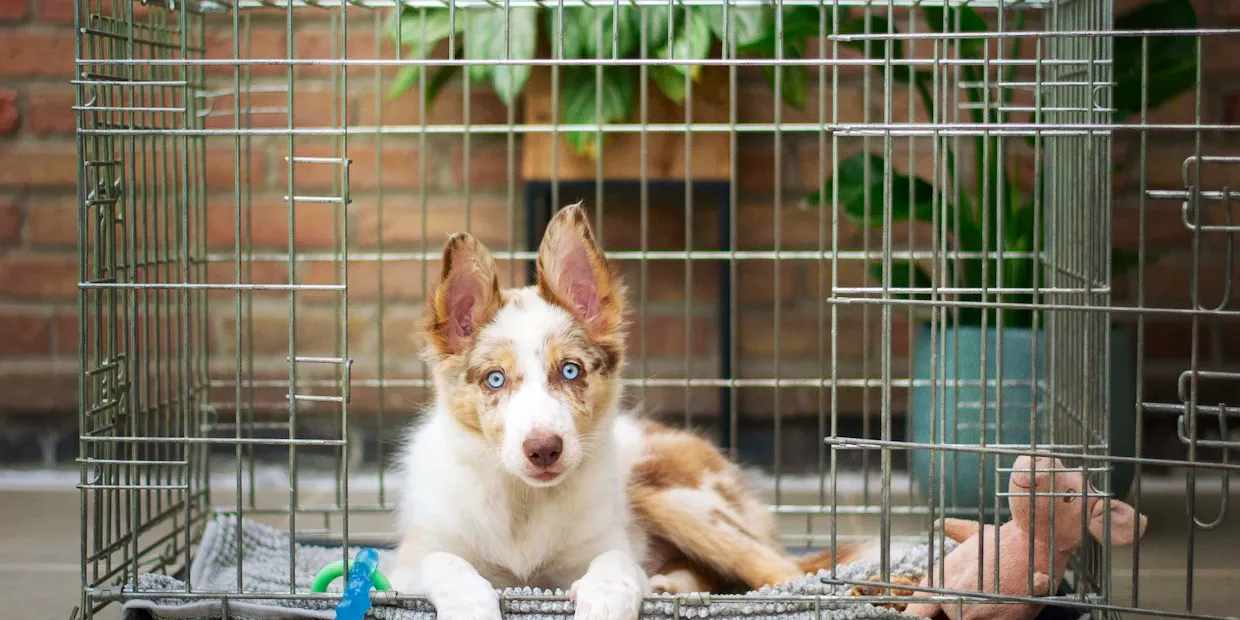
Confinement works because puppies avoid soiling where they sleep — but only if the space is the right size. The Wisconsin Humane Society's guidance is an area just big enough to comfortably stand, lie down and turn around in. VCA Animal Hospitals describes a suitable crate as one with enough floor space for the dog to lie down and stretch out comfortably, and tall enough to stand without hitting his head. Ohio State University's Indoor Pet Initiative supplies the other half of the rule: the puppy should not have enough room to eliminate in one corner and rest in another, which teaches exactly the wrong lesson. If you bought a crate sized for the adult dog, use the divider panel.
There are limits. VCA advises confining a puppy to a crate for no more than three hours when they are alone, and for longer absences recommends a larger pen that contains both a resting area and an appropriate toileting surface, such as a pad. That is a compromise, not a failure — a puppy who has to hold it for six hours will lose, and losing in the crate is a hard habit to unpick.
If the crate itself is still a fight in your house, our piece on why crate training makes life easier covers the case for doing it properly.
Reward on the Spot, Not at the Back Door
The schedule gets your puppy to the grass. What teaches them is what happens in the two seconds after they finish.
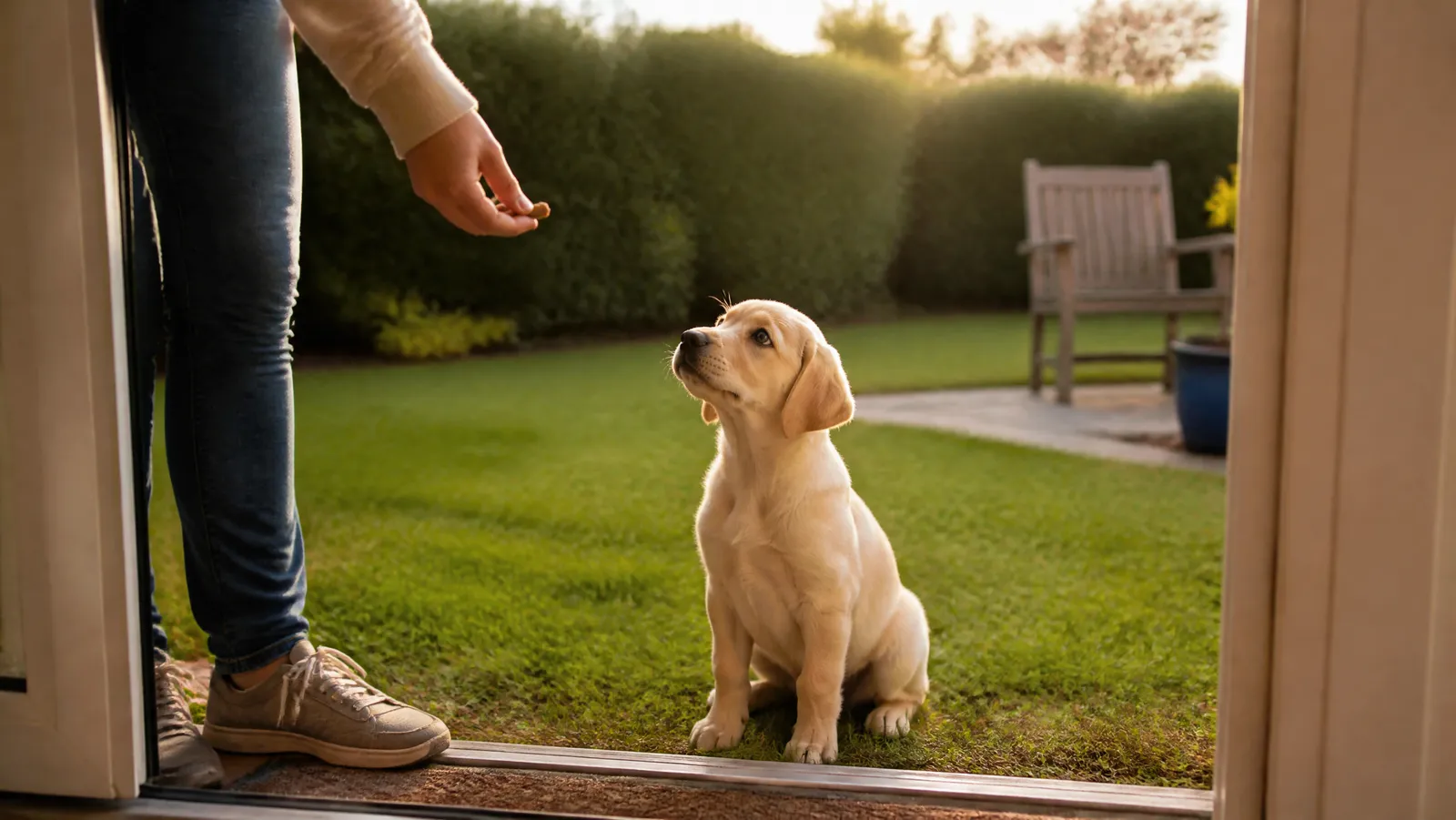
The AKC's guidance is to praise and reward immediately when your puppy goes outside — and immediately is literal. Dogs generally connect a reward to whatever they were doing a second or two beforehand, so a treat handed over in the kitchen rewards walking through the door, not eliminating on the grass. Reward outside, standing where it happened, before you go back in.
Which means the treats have to already be on you. Keep a bag by the door or in your coat pocket, because the trip where you forget them is the trip that teaches nothing. We use Blue Buffalo Baby BLUE Savory Chicken Puppy Training Treats for this — soft, small enough to swallow in one motion so the moment does not stall, and about $4.98 as of August 2026 for a 4-oz bag. At ten to fifteen potty trips a day, small matters more than fancy. Count them against the day's food, and break them in half if your puppy is tiny.
When an Accident Is Not a Training Problem
Two rules for accidents.
Do not punish. VCA Animal Hospitals is unambiguous: never punish a mistake you discover after the fact, never rub a dog's nose in it, and never strike your puppy. Beyond the obvious, punishment backfires in a specific way — it can teach a puppy that eliminating near a person is dangerous, so they start hiding to go, including outdoors when you are standing right there holding a treat. If you catch them mid-stream, a gentle interruption and a quick trip outside to finish is the whole intervention.
Clean with an enzymatic cleaner. The Wisconsin Humane Society points out that standard household cleaners remove the stain and the odor humans can detect, while the puppy can still smell the spot perfectly well — and a spot that smells like a toilet gets used like one. Enzyme cleaners made for pet urine break the residue down instead of masking it.
Then there is the category that is not training at all. If your puppy is straining, crying while urinating, dribbling constantly, passing blood, or suddenly needs to go far more often than they did last week, that is a vet visit, not a schedule adjustment. Urinary problems in puppies look exactly like house-training failures from the outside, and VCA advises consulting a veterinarian whenever a previously house-trained dog starts soiling. There is no home fix worth trying first.
What to Do Tomorrow Morning
Pick the row in the stretch table that matches your puppy's age, set a repeating timer for the awake interval, and add the six trigger trips on top. That is the whole system. Hold it for two weeks without changing anything, then add fifteen minutes to the interval and hold again.
Expect this to take months, not weeks — the AKC's marker of a six-month-old being dependable most of the time is a realistic target, and small breeds commonly run behind it. We go deeper on how long potty training a puppy takes in its own guide, and we'll cover potty training a puppy at night separately.
If you want the technique that goes inside this timetable — cue words, reward timing, supervision and what to do the first time it goes wrong on a carpet — start with our full guide to how to potty train a puppy. Then go set the timer.
Our top picks

Blue Buffalo Baby BLUE Savory Chicken Puppy Training Treats (4 oz)
Soft, bite-sized morsels made for the one job that actually teaches house training — the reward you hand over a second after your puppy finishes, while you are both still standing in the grass. Real chicken is the first ingredient, and there are no chicken or poultry by-product meals, corn, wheat or soy.
What we love
- Tender, bite-sized pieces you can deliver fast and repeat a dozen times a day
- Real chicken first; no by-product meals, corn, wheat or soy
- No artificial preservatives or colors
Keep in mind
- A single 4-oz bag does not last long at ten to fifteen rewards a day
- The DHA cognitive-development angle is the manufacturer's claim, not an independent finding
Frequently asked questions
What age should you start potty training a puppy?
The day they come home, which for most puppies is around eight weeks. VCA Animal Hospitals advises beginning house training as soon as you bring a new puppy home and being consistent from the start. That does not mean an eight-week-old can succeed at it yet — their bladder is far too small for that. What you are really doing in those first weeks is building a habit through sheer repetition: same door, same patch of grass, same reward. The puppy's body catches up with the routine over the following couple of months.
How long can a puppy hold their bladder at night?
Longer than during the day. The American Kennel Club notes that puppies can hold their bladder for a longer stretch while they are asleep, which is why overnight crating works at all. As a planning figure, VCA Animal Hospitals says puppies may need overnight outings until around five months of age. In practice most owners are doing one overnight trip from about ten to twelve weeks, and a lot of puppies drop it somewhere in the third or fourth month. Keep that trip boring — outside, potty, back to the crate, no play and no conversation.
How often should a 12-week-old puppy go outside?
Plan on every 90 minutes to 2 hours while they are awake, plus the automatic trips after waking, eating, drinking and playing. The American Kennel Club's month-plus-one rule puts the ceiling for a 12-week-old at about four hours, but that ceiling applies to a puppy asleep in a crate, not one wrestling a rope toy in your living room. VCA Animal Hospitals suggests a trip every 30 minutes during active play. Use the ceiling to plan your crate stretches and the shorter interval to plan your afternoon.
Why do small and toy breeds take longer to potty train?
Bladder capacity scales with body size, so a four-pound Yorkshire Terrier puppy simply holds less than a forty-pound Labrador puppy of the same age, and trainers who work with toy breeds commonly report needing breaks closer to every hour well past the point where a larger puppy has stretched out. Small-breed owners also tend to notice fewer accidents, because a teaspoon of urine on a rug is easy to miss — which means the puppy gets more unearned indoor practice. Tighter supervision and a smaller confinement area matter more here, not less.
My puppy was doing well and has started having accidents again. What now?
First rule out a medical cause. VCA Animal Hospitals advises consulting a veterinarian when a previously house-trained dog begins soiling, because urinary problems mimic training problems. Straining, crying while urinating, blood in the urine, constant dribbling or a sudden jump in frequency all warrant a call to your vet rather than more training. If your puppy is physically fine, the usual culprit is freedom granted too early. Go back to the interval that was working two weeks ago, tighten supervision for a week, and stretch again more slowly.
About the author
James Martin
I'm an animal lover through and through. I grew up with dogs, my family always had at least one pet, and today I share my home with a rescue who is the love of my life. I started Healthy Puppy Review to help owners cut through the marketing noise and make confident, well-researched choices about their dog's health and happiness.