Puppy Biting Kids: Household Rules That Keep Everyone Safe
Puppy mouthing is normal development, but a toddler is the hardest audience a puppy will ever have — short, fast, loud, with hands at exactly mouth height. The adults manage the environment; the training comes second. Here are the non-negotiables, the household rules, the short list a small child can actually follow, and the thresholds that mean you call a professional this week.

Contains affiliate links · our policy
In this guide
Puppy mouthing is normal development, not aggression — but a puppy biting a toddler is not the same problem as a puppy biting you. A small child is short, fast, loud, and waving hands at exactly puppy-mouth height, and no two-year-old can be expected to train a dog. So the adults manage the environment first. The training comes second.
Healthy Puppy Review is reader-supported: we may earn a commission from links on this page, at no extra cost to you.
The reassurance is real. According to the AKC, nipping is completely normal for teething puppies and something you can train away, and it describes the teething process as awfully painful for the puppy, with sore gums driving much of the chewing. Once you can see the teething stage behind the biting, the behavior stops looking like a character flaw.
The responsibility is also real. The AVMA's dog bite prevention guidance states that the number of recorded dog bites is significantly higher in children than in adults, and that because children are the most frequent victims of dog bites, parents and caregivers should never leave a baby or small child alone with a dog. That is not a verdict on your puppy — it is a statement about how many bites happen to children, and how fast a toddler moves.
We cannot tell you your puppy is safe with your child; no article can. What follows is the setup that removes most opportunities for a bite, and the thresholds that mean you make a call.
Why Kids Get Bitten More Than Adults Do
Parents searching puppy biting toddler are asking two questions at once: is this normal, and is my child in danger. Children are at more risk than adults from the same dog, for reasons that have nothing to do with temperament.
CDC researchers reporting on nonfatal dog-bite injuries treated in US emergency departments in 2001 found that the injury rate was highest for children aged 5 to 9 and decreased with increasing age, and that 64.9% of injuries among children aged under 4 were to the head or neck region. The data is old, but the geometry has not changed: a toddler's face is at the height of a dog's mouth.
Then stack the triggers a small child supplies:
- Height. Hands, sleeves and face are all in range without the puppy reaching.
- Pitch. A squeal sounds like a littermate losing a game, so play escalates rather than stops.
- Speed. The AVMA's bite-prevention guidance is blunt about running: don't run past a dog, because dogs naturally love to chase and catch things.
- Grabbing. Fistfuls of fur, ears and tail, usually affectionate, often startling.
- Inconsistency. The one household member who cannot respond the same way twice is often the one getting mouthed most, and an inconsistent response is how a behavior gets accidentally rewarded. If that pattern is new, why does my puppy bite me covers the five drivers behind mouthing and why each needs a different answer.
Your puppy probably does not have a problem with children, though no article can assess that for you. Your child is simply the hardest audience it will ever face, and right now the puppy is losing.
The Non-Negotiables
These are not training goals. They are conditions you set up once and then maintain, because a rule a tired adult can follow at 6pm beats a rule that needs everyone alert.
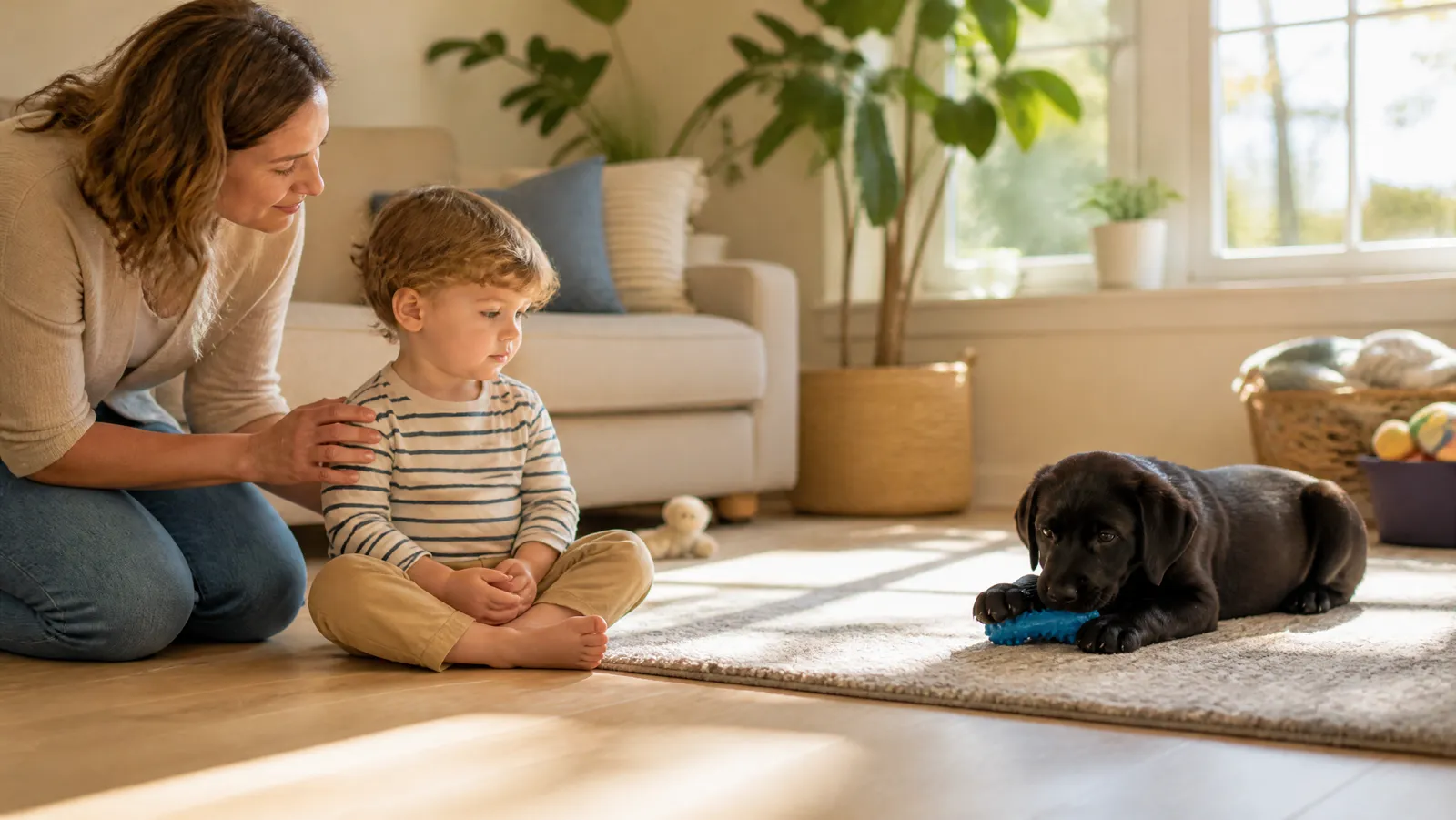
Never leave them alone together. The AVMA guidance for parents and caregivers is to never leave a baby or small child alone with a dog, to be on the lookout for potentially dangerous situations, and to start teaching young children — including toddlers — to be careful around pets. "Alone" includes the thirty seconds you are in the next room.
A real barrier, so supervision is possible. Supervision that needs an adult standing between puppy and child is not sustainable for a whole day. A gate, a pen or a closed door lets you watch from a chair. The AVSAB's humane dog training position statement makes the same point from the dog's side: management can include avoiding situations that lead to the unwanted behavior and ensuring the safety of all involved.
Separate, uninterrupted sleep. The AKC says puppies usually sleep 18 to 20 hours a day, and that naps after play or walks help prevent overtired behavior. The AVMA guidance also says never to disturb a dog that is sleeping or eating — which in a house with a toddler means the puppy's bed cannot be somewhere a child can reach it. That is the strongest practical argument for crate training your puppy rather than hoping for peace on an open dog bed.
No resource overlap. Food bowls, chews and beds come out when the child is out of the room or behind a barrier. A puppy who has never had to defend anything from a child has no reason to learn how.
Household Rules the Adults Enforce
The AVSAB says training methods are most effective when they focus on teaching the animal what to do, rather than punishing them for unwanted behaviors. Every rule below is written that way: something to set up, not something to scold.
- Four paws on the floor for attention. Nobody in the house pets, speaks to or looks at a jumping puppy. The AVSAB notes that common issues such as jumping can be managed by arranging the environment appropriately and reinforcing desirable responses.
- No hand games. No wiggling fingers, no play-slapping at the face, no chasing a hand under a blanket. Hands are not toys, and a child cannot hold a line the adults keep crossing.
- No tug-of-war with sleeves or trousers. The AVMA guidance says to avoid highly excitable games like wrestling or tug-of-war. Tug with a proper toy is a separate thing, covered below, and it belongs to adults.
- No chasing, in either direction. Not the child chasing the puppy, not the puppy chasing the child. Both end at the ankles.
- Trade, never grab. When the puppy has a sock or a toy car, an adult swaps it for something better. Nobody reaches into the mouth; the child comes and gets an adult instead.
- A legal chew whenever the child is in the room. The AKC's advice is to make sure you have a toy when you play with your puppy so he has something besides you to go after. The same logic applies to family time: the mouth needs a job before it finds one.
- Play ends before the overtired window, not after. The AKC lists overtiredness among the reasons puppies mouth. Watch the clock, not the puppy.
What to Teach the Child, and What Not to Expect
Keep the child's list to four items, physical rather than verbal. Below about three, the rules in this article are for the adults — a toddler is someone you manage, not someone you brief. The AVMA suggests that because so many dog bites happen to young children, parents wait to get a dog until their children are older than 4.
- Be a tree. When the puppy gets mouthy or jumpy: stop, stand still, fold hands into the chest, look away. The AVMA guidance says that if a dog approaches to sniff you, stay still, and that in most cases the dog will go away once it determines you are not a threat. Standing still is also the only instruction a frightened child reliably executes.
- Treats go on the floor. Not offered from fingers. It keeps teeth away from small hands and removes the snatch.
- Pet the chest and the shoulder. Not the face, not the tail, not the top of the head.
- Tell an adult. This replaces every version of correcting the puppy. If the puppy is being annoying, the answer is a grown-up, not a consequence.
Practise all four when the puppy is asleep or behind a gate, so the child rehearses without a live puppy attached.
What to Teach the Puppy
Four skills do most of the work, and all four are reward-based. The AVSAB states that evidence supports the use of reward-based methods for all canine training, and that aversive methods — which by definition rely on force, pain, or emotional or physical discomfort — should not be used in canine training or for the treatment of behavioral disorders.
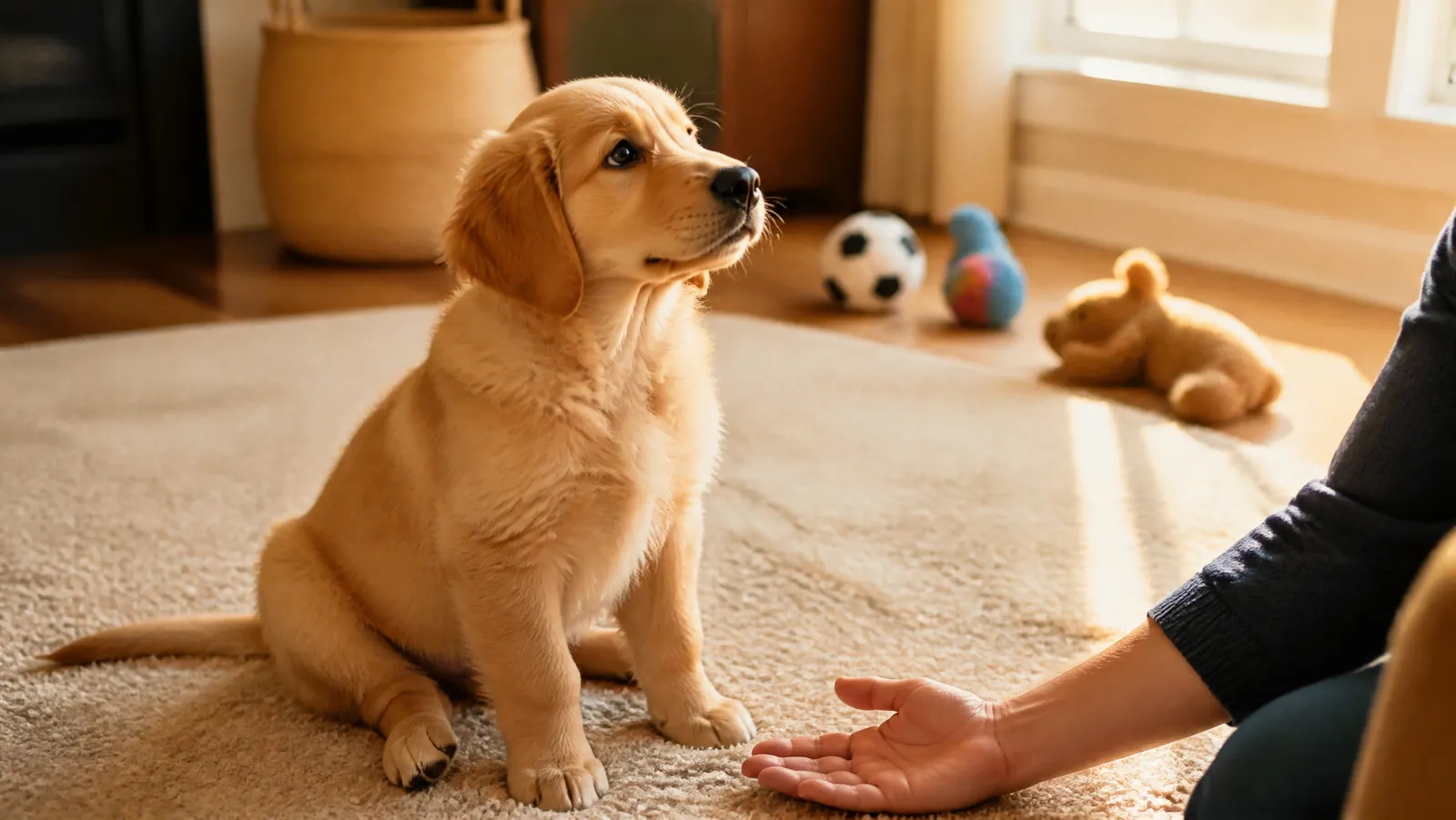
Settle on a mat or in a pen. The most useful behavior in a family house. Paid, repeatedly, for lying down and doing nothing while life happens nearby.
A trade cue. Giving something up produces something better. This is what makes "tell an adult" work: the adult has a move that does not involve a hand in a mouth.
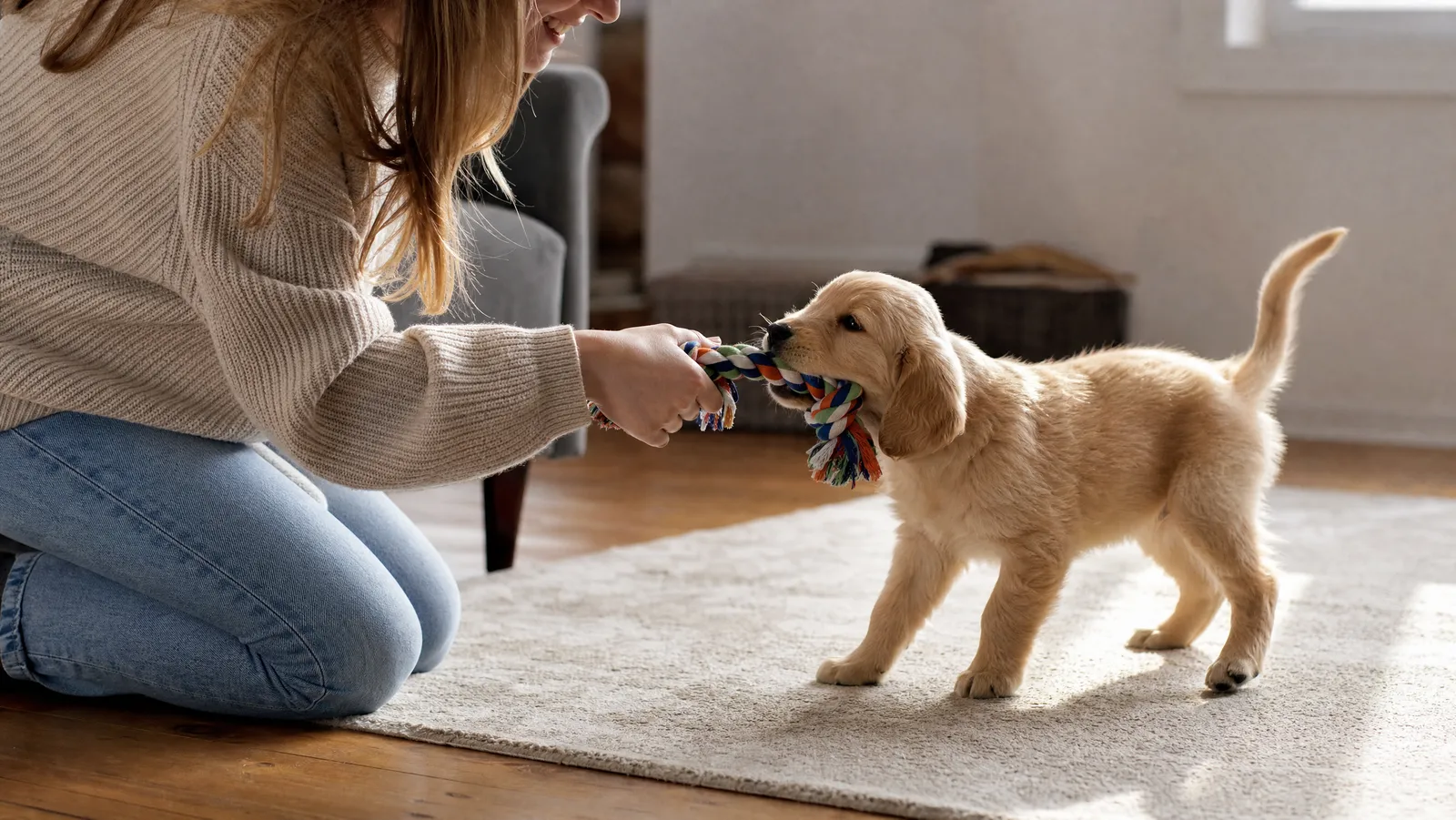
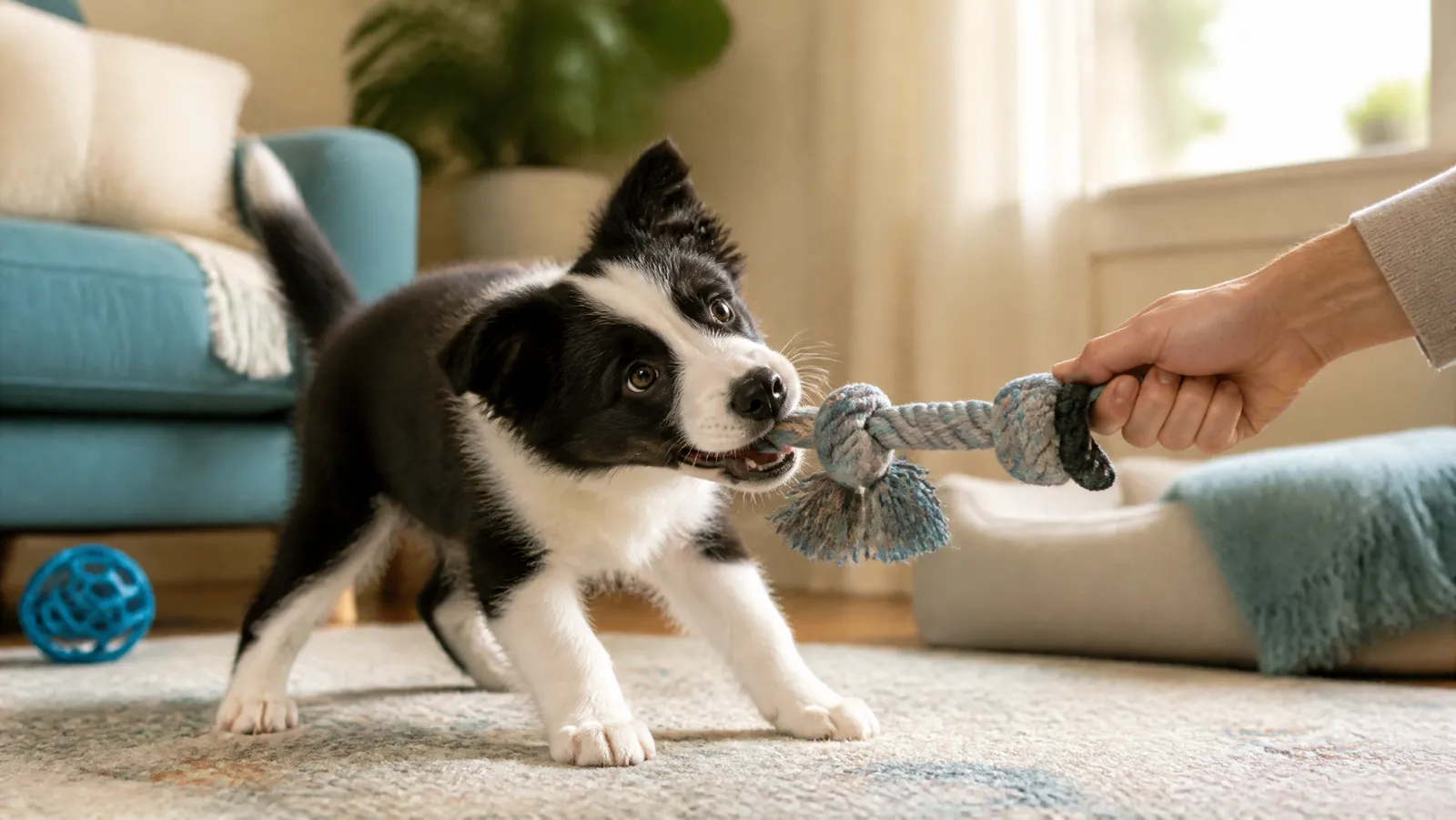
Tug on a long toy. The AKC says tug can promote impulse control and build confidence, advises a toy with some length so the handler's hand is not grabbed by mistake, and adds that there should only be light resistance when playing tug with young puppies. That keeps hands away from the teeth while still letting the puppy use its mouth, which is what a teething puppy is asking for. A long rope or flirt-pole-style toy is the shape you want — our round-up of must-have toys for a new puppy covers the difference between a redirect toy and a chew.
Chewing on something legal during chaos. Dinner time, homework time, friends over. The chew goes down before the noise starts, not as a response to it.
The mechanics of all four, including what to do when your high-pitched "ouch" makes your puppy worse, are in how to stop puppy biting. If you are mostly counting down, when do puppies stop biting sets realistic expectations.
The Schedule That Prevents Most Incidents
In our experience the hardest moments tend to fall in the same two windows: late afternoon, and whenever the house gets loud. Both are schedulable.
Enforced naps, not optional ones. Few puppies hit the AKC's 18-to-20-hour figure on their own in a house with children; many keep following the noise instead. We would put the puppy away on the clock — roughly after every 30 to 60 minutes of activity, which is close to the AKC's own sample day — and do it before the mouthiness starts, not in response to it.
A pen during the loudest hour. Whatever that hour is in your house, the puppy should already be behind a barrier when it starts. A six-panel pen like the FXW Rollick Dog Playpen (about $60 as of October 2026) is the management tool here: FXW says it assembles in about five minutes and that its walk-through gate uses an automatic gravity-actioned lock to cut down on dogs letting themselves out. At 24 inches it is a barrier rather than a ceiling, so watch a climber — and FXW recommends putting it on a pad or carpet indoors to protect floors.
Something that makes the pen worth being in. A pen only works if the puppy likes it, and a stuffable chew is the cheapest way to get there. The KONG Puppy Goodie Bone (about $8 as of October 2026) is built for it — Goodie Grippers at both ends take treats or paste, and KONG makes it in a softer puppy rubber the company says suits sore teeth and gums. The caveat, in KONG's own words: no dog toy is indestructible, so supervise play and discard the toy if it is damaged. A stuffed chew in a pen is a supervised activity, not a babysitter.
A short decompression routine before family time. Five minutes of sniffing outside, a few trades, then the chew. Arriving straight from a wrestle goes badly; arriving from something calm and nose-led works better. A predictable rhythm across the day helps for the same reason, which is why we push a predictable puppy feeding schedule.
When to Call a Professional Today, Not Next Month
This article cannot diagnose aggression, and neither can any other article. What it can do is tell you where the line sits. Get hands-on help if you see any of these:
- Any bite that breaks a child's skin, however it happened, and especially one to the face or head.
- A freeze, a stiff body or a hard stare directed at a child.
- Growling or stiffening over food, a chew or a bed when a child is nearby.
- Mouthing that is getting worse despite real management.
For an injury, the medical call comes first: a bite that breaks skin is a reason to contact your child's doctor or urgent care rather than judge severity yourself.
Then two professionals, because they do different jobs. A veterinary exam is worth booking because pain changes behavior; the AVMA's guidance makes the general point that health care matters because how your dog feels directly affects how it behaves. If you are seeing other changes — a teething puppy not eating, say, or a flinch when handled — mention them at the same visit. For the behavior itself, look for a certified professional trainer who works with reward-based methods and, where a child is involved, a board-certified veterinary behaviorist. The AVSAB notes that more serious behavior concerns such as aggression, anxiety and fear require a treatment plan that includes environmental management, behavior modification and, in some cases, medication — which is to say, not a video and a weekend.
One thing not to do while you wait: punish the growl. A growl is information. The AVSAB reports a survey-study association between aversive training methods and long-term behavior problems including aggressive behavior toward people, while noting those studies cannot separate cause from correlation. Even the AKC's mildest consequence — putting the puppy calmly in the crate after repeated nipping — is framed as a time out rather than a punishment, and it cautions that some puppies get more worked up if you yell.
The Short Version
Mouthing is normal development for most puppies — but normal is not the same as safe around a small child, and neither fact is a plan. The plan is barriers, naps, no resource overlap, four adult-enforced rules, four short instructions for the child, and a number you call the first time something looks like more than mouthing.
Set the environment up so the puppy cannot practise the behavior and the training has room to work. For the developmental arc behind all of this — what erupts when, and what fades on its own — see Healthy Puppy Review's teething and biting guide.
Start with the barrier tonight. Everything else is easier once nobody has to be vigilant.
Our top picks

This is a management tool rather than a training tool: six 24-inch panels that give a puppy a legal place to be while a small child has the run of the room. FXW says the rod-connected design assembles in about five minutes and that the walk-through gate's automatic gravity-actioned lock reduces dogs letting themselves out.
What we love
- Six panels you can add to or remove to change the shape of the pen
- Walk-through gate with an automatic gravity-actioned lock, which FXW says cuts down on self-releases
- Rounded ball tops on the stakes, and rods that insert into the ground for outdoor stability
- Powder coating for rust resistance, so it works indoors or in the yard
Keep in mind
- At 24 inches it is a barrier, not a ceiling, so a climber or a taller puppy will outgrow it
- FXW recommends placing it on a pad or carpet indoors to protect floors, which is one more thing to buy

This is what makes the pen worth being in. The Goodie Grippers at both ends hold treats or paste, so the pen becomes where good things happen rather than where the puppy gets sent, and KONG makes it in a softer puppy rubber formulation the company says suits sore teeth and gums.
What we love
- Stuffable at both ends, which is what turns a pen into somewhere a puppy wants to go
- Softer KONG puppy rubber formulation, which the company says suits sore teeth and gums
- Bone shape a small puppy can hold and carry
- Made in the USA with globally sourced materials, with KONG's satisfaction guarantee
Keep in mind
- KONG states that no dog toy is indestructible, and says to supervise play and discard the toy if it is damaged, so this is not a leave-them-to-it chew
- Sized and formulated for a small puppy, so you will be reassessing once the adult teeth arrive
Frequently asked questions
Is it normal for my puppy to bite my toddler?
Mouthing itself is normal. The AKC calls nipping completely normal for teething puppies and something you can train away, and it lists teething, overtiredness and littermate-style play among the reasons puppies mouth. What is not normal, and what no article can assess for you, is stiffening, freezing, a hard stare or a growl directed at a child. Normal behavior can still break skin on a toddler, which is why the AVMA's rule is to never leave a baby or small child alone with a dog.
How do I stop my puppy jumping on my kids?
Change the room before you change the dog. The AVSAB's humane dog training position statement says common training issues such as jumping can be managed by arranging the environment appropriately and reinforcing desirable responses, and that training works best when it focuses on teaching the animal what to do rather than punishing unwanted behavior. In practice that means a gate or pen when the children are running, attention only when all four paws are on the floor, and no adult in the house rewarding the jump by accident.
Should my child discipline the puppy?
No. A child cannot apply a consequence consistently, and consistency is the only thing that makes a consequence mean anything. The AVSAB recommends reward-based methods for all canine training and says aversive methods, which rely on force, pain or emotional or physical discomfort, should not be used. It also reports a survey-study association between aversive methods and long-term problems including aggression toward people, while noting those studies cannot separate cause from correlation. Give your child one job instead: tell an adult.
At what age can a child help train the puppy?
It varies with the child, not the calendar. The AVMA suggests parents wait until children are older than 4 years of age before getting a dog — guidance about getting a dog rather than a training milestone, but a rough sense of when a child may participate rather than just be managed. Below about three, the rules in this article are for the adults. Older children can hand-feed from a flat palm or drop treats, with an adult in the room, before they are given anything resembling a training plan.
When do puppies grow out of biting?
Gradually, not on a date. The AKC says puppy teeth begin to fall out at about 3 to 4 months to make room for 42 adult teeth, and that by about six months the baby teeth should have fallen out and the adult teeth grown in. Mouthing usually fades across that window rather than stopping one morning. Expect improvement measured in weeks, with bad evenings scattered through it.
About the author
James Martin
I'm an animal lover through and through. I grew up with dogs, my family always had at least one pet, and today I share my home with a rescue who is the love of my life. I started Healthy Puppy Review to help owners cut through the marketing noise and make confident, well-researched choices about their dog's health and happiness.